

Talkhis al-fawâʾid wa taqrîb al-mütabâʿid [Commentary on al-Shatibi]
- Ink on thick burnished paper, 21 lines per page, in Levantine-style script in black ink with headings and occasional passages in
- [Ottoman lands , 1833
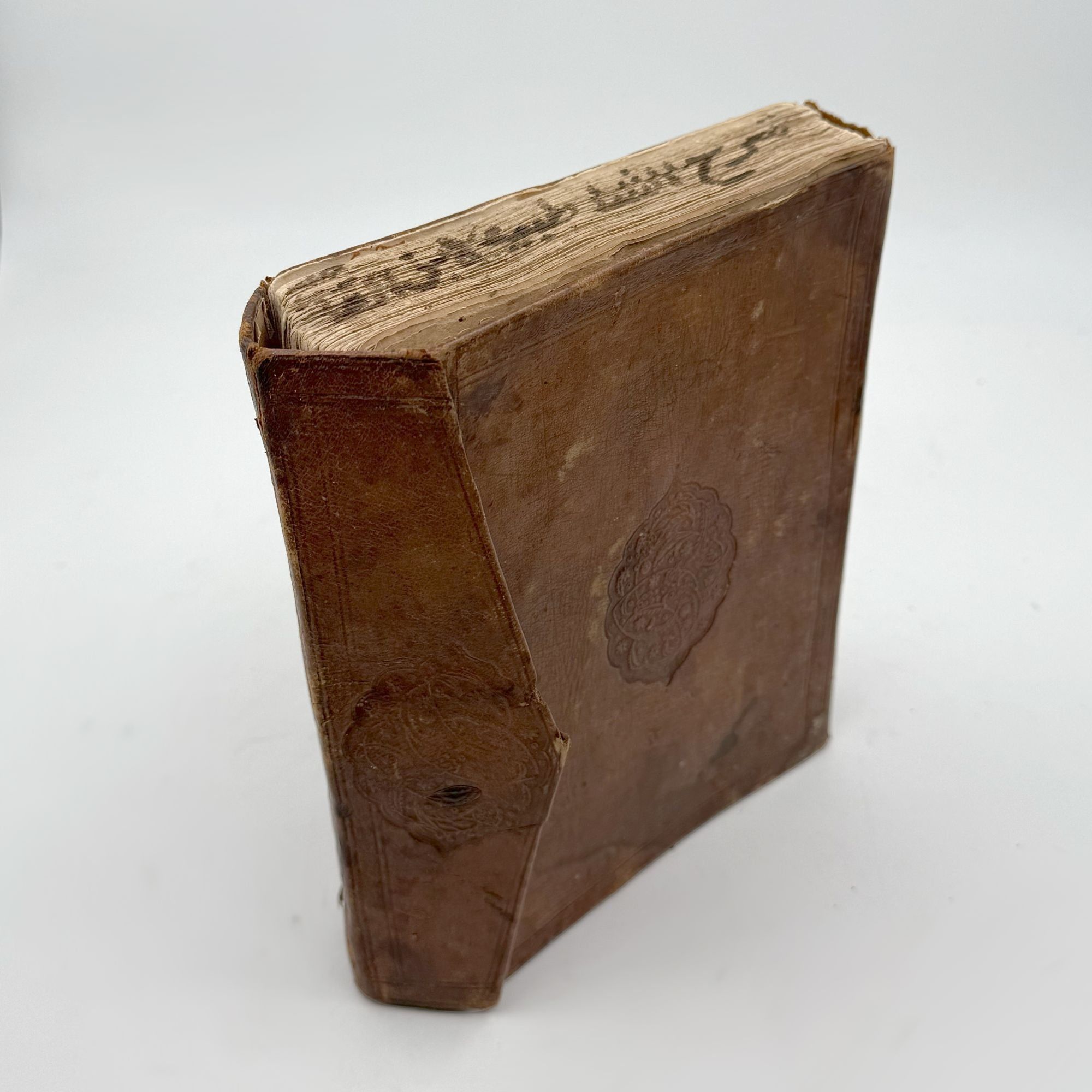
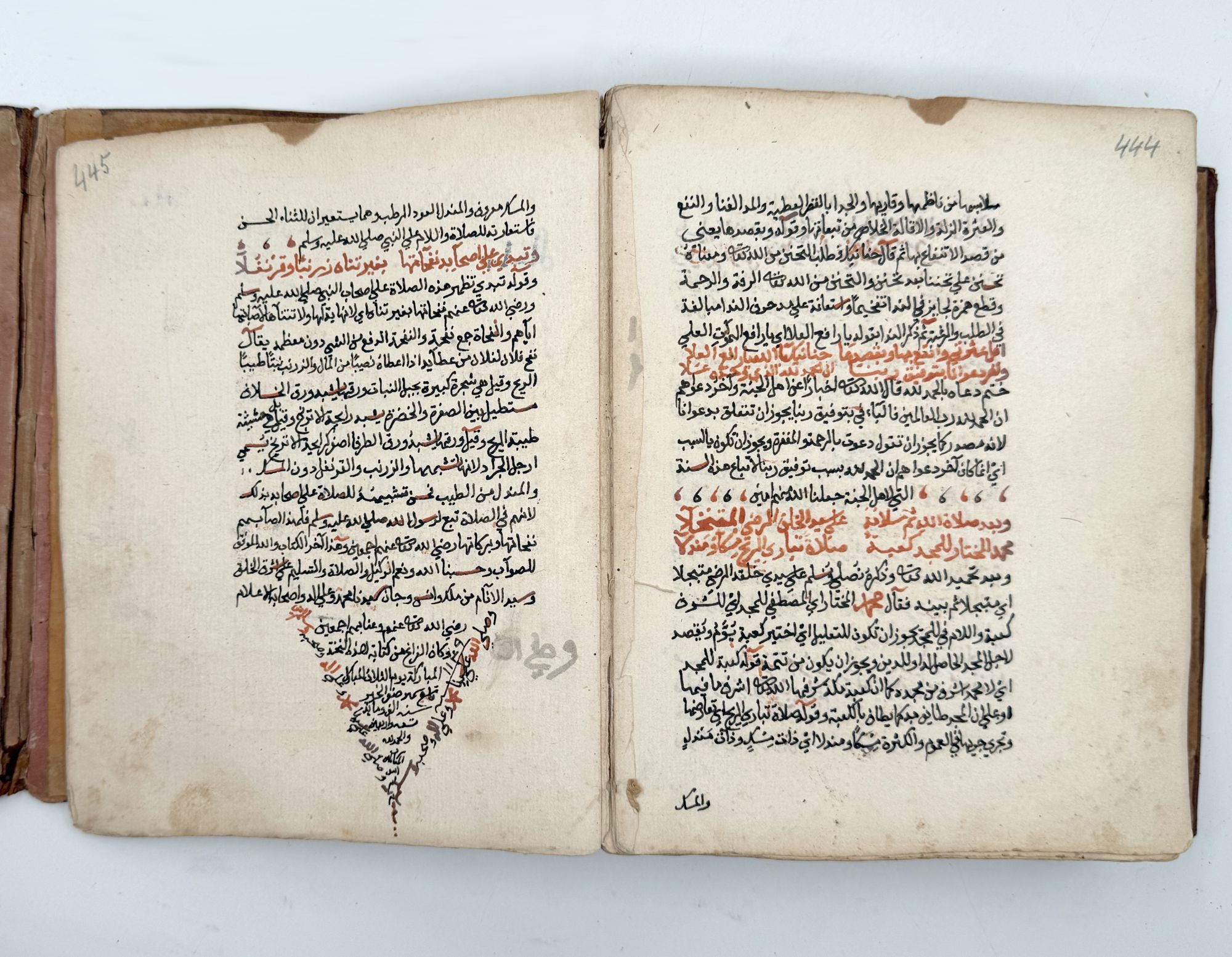
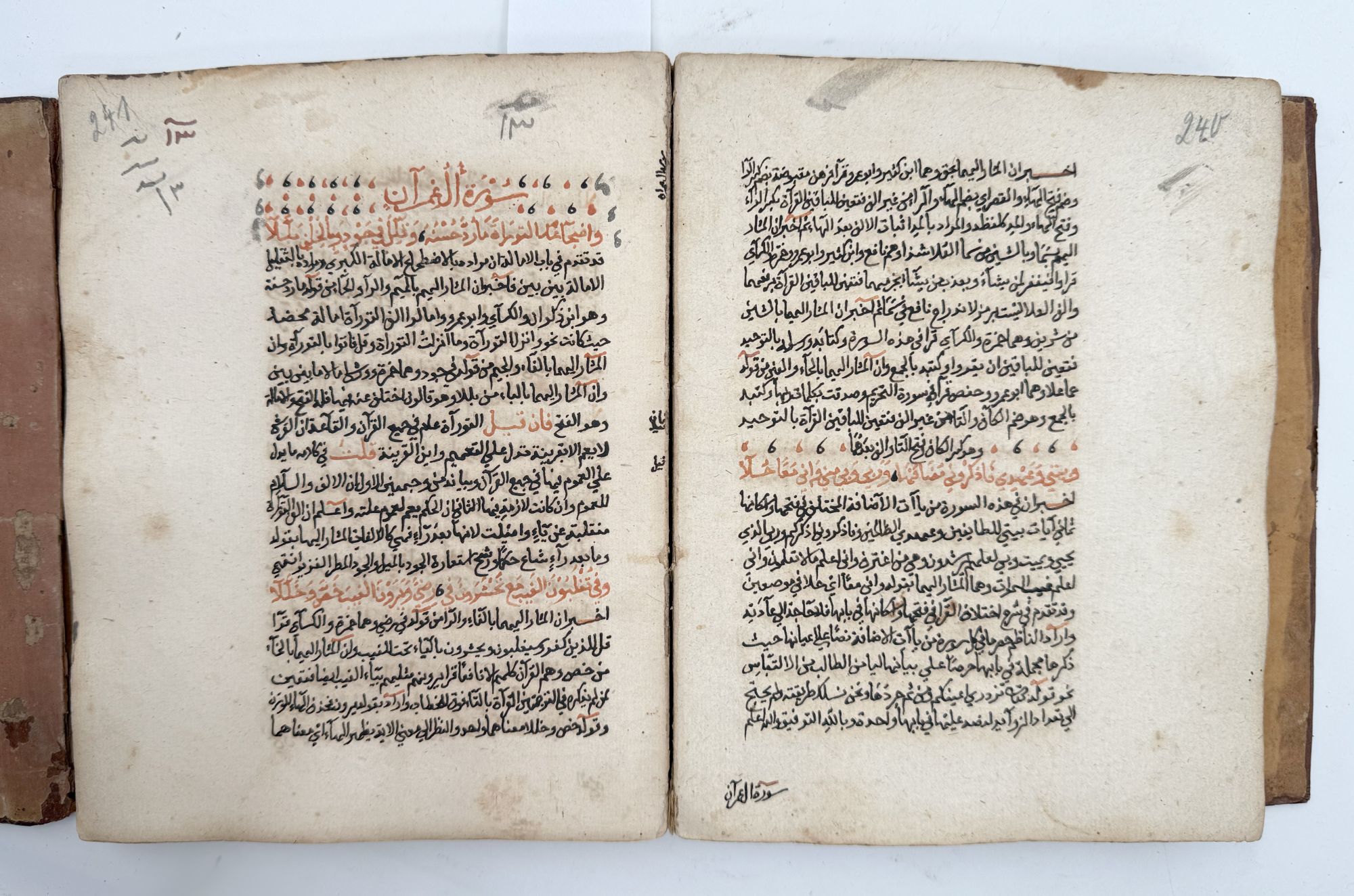
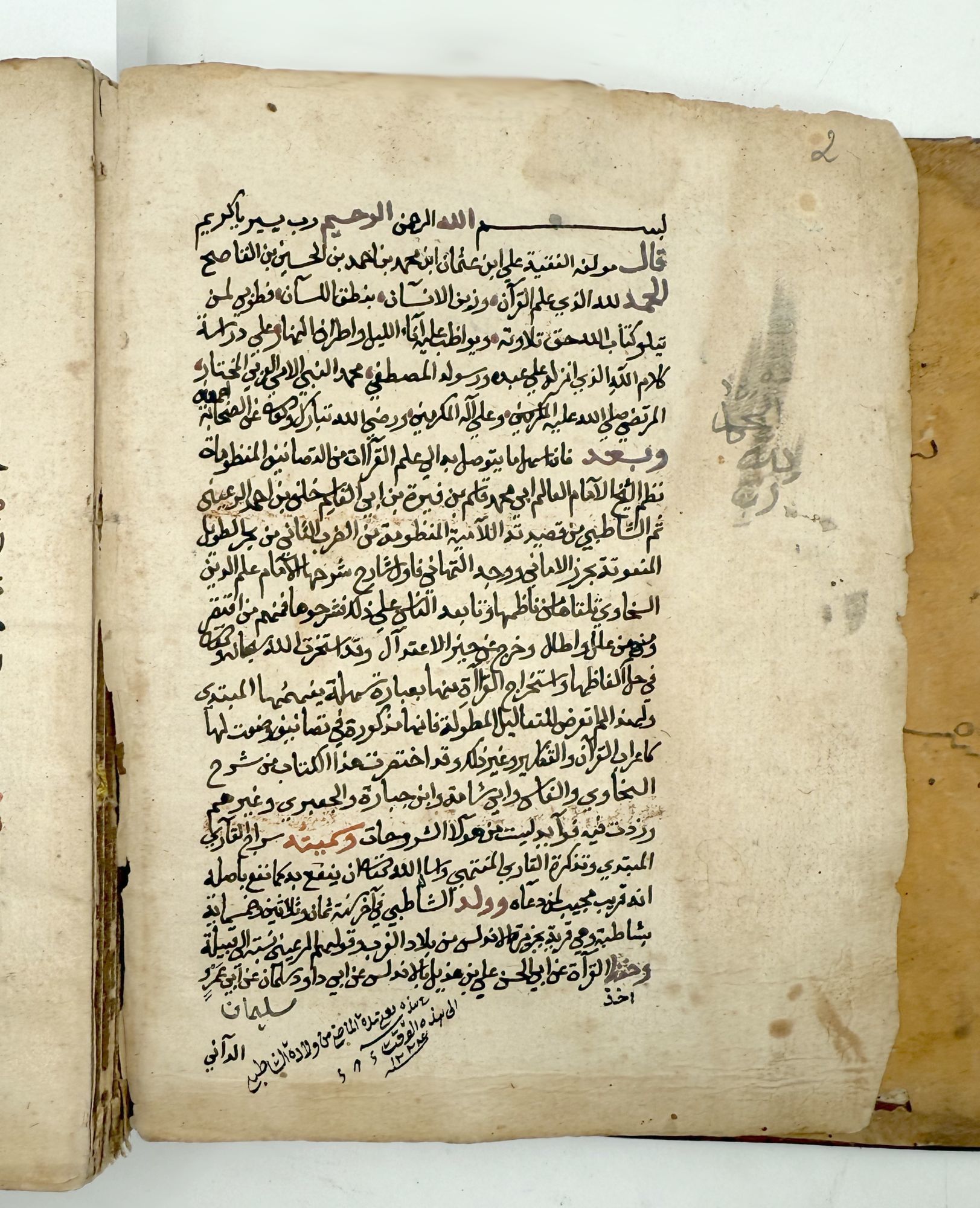
[Ottoman lands, 1833. Ink on thick burnished paper, 21 lines per page, in Levantine-style script in black ink with headings and occasional passages in red ink, dated A.H. 1249 = C.E. 1833. 448 pp. The first few pages extensively annotated in margins in a later scholarly hand, with numerous doodles and pen starts on last leaves. 1 vols. 8vo (8 x 6 inches). Leather wallet binding with fore edge guard, boards decorated with a shamsa motif in blind, top edge marked in ink “Sharh al-Shatibi”. A bit shaken, textblock loose in binding, very good overall. Ink on thick burnished paper, 21 lines per page, in Levantine-style script in black ink with headings and occasional passages in red ink, dated A.H. 1249 = C.E. 1833. 448 pp. The first few pages extensively annotated in margins in a later scholarly hand, with numerous doodles and pen starts on last leaves. 1 vols. 8vo (8 x 6 inches). Ibn al-Qāsıh (1316-1399 C.E.), an eminent scholar of Qira’at and Islamic textual transmission, was born in Baghdad and studied in Egypt, where he mastered the ten canonical recitations (‘ashara). He later became a renowned instructor at Madânî Mosque, where he taught many scholars. His works, particularly Siraj al-Qāriʾal-mubtadî wa Tadhkar al-Muqriʾal-mutahi, are critical to the tradition of Qira’at pedagogy.
This manuscript is an early nineteenth-century copy of a standard work, an extensive and detailed commentary on al-Shatıbi’s Ḥırz al-Amani, a foundational text in the science of Qur’anic recitation. While al-Shatıbi’s work is a didactic poem that systematically presents the rules of Qira’at, this commentary expands upon its meanings with in-depth linguistic, grammatical, and recitational analyses, providing a comprehensive exegesis that was widely studied by advanced scholars. The presence of extensive marginal annotations suggests active scholarly engagement, making this manuscript an invaluable resource for the study of classical Qira’at methodologies and textual transmission.
A significant scholarly manuscript, offering a deeply analytical and authoritative commentary on one of the most important texts in the Qira’at tradition.
This manuscript is an early nineteenth-century copy of a standard work, an extensive and detailed commentary on al-Shatıbi’s Ḥırz al-Amani, a foundational text in the science of Qur’anic recitation. While al-Shatıbi’s work is a didactic poem that systematically presents the rules of Qira’at, this commentary expands upon its meanings with in-depth linguistic, grammatical, and recitational analyses, providing a comprehensive exegesis that was widely studied by advanced scholars. The presence of extensive marginal annotations suggests active scholarly engagement, making this manuscript an invaluable resource for the study of classical Qira’at methodologies and textual transmission.
A significant scholarly manuscript, offering a deeply analytical and authoritative commentary on one of the most important texts in the Qira’at tradition.