

Archive of Dinner Records hosted by the United States Ambassador to NATO and His Wife, 1949-1975
- New York , 1949
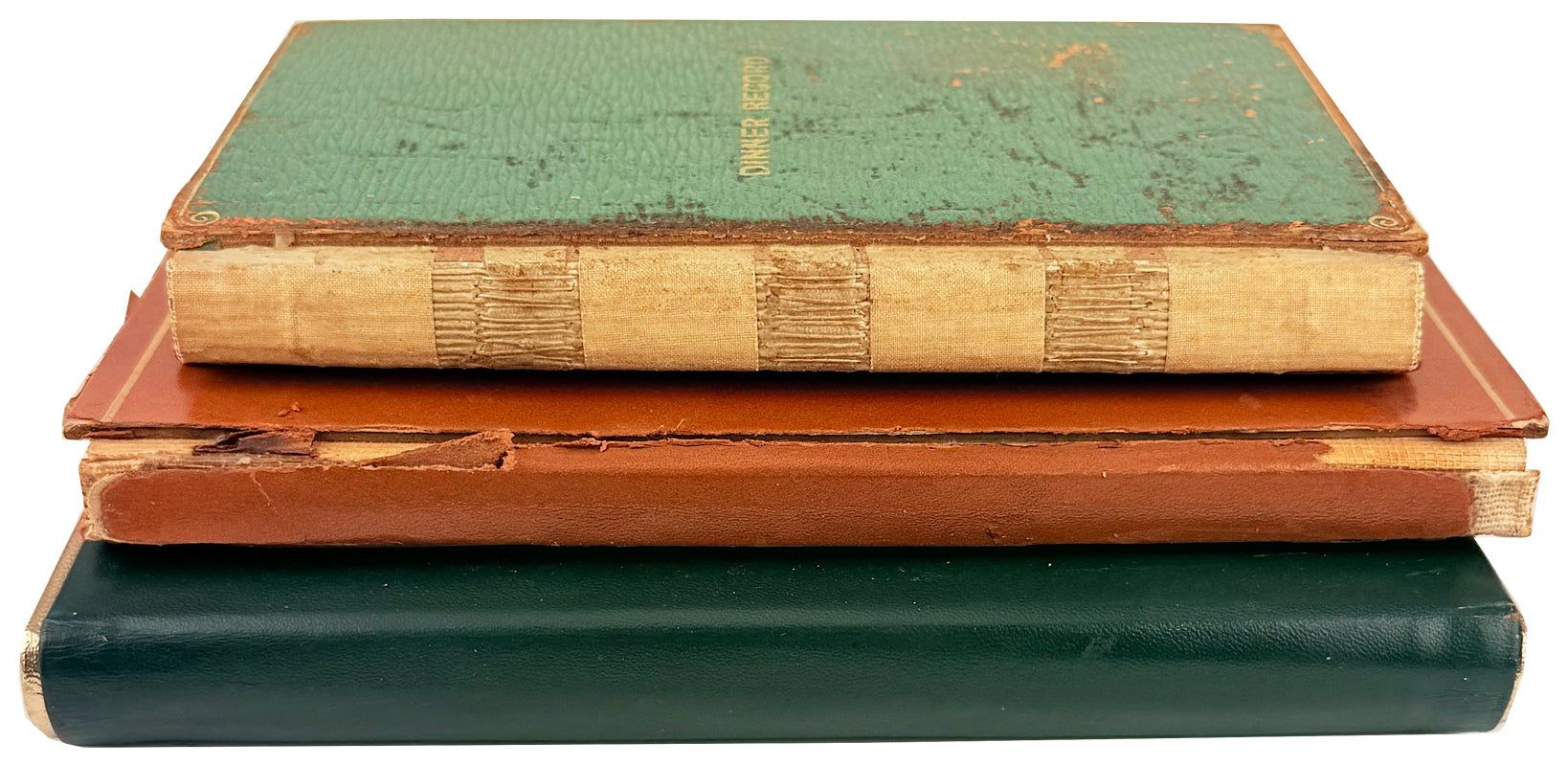
New York, 1949. Very Good. New York: 1949–1975. Collection of three manuscript volumes recording the dinners hosted by NATO ambassador John Chambers Hughes (1891–1970) and his wife Margaret Kelly Hughes (1893–1980). Collection comprised of the following:
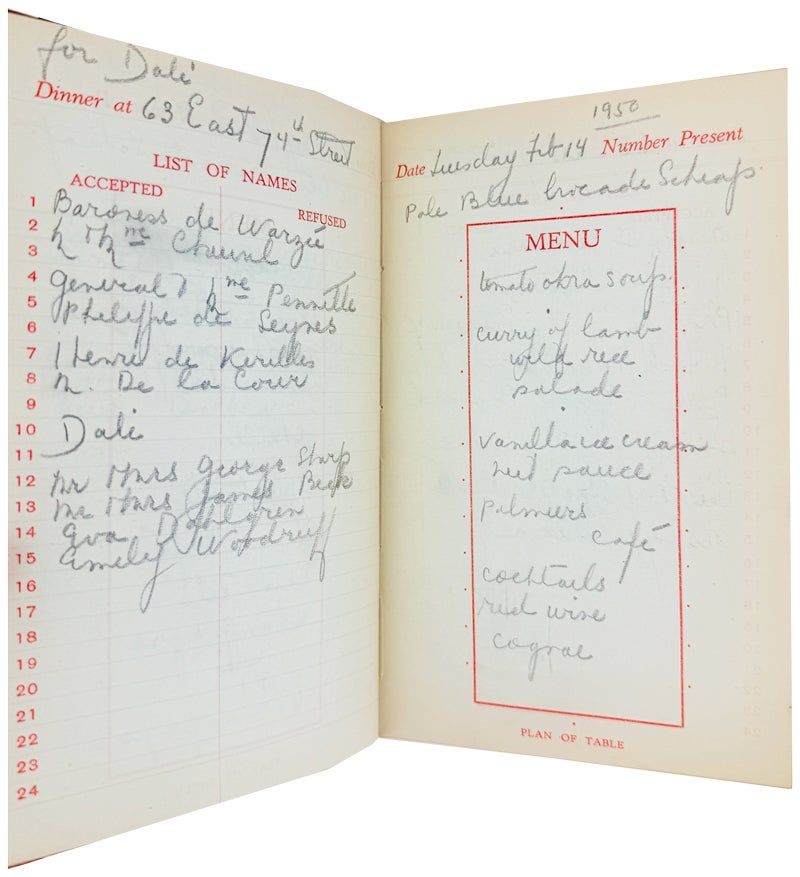
First volume covering the years 1949 to 1951. Octavo (19cm.); bright green straight grained morocco lettered and ruled in gilt; [196]pp. filled to completion in Kelly Hughes's pencil hand. Leather significantly dried and worn at margins and corners, spine perished. Contents clean and sound.
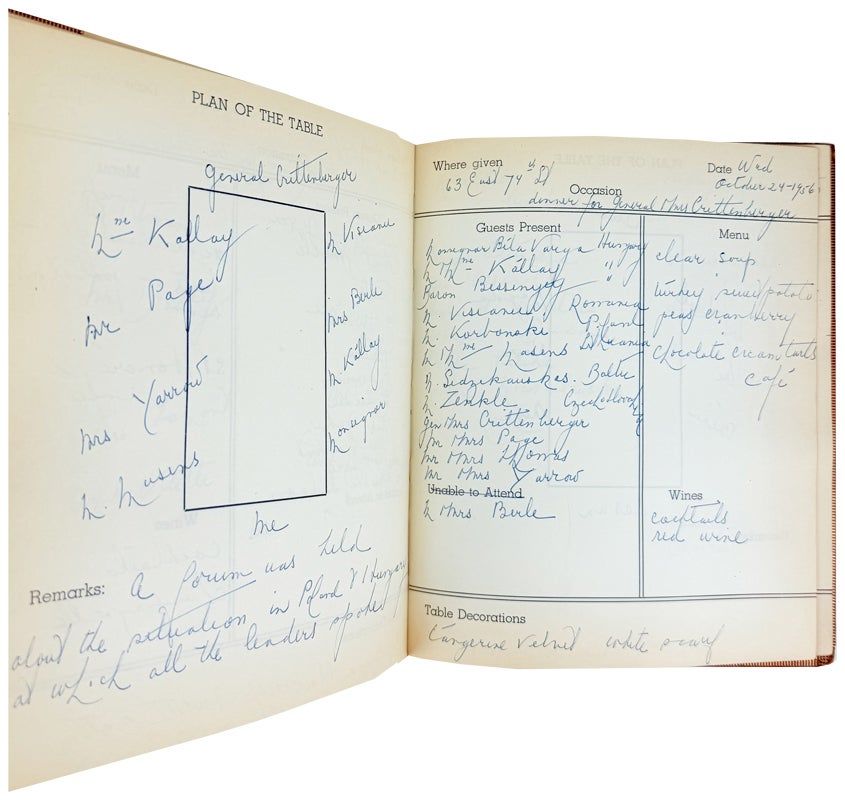
Second volume covering the years 1955 to 1957. Small square quarto (22cm.); brown gilt-ruled leatherette; [172]pp. filled to completion in Kelly Hughes's ink hand. Leather worn at margins with exposure at corners and significant chipping to spine, contents clean and sound.
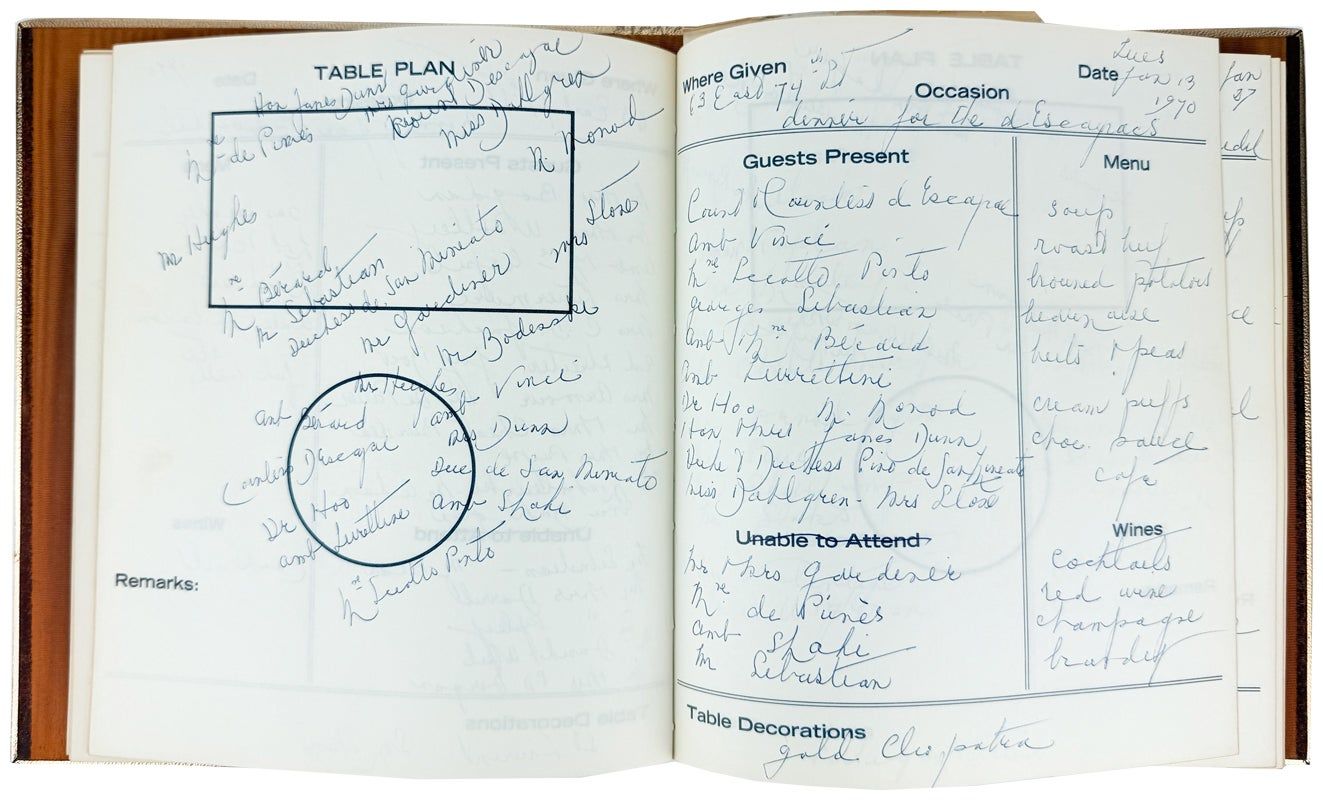
Third volume covering the years 1969 to 1975. Small square quarto (21cm.); green and gilt leatherette, moiré silk endpapers; [176]pp. filled very nearly to completion in Kelly Hughes's ink hand. Silk endpapers toned along margins, else Very Good and sound.
Exceptional record of American Cold War diplomacy. John Chambers Hughes had a hugely successful career as a businessman, a World War II operative for the OSS, the United States ambassador to NATO, and a member of President Eisenhower's Committee on International Information Activities. In the years following the second World War the Hughes's were stationed in France and the earliest volume in the collection is heavily francophile in its guest lists: exiled aviator French Henri de Kerillis appears to have had an open invitation to nearly every meal in 1950 alone. The first mention of a German guest of honor (at least in this collection) does not appear until 1955, when the Hughes's gave a dinner for ambassador Van Eckhardt. As the Cold War advanced, however, the dinner guest nationalities expanded into Eastern Europe: a special dinner given for General Willis Crittenberger in 1956 boasted guests from Hungary, Romania, Poland, Lithuania, and Czechoslovakia.
Notable dinners and guests included Admiral Thomas C. Kincaid; OSS Head General William J. Donovan; Salvador and Gala Dali (who appear as guests eight times); Allen Dulles, a close friend of the Hughes's, who dined with them at least ten times; the King and Queen of Romania (in whose honor a quiche lorraine luncheon was given); two dinners given in honor of Ambassador Clare Booth Luce; a dinner given in honor of Henri Carrère (a.k.a. "Papillon"); ambassador Francis Plimpton, father of George; actors Ralph Richardson and John Gielgud; Helen and Walter Lippmann, who were guests at three different meals in the 1970s; South African conservationist and fraudster Laurens van der Post; Pulitzer Prize-winning journalist Harrison Salisbury; and the novelist Edward Streeter. At the dinner given in honor of Soviet ballerina and actress Tamara Geva, Kelly Hughes included pigs in a blanket on the menu and Dali on the guest list.
Each meal entry includes the complete guest list, a diagram of the dinner table, the menu, and what the hostess wore. For nearly twenty years the menu reflects the gustatory trends of the age—the meals from the 1950s are sometimes laughably banal (chicken and wild rice appears over and over again). It is hard to imagine feeding Salvador Dali tomato and black bean soups, but that's what was on the menu at two of the dinner he attended, in January and February of 1950. And while the menu showed changes over time, the presence of wild rice stayed the same: it was served at the first meal recorded in this collection, it was served at the final meal recorded before John Chambers Hughes's death in May, 1971, and it was served myriad times in between.
Another fascinating facet of the collection is the record it provides of Margaret Kelly Hughes's clothes closet. At a booze-less dinner given in honor of Horace Sewell, the British General whose grandparents were a white Jamaican planter and his Black slave, Kelly Hughes questionably wore a black and white taffeta dress. For a dinner given in honor of the Dalis, on the other hand, she wore a green and flame dress by the haute couture house of Grès. For her dinner in honor of Henri Carrère in 1970 she wore a gypsy dress, though that year she primarily switched between the pink Chanel and something she describes as her "Gold Cleopatra." At the dinner for General Crittenberger she wore tangerine velvet with a white scarf, while at her New Year's Eve party for the Secretary of State she wore a black velvet Dior. A six month gap in events is recorded following Chambers Hughes's death, but at the first cocktail party she gave in her widowhood Kelly Hughes wore red.
Margaret Kelly Hughes passed away nearly ten years after her husband, in 1980, to very little notice. Her obituary simply stated that she was thrice recognized by France for her service rendered during World War II. This collection hopefully will update her legacy as an indefatigable and talented hostess when so much of American diplomacy unfolded at the dinner table.
First volume covering the years 1949 to 1951. Octavo (19cm.); bright green straight grained morocco lettered and ruled in gilt; [196]pp. filled to completion in Kelly Hughes's pencil hand. Leather significantly dried and worn at margins and corners, spine perished. Contents clean and sound.
Second volume covering the years 1955 to 1957. Small square quarto (22cm.); brown gilt-ruled leatherette; [172]pp. filled to completion in Kelly Hughes's ink hand. Leather worn at margins with exposure at corners and significant chipping to spine, contents clean and sound.
Third volume covering the years 1969 to 1975. Small square quarto (21cm.); green and gilt leatherette, moiré silk endpapers; [176]pp. filled very nearly to completion in Kelly Hughes's ink hand. Silk endpapers toned along margins, else Very Good and sound.
Exceptional record of American Cold War diplomacy. John Chambers Hughes had a hugely successful career as a businessman, a World War II operative for the OSS, the United States ambassador to NATO, and a member of President Eisenhower's Committee on International Information Activities. In the years following the second World War the Hughes's were stationed in France and the earliest volume in the collection is heavily francophile in its guest lists: exiled aviator French Henri de Kerillis appears to have had an open invitation to nearly every meal in 1950 alone. The first mention of a German guest of honor (at least in this collection) does not appear until 1955, when the Hughes's gave a dinner for ambassador Van Eckhardt. As the Cold War advanced, however, the dinner guest nationalities expanded into Eastern Europe: a special dinner given for General Willis Crittenberger in 1956 boasted guests from Hungary, Romania, Poland, Lithuania, and Czechoslovakia.
Notable dinners and guests included Admiral Thomas C. Kincaid; OSS Head General William J. Donovan; Salvador and Gala Dali (who appear as guests eight times); Allen Dulles, a close friend of the Hughes's, who dined with them at least ten times; the King and Queen of Romania (in whose honor a quiche lorraine luncheon was given); two dinners given in honor of Ambassador Clare Booth Luce; a dinner given in honor of Henri Carrère (a.k.a. "Papillon"); ambassador Francis Plimpton, father of George; actors Ralph Richardson and John Gielgud; Helen and Walter Lippmann, who were guests at three different meals in the 1970s; South African conservationist and fraudster Laurens van der Post; Pulitzer Prize-winning journalist Harrison Salisbury; and the novelist Edward Streeter. At the dinner given in honor of Soviet ballerina and actress Tamara Geva, Kelly Hughes included pigs in a blanket on the menu and Dali on the guest list.
Each meal entry includes the complete guest list, a diagram of the dinner table, the menu, and what the hostess wore. For nearly twenty years the menu reflects the gustatory trends of the age—the meals from the 1950s are sometimes laughably banal (chicken and wild rice appears over and over again). It is hard to imagine feeding Salvador Dali tomato and black bean soups, but that's what was on the menu at two of the dinner he attended, in January and February of 1950. And while the menu showed changes over time, the presence of wild rice stayed the same: it was served at the first meal recorded in this collection, it was served at the final meal recorded before John Chambers Hughes's death in May, 1971, and it was served myriad times in between.
Another fascinating facet of the collection is the record it provides of Margaret Kelly Hughes's clothes closet. At a booze-less dinner given in honor of Horace Sewell, the British General whose grandparents were a white Jamaican planter and his Black slave, Kelly Hughes questionably wore a black and white taffeta dress. For a dinner given in honor of the Dalis, on the other hand, she wore a green and flame dress by the haute couture house of Grès. For her dinner in honor of Henri Carrère in 1970 she wore a gypsy dress, though that year she primarily switched between the pink Chanel and something she describes as her "Gold Cleopatra." At the dinner for General Crittenberger she wore tangerine velvet with a white scarf, while at her New Year's Eve party for the Secretary of State she wore a black velvet Dior. A six month gap in events is recorded following Chambers Hughes's death, but at the first cocktail party she gave in her widowhood Kelly Hughes wore red.
Margaret Kelly Hughes passed away nearly ten years after her husband, in 1980, to very little notice. Her obituary simply stated that she was thrice recognized by France for her service rendered during World War II. This collection hopefully will update her legacy as an indefatigable and talented hostess when so much of American diplomacy unfolded at the dinner table.