

Heavenly Express; a play in three acts
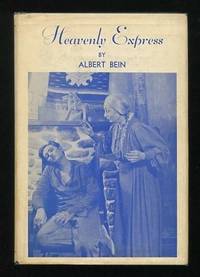
- Hardcover
- New York/Los Angeles: Samuel French Ltd., 1940 (c.1932, 1937)
New York/Los Angeles: Samuel French Ltd.. Fine in Very Good dj. 1940 (c.1932, 1937). First Edition. Hardcover. [nice clean book with no discernible wear; the jacket is a bit age-toned and lightly soiled, with a bit of paper loss at both ends of the spine (B&W photographs) A fantasy-drama about the hobo life, both before and after death. The author, born in Russia in 1902, emigrated with his family to Chicago as a small child. Apparently a bit of a wild kid, he ran away from the Windy City while still in his teens to ride the rails, during which adventure he was arrested and did a stretch in a reform school. (One contemporary newspaper profile claimed that he had actually served two jail terms, the second one for a bungled bank robbery.) Upon his release he resumed the hobo life, but it was cut short (no pun intended) when he fell beneath the wheels of a freight train and lost the lower half of his left leg. He proceeded (as one does) to become a novelist (he had begun writing while incarcerated), and by 1930 had published two works of fiction: "Love in Chicago" (1929, under the pseudonym Charles Walt) and "Youth in Hell," the latter informed by his reform-school experience. He passed through Hollywood on the strength of the former (bought for the movies but never filmed), and then set his sights on becoming a playwright, by reworking the raw material of "Youth in Hell" into a play called "Little Ol' Boy," which made the rounds of a half-dozen or so New York producers (various press reports claimed that Arthur Hopkins, then Jed Harris, then George Abbott and Phillip Dunning were all interested at one time or another) before finally being staged on Broadway by a newcomer named Henry Hammond, in April 1933. Alas, it ran for just twelve performances, despite generally good reviews. (A particularly long and glowing notice, by Stark Young, appeared in the May 17 issue of The New Republic, far too late to be helpful.) As far as "Heavenly Express" itself is concerned, its lengthly genesis is embodied in the copyright page of this edition: "Copyright, 1932, by Albert Bein; First revision copyright, 1937; Second revision copyright, 1940." The first press mention of the play that my research has turned up was from June 1932, when the Scarborough (N.Y.) Players staged it as the second play of their summer season. (At about the same time, it was reported that Bein had fallen in with the Group Theatre, at that time barely a year old, although the association never bore fruit, except glancingly some years later.) Near the end of the short run of "Little Ol' Boy," it was stated in the press that Bein was already at work on his next play (in collaboration with Lewis Amster), to be called "Wherever the Wind Blows," described as concerning "some young rovers on the face of the American map in the boom period of 1932-33" -- which suggests another (perhaps unrelated) hobo-themed play. "Heavenly Express" (under that title) pops up again in the press in September 1933, when it was stated that a producer named Courtney Burr was then holding the rights, but that apparently went nowhere. The next Bein play to actually make it onto the Broadway boards was "Let Freedom Ring," a dramatization of Grace Lumpkin's novel "To Make My Bread" (a proletarian novel described in the press as a "hillbilly best-seller"); originally announced as an upcoming Theatre Guild production, in the end it was co-produced by Bein himself (with Jack Goldsmith) during the 1935/36 season, and had a respectable run of 108 performances, the biggest success Bein ever enjoyed as a playwright. (It also helped to establish his proletarian bona fides; at about the same time it was announced that "Little Ol' Boy" was to be staged in Moscow!) There were press reports of the revised version of "Heavenly Express" making the rounds in late 1937 (hence the second copyright), but with no resulting production; it apparently got close to production in November 1938, but there was a big blowup between the playwright and the producers over their choice of director. ("Bein and discontent are scarcely strangers," as one article put it. "George Abbott, Phillip Dunning, the Shuberts, Henry Hammond and the Theatre Union have prominent places on his hate list.") By 1939 the play (and Bein) had come back into the orbit of the Group Theatre; there was even a piece report from September of that year that "either Clifford Odets or Irwin Shaw will rewrite the last act," and that it would be the first production of the Group's 1939/40 season. That didn't happen as planned, but the play did finally open in April 1940, produced by Kermit Bloomgarden at the National Theatre -- not as an official production of the Group (which was by then in the throes of breaking up), but rather "associated" with them, and with a cast festooned with Group alumni, including John Garfield (lured back to the N.Y. stage after several years in Hollywood), Philip Loeb, Art Smith, and Russell Collins. (Also in the cast were Harry Carey, Burl Ives, and Aline MacMahon.) And after ALL THAT, it closed after a mere twenty performances, which was just long enough to garner some pretty decent reviews (four of which -- including Brooks Atkinson in The New York Times -- are quoted on the jacket flaps of this published edition). A little weirdly, given the play's lack of success, the publisher chose to illustrate the text with five full-page scene stills (plus one more on the front jacket panel; Garfield is present in three of these images). And then -- Albert Bein was almost never heard from again. He co-wrote a couple of forgettable B-movies released in 1942, and his only other credit of any kind that I could find was for a play called "Land of Fame," which ran for just SIX performances in September 1943. He purportedly died in January 1990, but I've been unable to turn up an obituary. .