

Stabat Mater A 2. Voci Con V. V. [Paymer 77]. [Manuscript full score]
![Stabat Mater A 2. Voci Con V. V. [Paymer 77]. [Man](https://d3525k1ryd2155.cloudfront.net/h/426/817/1683817426.0.x.jpg)
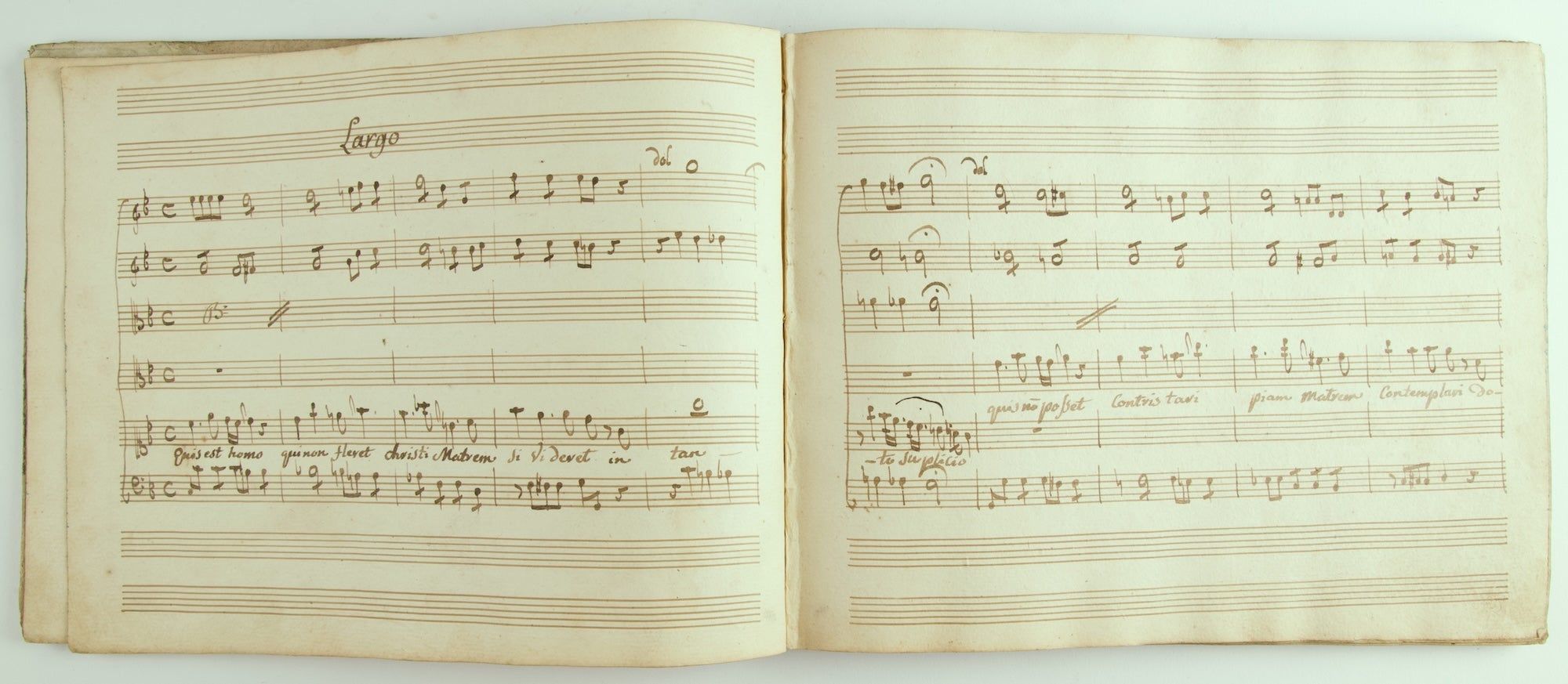
- Italy , 1750
Italy, 1750. Oblong quarto (217 x 278 mm). Contemporary ivory cloth-backed paper boards with dark red leather label to upper with titling gilt and red leather corners. Notated in brown ink on 10-stave rastrum-ruled paper. 124, [i] (blank) pp. Watermark indecipherable.
Occasional performance and expression markings including "dolce," "dol.," "sotto voce," and "amoroso;" one small cancellation.
Binding somewhat worn, rubbed, and bumped. Slightly worn internally; occasional minor soiling and small stains to blank margins; lower outer corners of final leaves tender, with some minor tears and losses. "The Stabat mater, first published in London in 1749, became the most frequently printed single work in the 18th century. It was also circulated in many adaptations, including one by Bach (as Tilge, Höchster, meine Sünden). ...
For two solo voices and strings, [Pergolesi's] most famous work was evidently written in competition with Alessandro Scarlatti’s Stabat mater for the same voices and instruments. A comparison between the works shows Pergolesi’s new approach to the concertante vocal movement and his development of the ‘church aria’, as well as the earliest application to sacred music of the style of expressive sensibility. The work stirred considerable controversy at home and abroad for its religious propriety and musical style. Padre Martini’s traditional views towards counterpoint incited some to criticize Pergolesi’s setting, while others found it ‘galant’, expressive and new." Helmut Hucke, and Dale E. Monson in Grove Music Online
Pergolesi's most celebrated sacred work.
Occasional performance and expression markings including "dolce," "dol.," "sotto voce," and "amoroso;" one small cancellation.
Binding somewhat worn, rubbed, and bumped. Slightly worn internally; occasional minor soiling and small stains to blank margins; lower outer corners of final leaves tender, with some minor tears and losses. "The Stabat mater, first published in London in 1749, became the most frequently printed single work in the 18th century. It was also circulated in many adaptations, including one by Bach (as Tilge, Höchster, meine Sünden). ...
For two solo voices and strings, [Pergolesi's] most famous work was evidently written in competition with Alessandro Scarlatti’s Stabat mater for the same voices and instruments. A comparison between the works shows Pergolesi’s new approach to the concertante vocal movement and his development of the ‘church aria’, as well as the earliest application to sacred music of the style of expressive sensibility. The work stirred considerable controversy at home and abroad for its religious propriety and musical style. Padre Martini’s traditional views towards counterpoint incited some to criticize Pergolesi’s setting, while others found it ‘galant’, expressive and new." Helmut Hucke, and Dale E. Monson in Grove Music Online
Pergolesi's most celebrated sacred work.