

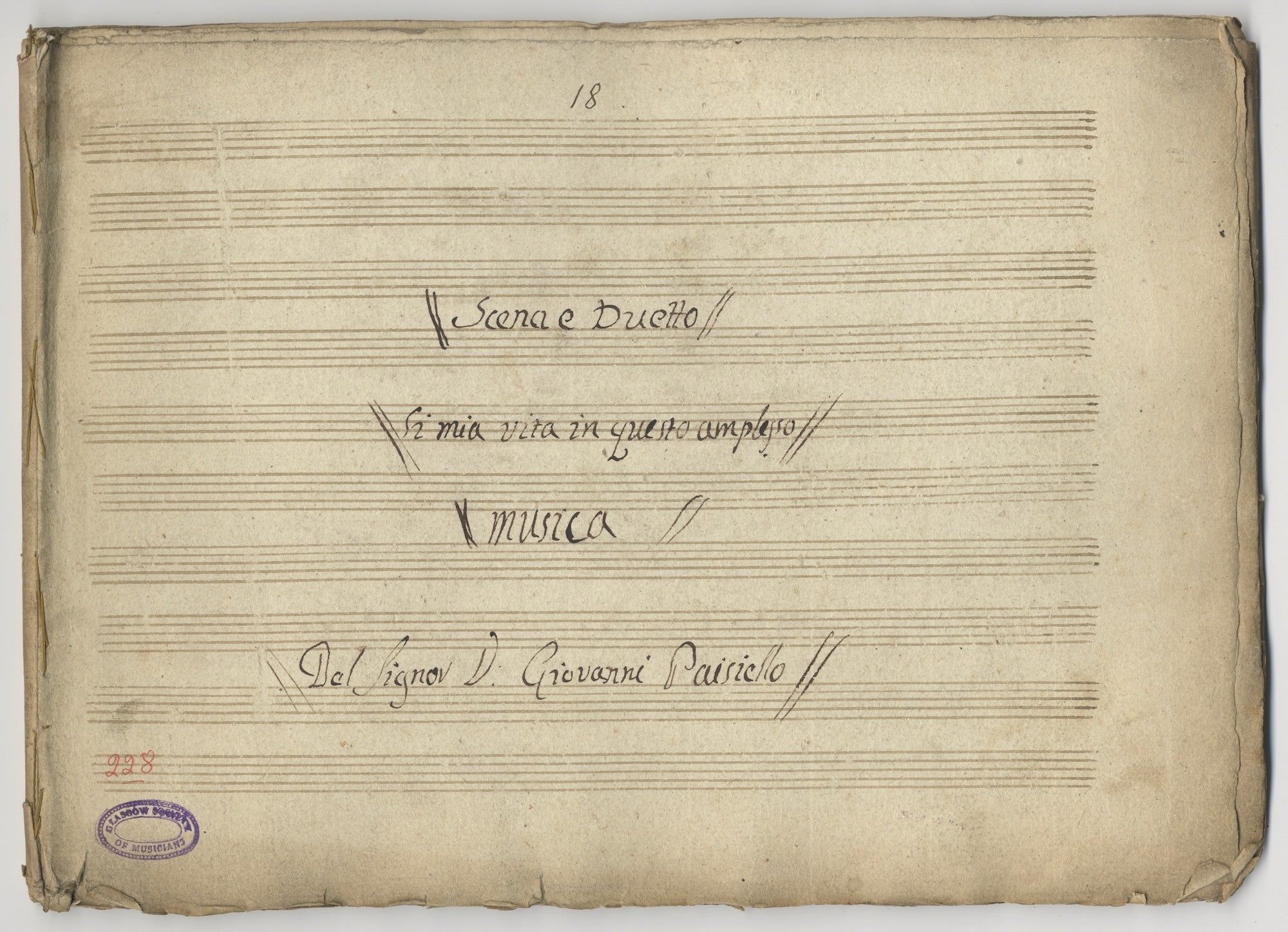
Scena e Duetto Si mia vita in questo amplesso musica [Copyist manuscript full score]
- 1794
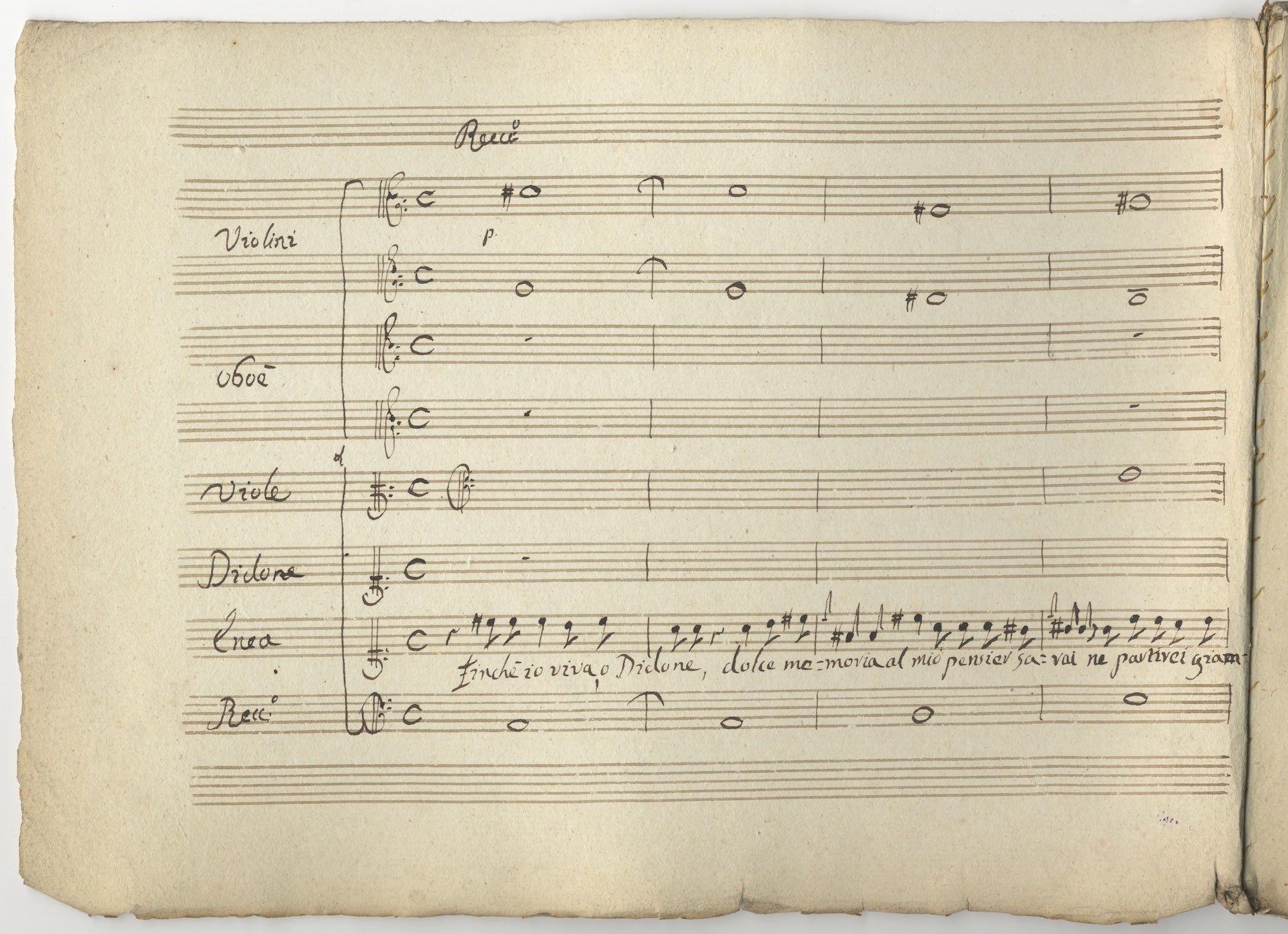
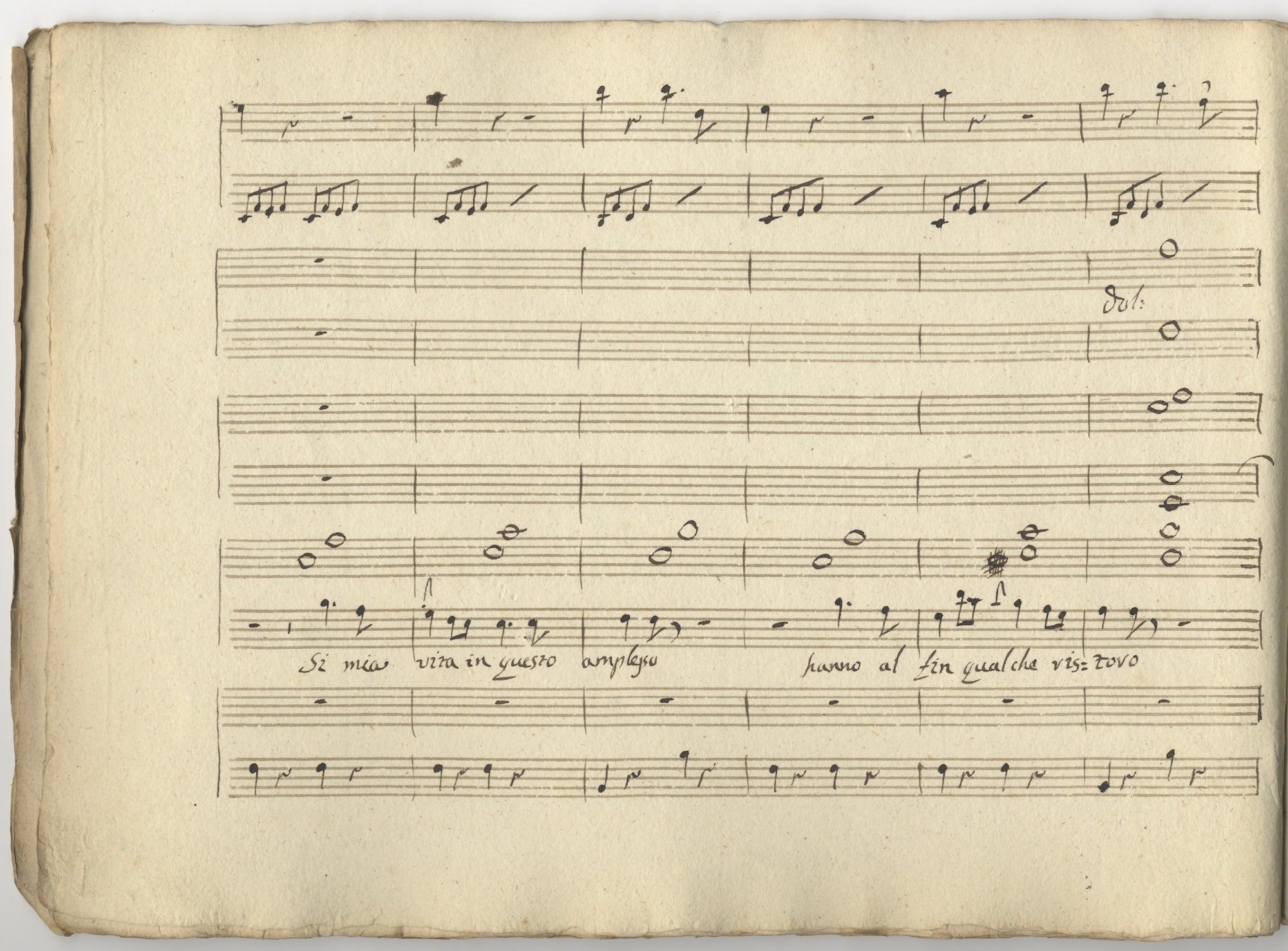
1794. ANDREOZZI, Gaetano 1755-1826. Oblong folio (235 x 333 mm). Sewn. [i] (title), 34, [iii] (blank) pp. Notated in black ink on 10-stave rastrum-ruled paper. Text in Italian. Untrimmed.
Contains:
1) Paisiello. Accompanied recitative, "Finchè io viva, o Didone", 8 pp.
2) Andreozzi. Accompanied recitative, "Sgombra mio ben l'affanno", 5 pp.
3) Andreozzi. Aria [duetto], "Si mia vita in questo amplesso" 23 pp.
With small oval handstamp of the Glasgow Society of Musicians to lower inner corner of title and final page of music; "228" in contemporary manuscript to lower inner corner and "18" in contemporary manuscript to upper margin of title. Misattributed to Giovanni Paisiello (1740-1816) on title.
Slightly soiled; small tears to blank lower margin of title. The accompanied recitative, "Finchè io viva Didone," is drawn from Paisiello's "Didone abbandonata" (premiered Naples, Teatro San Carlo, 4, November 1794).
The aria and accompanied recitative that follow it may be from Andreozzi's opera "Didone abbandonata," set to a libretto by Metastasio, first performed in St. Petersburg at the Hermitage in 1784.
The Andreozzi pieces appear in three other manuscript sources, at the Biblioteca Palatina (located via OPAC SBN: ITICCUMSM000022), Biblioteca del Conservatorio Benedetto Marcello (ITICCUMSM104738), and Biblioteca del Conservatorio statale di musica Nicolò Paganini (ITICCULIG475686) but with different names for the characters (Davidde and Micolle), with the Biblioteca Palatina source indicating on its title that its music is from Andreozzi's 1794 Lenten opera "Saulle," and the latter two sources indicating the same from their character designations within the scores. "Saulle" was first performed Naples, Fondo, Lent 1794. Andreozzi's "Didone abbandonata" does not appear to have survived in its entirety. It is possible, though (given the character names here) that the composer recycled this scene and duet from his own "Didone" to use in his later opera "Saulle".
Andreozzi, an Italian composer, "studied singing, harmony and counterpoint with Fenaroli and P.A. Gallo at the Conservatorio di S Maria di Loreto, Naples. He was called ‘Jommellini’ after his maternal uncle, Niccolò Jommelli, with whom he also studied. Following his début work, the oratorio Giefte (1779, Rome), he established himself as a regular contributor of comic operas for Florence and Venice, but he did not write an opera seria for Venice until 1788. After Carnival 1784 he travelled to St Petersburg, where his Didone abbandonata was performed. ... For most of his career he worked in northern Italy, returning frequently to Naples to compose operas. Beginning in 1790, he was called upon to write an occasional carnival opera for Rome. He also probably accompanied his wife on her Madrid trip, during which his Angelica e Medoro and Didone abbandonata were given at the Caños del Peral, although there is no evidence to support Fétis’s claim that Andreozzi wrote a new opera for the city, Gustavo, re di Svezia. His Lenten opera, Saulle (1794, Naples), enjoyed numerous revivals throughout the first decade of the 19th century. ... Andreozzi was a skilled and original composer. He often contrasted wind and string sonorities and used solo instruments in dialogue or to provide obbligato embellishment or a simple countermelody to the voice. The English horn, clarinet and bassoon, as well as horns and oboes, heighten the effect of obbligato recitatives. His lean accompaniments often take the form of motivic, rhythmic or syncopated beat-keeping, using arpeggiated, oscillating or repeated note figures. Simple string accompaniment for the vocal phrases are in strong contrast with motivic tutti commentaries in orchestral passages and ritornellos. Andreozzi often establishes a dialogue between voice and orchestra, and occasional examples of motivic, textural or harmonic word-painting can be found. Andreozzi’s prominent use of wind instruments, crescendo passages, chromaticism, modality and disguised recapitulations, as well as his tonally unified scene complexes, all point to Jommelli’s influence." Marita P. McClymonds in Grove Music Online.
Contains:
1) Paisiello. Accompanied recitative, "Finchè io viva, o Didone", 8 pp.
2) Andreozzi. Accompanied recitative, "Sgombra mio ben l'affanno", 5 pp.
3) Andreozzi. Aria [duetto], "Si mia vita in questo amplesso" 23 pp.
With small oval handstamp of the Glasgow Society of Musicians to lower inner corner of title and final page of music; "228" in contemporary manuscript to lower inner corner and "18" in contemporary manuscript to upper margin of title. Misattributed to Giovanni Paisiello (1740-1816) on title.
Slightly soiled; small tears to blank lower margin of title. The accompanied recitative, "Finchè io viva Didone," is drawn from Paisiello's "Didone abbandonata" (premiered Naples, Teatro San Carlo, 4, November 1794).
The aria and accompanied recitative that follow it may be from Andreozzi's opera "Didone abbandonata," set to a libretto by Metastasio, first performed in St. Petersburg at the Hermitage in 1784.
The Andreozzi pieces appear in three other manuscript sources, at the Biblioteca Palatina (located via OPAC SBN: ITICCUMSM000022), Biblioteca del Conservatorio Benedetto Marcello (ITICCUMSM104738), and Biblioteca del Conservatorio statale di musica Nicolò Paganini (ITICCULIG475686) but with different names for the characters (Davidde and Micolle), with the Biblioteca Palatina source indicating on its title that its music is from Andreozzi's 1794 Lenten opera "Saulle," and the latter two sources indicating the same from their character designations within the scores. "Saulle" was first performed Naples, Fondo, Lent 1794. Andreozzi's "Didone abbandonata" does not appear to have survived in its entirety. It is possible, though (given the character names here) that the composer recycled this scene and duet from his own "Didone" to use in his later opera "Saulle".
Andreozzi, an Italian composer, "studied singing, harmony and counterpoint with Fenaroli and P.A. Gallo at the Conservatorio di S Maria di Loreto, Naples. He was called ‘Jommellini’ after his maternal uncle, Niccolò Jommelli, with whom he also studied. Following his début work, the oratorio Giefte (1779, Rome), he established himself as a regular contributor of comic operas for Florence and Venice, but he did not write an opera seria for Venice until 1788. After Carnival 1784 he travelled to St Petersburg, where his Didone abbandonata was performed. ... For most of his career he worked in northern Italy, returning frequently to Naples to compose operas. Beginning in 1790, he was called upon to write an occasional carnival opera for Rome. He also probably accompanied his wife on her Madrid trip, during which his Angelica e Medoro and Didone abbandonata were given at the Caños del Peral, although there is no evidence to support Fétis’s claim that Andreozzi wrote a new opera for the city, Gustavo, re di Svezia. His Lenten opera, Saulle (1794, Naples), enjoyed numerous revivals throughout the first decade of the 19th century. ... Andreozzi was a skilled and original composer. He often contrasted wind and string sonorities and used solo instruments in dialogue or to provide obbligato embellishment or a simple countermelody to the voice. The English horn, clarinet and bassoon, as well as horns and oboes, heighten the effect of obbligato recitatives. His lean accompaniments often take the form of motivic, rhythmic or syncopated beat-keeping, using arpeggiated, oscillating or repeated note figures. Simple string accompaniment for the vocal phrases are in strong contrast with motivic tutti commentaries in orchestral passages and ritornellos. Andreozzi often establishes a dialogue between voice and orchestra, and occasional examples of motivic, textural or harmonic word-painting can be found. Andreozzi’s prominent use of wind instruments, crescendo passages, chromaticism, modality and disguised recapitulations, as well as his tonally unified scene complexes, all point to Jommelli’s influence." Marita P. McClymonds in Grove Music Online.