

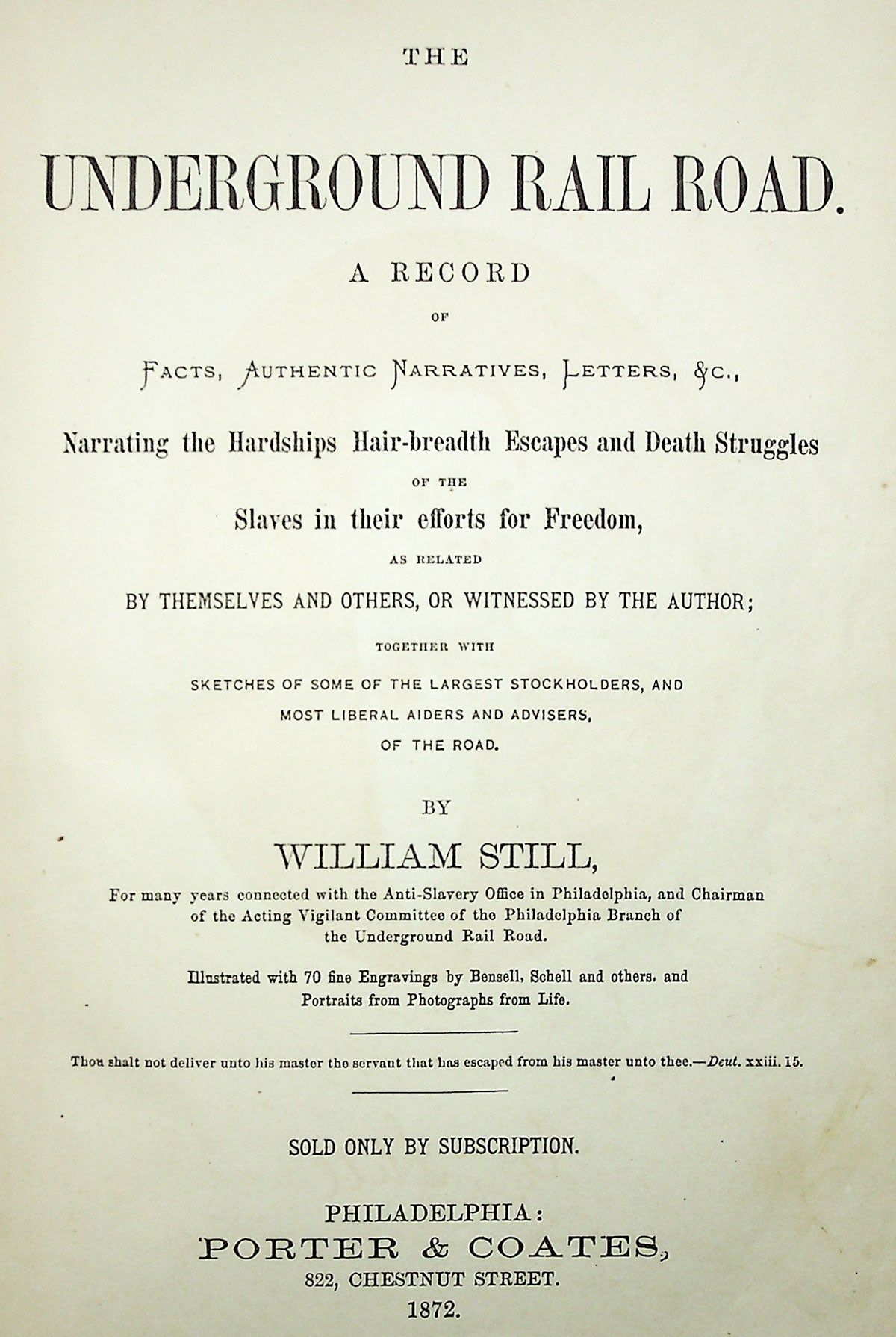
The Underground Rail Road. A Record of Facts, Authentic Narratives, Letters, &c., Narrating the Hardships, Hair-breadth Escapes, and Death Struggles of the Slaves in their Efforts for Freedom, as Related by Themselves and Others, or Witnessed by the Author
- Philadelphia: Porter & Coates, Publishers, 1872
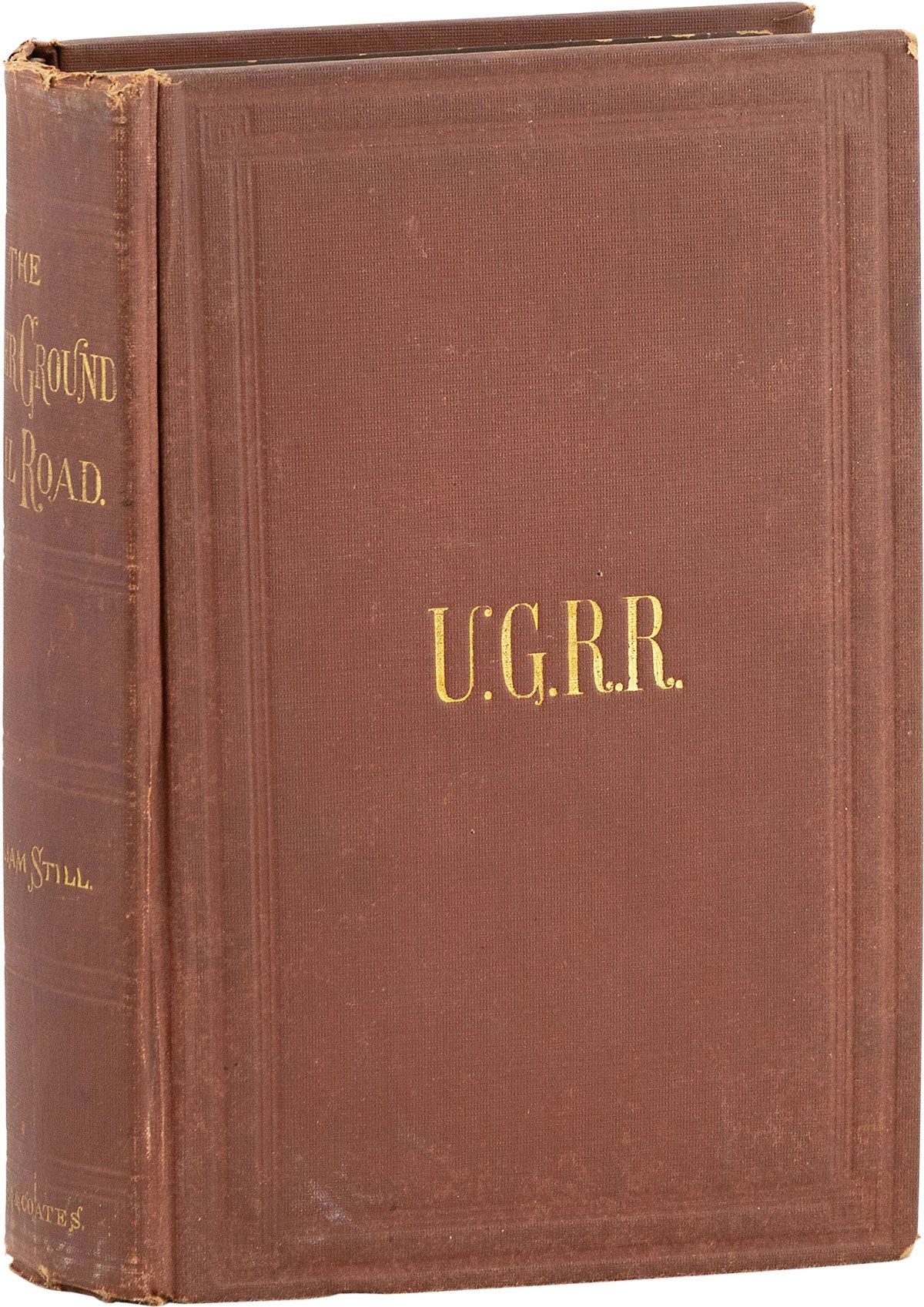
Philadelphia: Porter & Coates, Publishers, 1872. First Edition. Thick octavo (24.5cm); variant in the publisher's terracotta fine English cloth binding, with titles stamped in gilt on spine and front cover; dark brown clay-coated endpapers; 4pp.ads, [iv],780,[2]pp, with an engraved frontispiece portrait of Still and 43 plates of illustrations. Gently spine-sunned, spine ends pushed and a bit worn, minute board exposure to corners, some light surface wear and dust-soil to cloth, with some partial cracks to front hinge, and a small one to lower rear hinge; some light foxing and occasional finger-soil to margins of plates, with some staining to lower third of pp.50-51 and the plate in between; a solidly Very Good, unrepaired copy.
A historically significant document by Still, a free-born Black man who became an author and abolitionist movement leader in Philadelphia, PA. The volume documented the stories of escaped slaves, and remains "the only first-person account of Black activities on the Underground Railroad written and self-published by an African-American...William Still was a major contributor to the success of the Underground Railroad activities in Philadelphia and a part of Philadelphia's free Black community that played an essential role in the Underground Railroad. He personally provided room and board for many African Americans who escaped slavery and stopped in Philadelphia on their way to Canada. Through his work with the Pennsylvania Society for the Abolition of Slavery's Vigilance Committee, he raised funds to assist runaways and arrange their passage to the North. He was instrumental in financing several of Harriet Tubman's trips to the South to liberate enslaved Africans" (Turner, Diane D. "William Still's National Significance." Web blog post. William Still: African American Abolitionist. Temple University, n.d. 18 August, 2016).
Still kept meticulous notes concerning the many escaped slaves who passed through the Philadelphia "station;" he took pains to record names, brief biographies, and the destination for each individual, along with any adopted aliases, in hopes of reuniting family members who were separated by slavery. He kept his notes secret, hidden in diaries he kept during those years, and published them after the Civil War. The Underground Rail Road went through three editions, and was displayed at the Philadelphia Centennial Exhibition in 1876. SCHOMBURG, p.7, 394; WORK, p.338.
A historically significant document by Still, a free-born Black man who became an author and abolitionist movement leader in Philadelphia, PA. The volume documented the stories of escaped slaves, and remains "the only first-person account of Black activities on the Underground Railroad written and self-published by an African-American...William Still was a major contributor to the success of the Underground Railroad activities in Philadelphia and a part of Philadelphia's free Black community that played an essential role in the Underground Railroad. He personally provided room and board for many African Americans who escaped slavery and stopped in Philadelphia on their way to Canada. Through his work with the Pennsylvania Society for the Abolition of Slavery's Vigilance Committee, he raised funds to assist runaways and arrange their passage to the North. He was instrumental in financing several of Harriet Tubman's trips to the South to liberate enslaved Africans" (Turner, Diane D. "William Still's National Significance." Web blog post. William Still: African American Abolitionist. Temple University, n.d. 18 August, 2016).
Still kept meticulous notes concerning the many escaped slaves who passed through the Philadelphia "station;" he took pains to record names, brief biographies, and the destination for each individual, along with any adopted aliases, in hopes of reuniting family members who were separated by slavery. He kept his notes secret, hidden in diaries he kept during those years, and published them after the Civil War. The Underground Rail Road went through three editions, and was displayed at the Philadelphia Centennial Exhibition in 1876. SCHOMBURG, p.7, 394; WORK, p.338.