

Autograph Letter with descriptions of New York State Reformatory for Women at Bedford Hills, New York
- New York , 1911
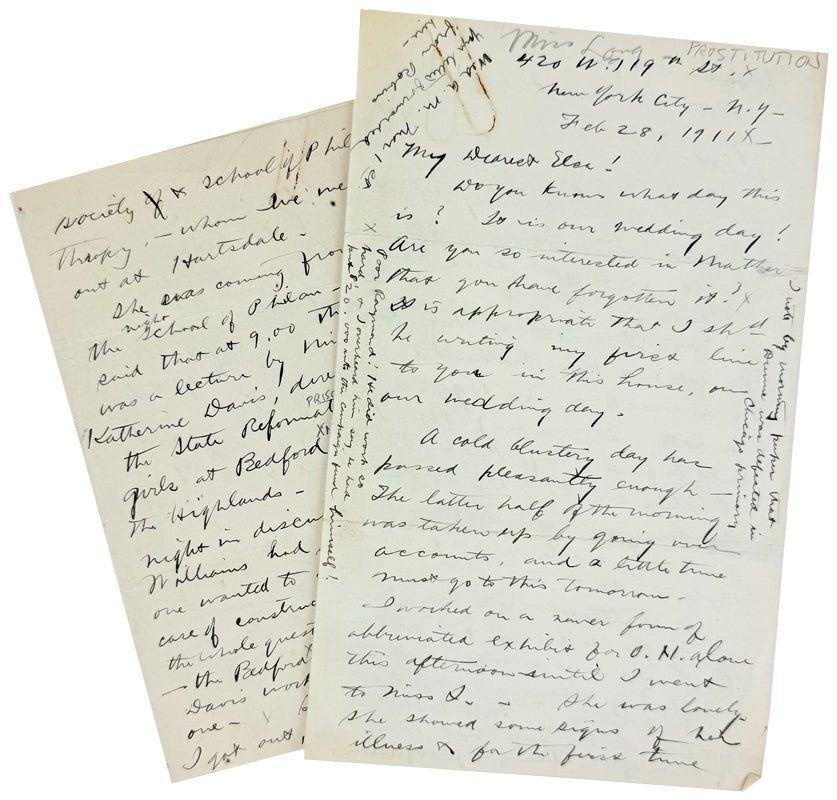
New York, 1911. Very Good. New York: 1911. Six-page manuscript letter from an unnamed man to an Elsa Lang (his wife?) with a focus on sex hygiene and remarks from Katharine Davis regarding her work as director of the New York State Reformatory for Women at Bedford Hills, New York. Light wrinkling to edges, old mail folds; oxidation from removed paperclip; brief tape mending; legible throughout; Very Good.
After relating usual and unusual formalities - the author asks Miss Lang whether she remembers it's their wedding day - the letter continues, "I tried to see Mrs. Hilitz (too late) + Miss Richmond for a crack on sex hygiene (too late - she was out)." Eventually the author is referred to a lecture given by social reformer and criminologist Katherine Bement Davis (1860-1935) and he relays in great detail from Davis's lecture about the Bedford Hills Reformatory in New York: 360 inmates aged 16 to 30 years. Most of the inmates are "some kind of prostitute before they come," and "they [the Reformatory] are not concerned with her past - all she has got to care about is her future." Most women are illiterate and they focus on elementary lessons as well as manual work - building cement walls and tending their pig pen.
As well as clubs, games, and dramatics (Shaw and Ibsen are mentioned), some of the inmates also have self-government as a way to prepare them for returning to civilian life. Davis however says the prison is an "experiment station" for ways of suggesting prevention: she reports 5000 women and girls per year are convicted in New York City alone. The author concludes by saying he asked Davis afterwards what to do to by way of prevention, and she replied, "attack the double moral standard."
Despite her science-based approach to prison reform and pioneering work on female sexuality, Davis also adopted a eugenics line of thinking later in life. Nevertheless, an intriguing primary source record of the state of prisons and sex work in the early 20th century.
After relating usual and unusual formalities - the author asks Miss Lang whether she remembers it's their wedding day - the letter continues, "I tried to see Mrs. Hilitz (too late) + Miss Richmond for a crack on sex hygiene (too late - she was out)." Eventually the author is referred to a lecture given by social reformer and criminologist Katherine Bement Davis (1860-1935) and he relays in great detail from Davis's lecture about the Bedford Hills Reformatory in New York: 360 inmates aged 16 to 30 years. Most of the inmates are "some kind of prostitute before they come," and "they [the Reformatory] are not concerned with her past - all she has got to care about is her future." Most women are illiterate and they focus on elementary lessons as well as manual work - building cement walls and tending their pig pen.
As well as clubs, games, and dramatics (Shaw and Ibsen are mentioned), some of the inmates also have self-government as a way to prepare them for returning to civilian life. Davis however says the prison is an "experiment station" for ways of suggesting prevention: she reports 5000 women and girls per year are convicted in New York City alone. The author concludes by saying he asked Davis afterwards what to do to by way of prevention, and she replied, "attack the double moral standard."
Despite her science-based approach to prison reform and pioneering work on female sexuality, Davis also adopted a eugenics line of thinking later in life. Nevertheless, an intriguing primary source record of the state of prisons and sex work in the early 20th century.