

Confitebor tibi Domine A cinque Voice Con Violini, Viola, e Basso. [Paymer 66]. [Manuscript full score]
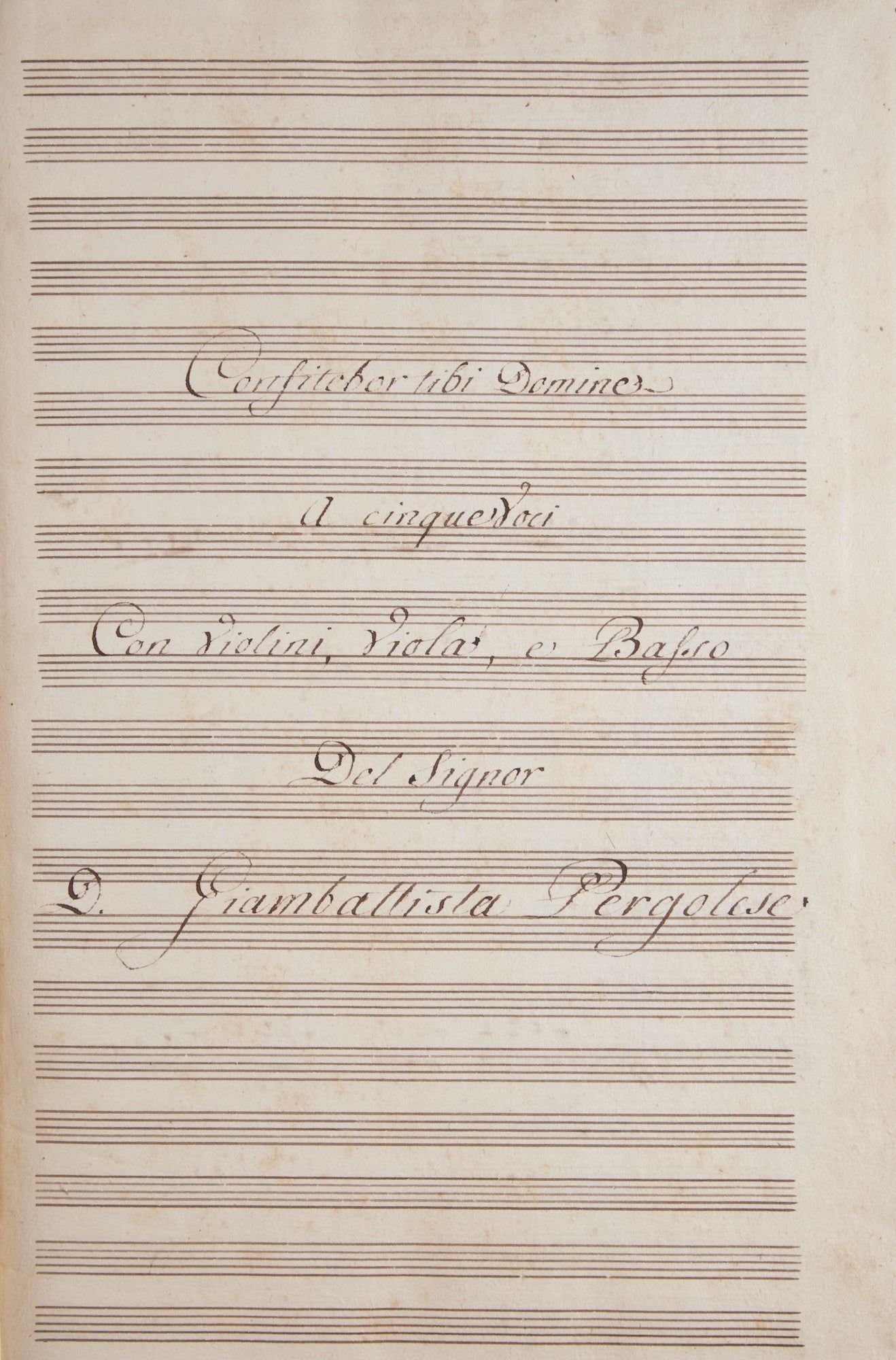
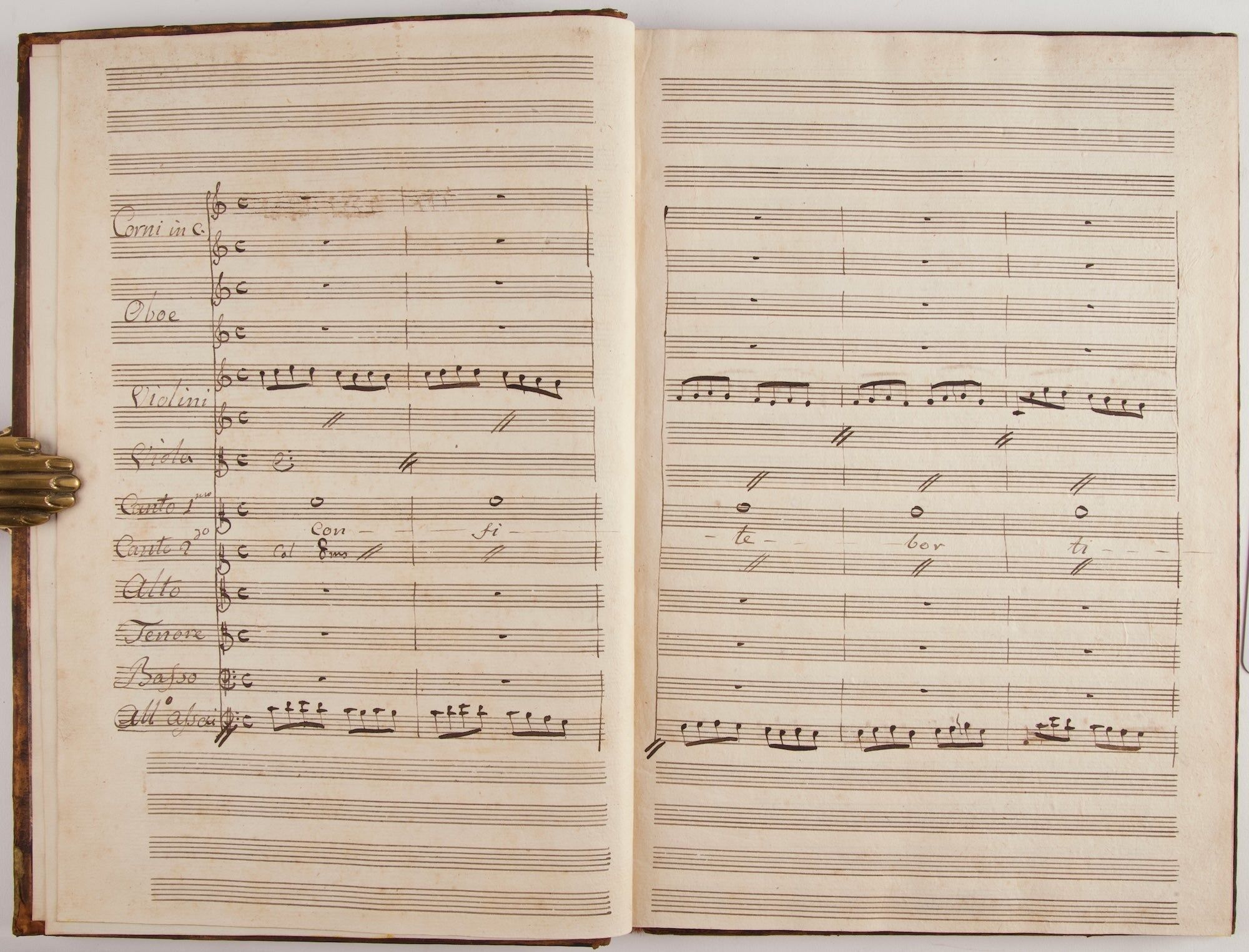
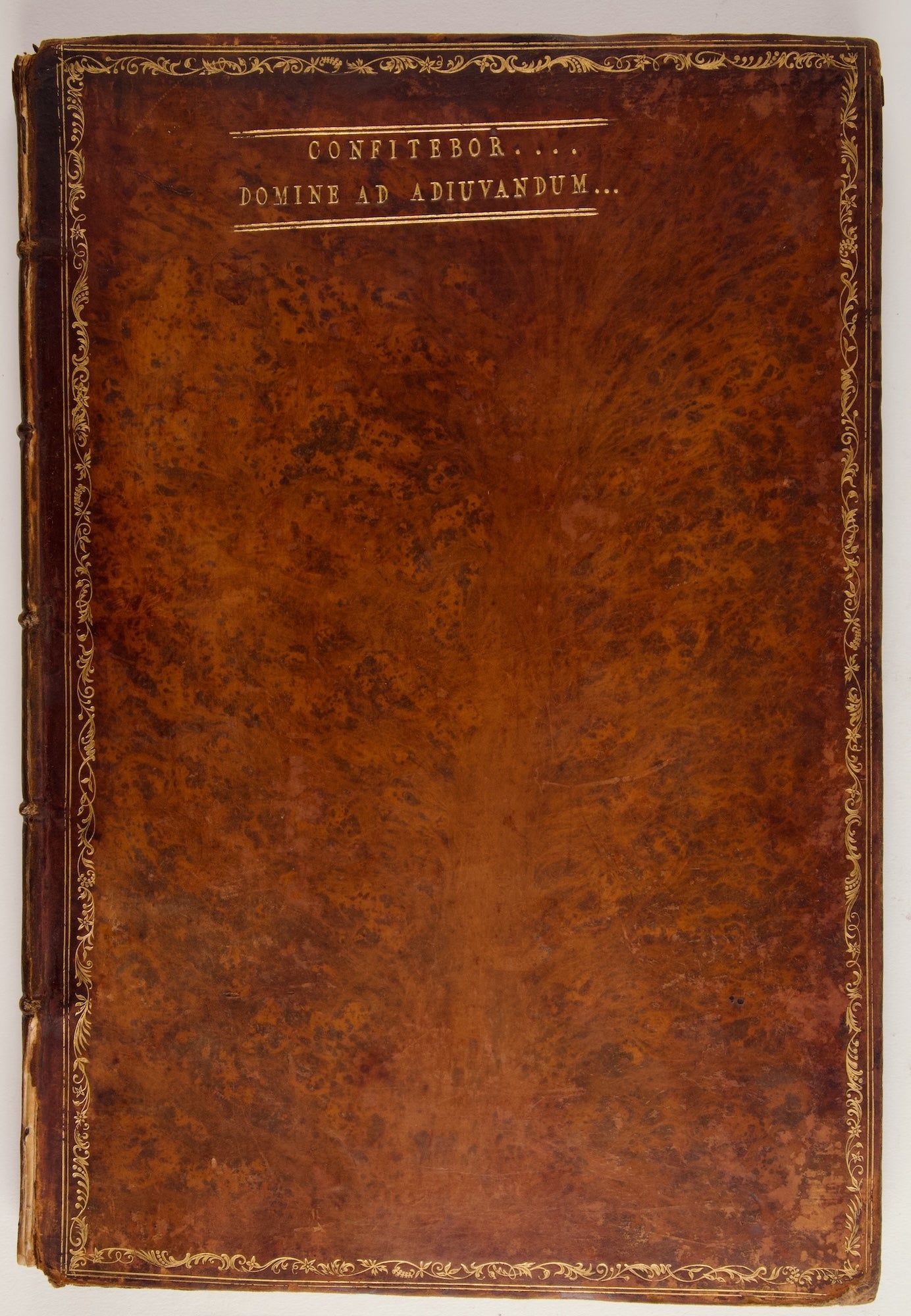
- [?Naples] , 1740
[?Naples], 1740. Folio (203 x 311 mm). 18th century mid-tan tree calf with titling and plain double rule and inner decorative floral rule gilt to edges of boards, raised bands on spine in decorative compartments gilt, marbled endpapers. [i] (title), 101, [ii] (blank] pp. Notated in black ink on 20-stave rastrum-ruled paper, with watermark of a fleur-de-lis within a circle with letters "GP" below and with a fleur-de-lis within a circle with "F" above and "B" and "F" below. See Heawood 1587.
Bound with:
Domine adiuvandum me festina A cinque Voci Con Violini, Oboe, Trombe, Viola e Basso ... In Napoli. [Paymer 51]. [Manuscript full score]. Notated in black ink on 20-stave rastrum-ruled paper. [i] (title), 35 pp.
The two manuscripts in the same hand.
Binding worn, rubbed, and bumped. In very good condition internally. Both works consist of grand choral movements with interpolated solo arias. Of the two works, only the second, "Domine adiuvandum me festina," is considered authentic by Paymer (p. 17).
"In 1732 Pergolesi became maestro di cappella to Prince Ferdinando Colonna Stigliano, equerry to the Viceroy of Naples. ... There were earthquakes in 1731 and again in November 1732; the archbishop summoned the people to services of atonement and the municipality elected St Emidius, protector against earthquakes, as the city’s special patron saint. A vow was taken to celebrate his festival annually with a solemn mass and double vespers, and the decree was formally proclaimed on 31 December 1732 in the church of S Maria della Stella. Villarosa reported that Pergolesi composed for the occasion a mass for double chorus, a Domine ad adjuvandum me and the psalms Dixit Dominus, Laudate and Confitebor. ... Pergolesi’s psalm settings are intended for vespers. They too are on a large scale and are divided into choral and solo sections, with concertante movements for soloists and chorus. The solo sections in Pergolesi’s church music are two-section, aria-like pieces, different from the typical opera and oratorio arias and apparently derived from the vocal and instrumental concerto movement. Many of the choral movements, too, betray the same influence, and some of them show signs of being reduced polychoral settings. Within its stylistic bounds, Pergolesi’s church music is distinguished by the lively declamation of the text and the melodic charm of the solo sections, and by the rich contrasts of the choral ones. It may have influenced the later work of his teacher, Francesco Durante, and of Leonardo Leo, both of whom survived Pergolesi." Helmut Hucke, and Dale E. Monson in Grove Music Online
Attractive manuscripts, carefully executed on quality paper.
Bound with:
Domine adiuvandum me festina A cinque Voci Con Violini, Oboe, Trombe, Viola e Basso ... In Napoli. [Paymer 51]. [Manuscript full score]. Notated in black ink on 20-stave rastrum-ruled paper. [i] (title), 35 pp.
The two manuscripts in the same hand.
Binding worn, rubbed, and bumped. In very good condition internally. Both works consist of grand choral movements with interpolated solo arias. Of the two works, only the second, "Domine adiuvandum me festina," is considered authentic by Paymer (p. 17).
"In 1732 Pergolesi became maestro di cappella to Prince Ferdinando Colonna Stigliano, equerry to the Viceroy of Naples. ... There were earthquakes in 1731 and again in November 1732; the archbishop summoned the people to services of atonement and the municipality elected St Emidius, protector against earthquakes, as the city’s special patron saint. A vow was taken to celebrate his festival annually with a solemn mass and double vespers, and the decree was formally proclaimed on 31 December 1732 in the church of S Maria della Stella. Villarosa reported that Pergolesi composed for the occasion a mass for double chorus, a Domine ad adjuvandum me and the psalms Dixit Dominus, Laudate and Confitebor. ... Pergolesi’s psalm settings are intended for vespers. They too are on a large scale and are divided into choral and solo sections, with concertante movements for soloists and chorus. The solo sections in Pergolesi’s church music are two-section, aria-like pieces, different from the typical opera and oratorio arias and apparently derived from the vocal and instrumental concerto movement. Many of the choral movements, too, betray the same influence, and some of them show signs of being reduced polychoral settings. Within its stylistic bounds, Pergolesi’s church music is distinguished by the lively declamation of the text and the melodic charm of the solo sections, and by the rich contrasts of the choral ones. It may have influenced the later work of his teacher, Francesco Durante, and of Leonardo Leo, both of whom survived Pergolesi." Helmut Hucke, and Dale E. Monson in Grove Music Online
Attractive manuscripts, carefully executed on quality paper.