

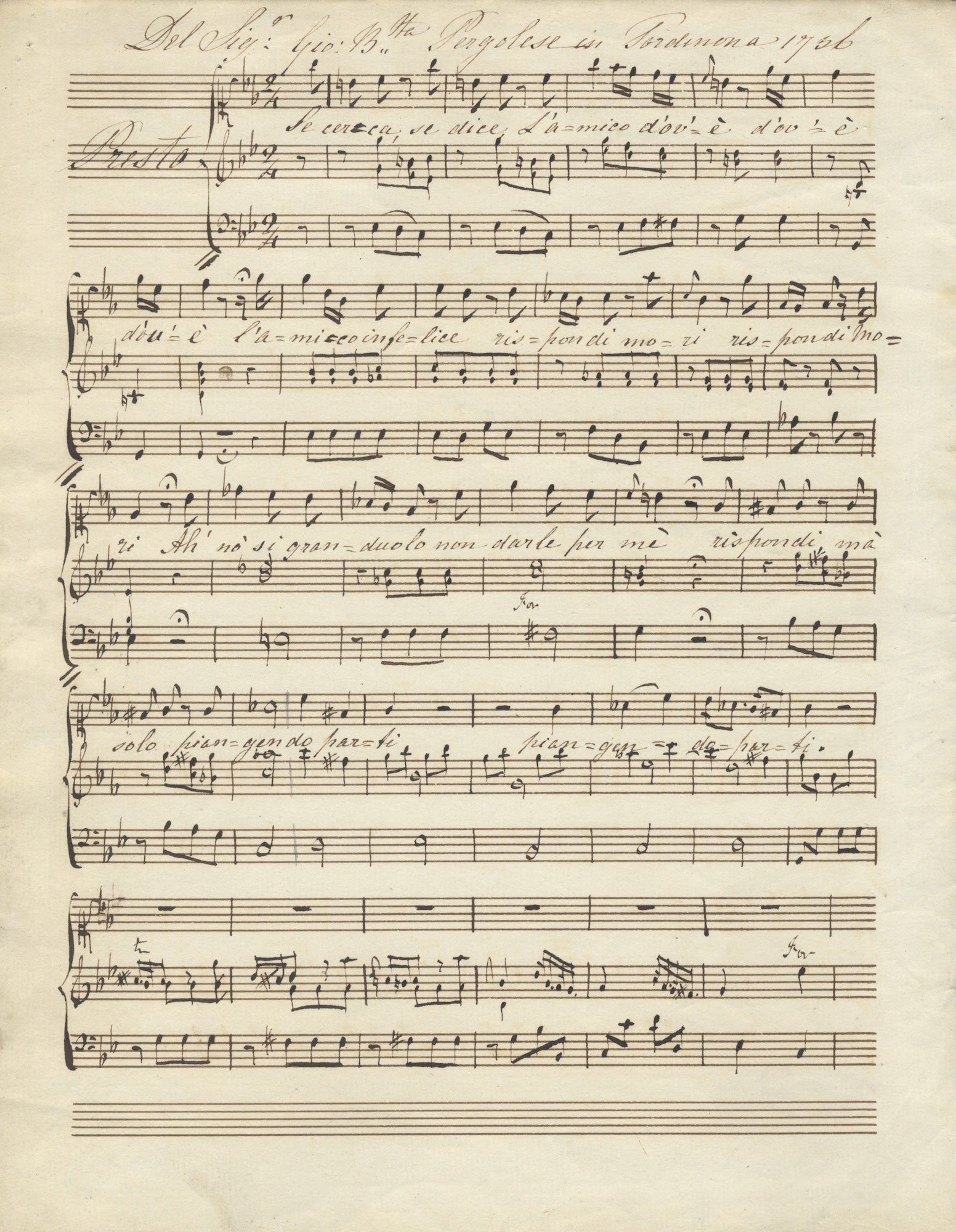
Se cerca, se dice" Aria. [Copyist manuscript]
![Se cerca, se dice" Aria. [Copyist manuscript]](https://d3525k1ryd2155.cloudfront.net/h/946/360/1684360946.0.x.jpg)
- [?]England , 1805
[?]England, 1805. Folio (239 x 297 mm). [i] (title), 7 pp. Notated in black ink on 16-stave rastrum-ruled paper. Watermark of John Wise dated 1805. Untrimmed.
With small oval handstamp of the Glasgow Society of Musicians to lower inner corner of title and final page of music; "1" and "23" in contemporary manuscript to upper center with "253" in contemporary manuscript to lower inner corner of title.
Slightly soiled; minor loss to blank outer edge of first leaf. Drawn from the opera "L'Olimpiade," set to a libretto by Metastasio, first performed in Rome at the Teatro Tordinona on 2 January 1735.
The present aria, sung by Megacle in Act II, scene 12 of the opera, was one of Pergolesi's most famous and widely-circulated works.
"L’olimpiade is characterized by idyllic and delicate tone-colours, smooth, expressive melodies with reserved virtuosity, free treatment of the text (for example with verbal repetitions of the kind used in opera buffa) and a greater intensity of feeling. Pergolesi excelled as a dramatic composer in his variety of mood, figure and expression." Helmut Hucke, and Dale E. Monson in Grove Music Online.
With small oval handstamp of the Glasgow Society of Musicians to lower inner corner of title and final page of music; "1" and "23" in contemporary manuscript to upper center with "253" in contemporary manuscript to lower inner corner of title.
Slightly soiled; minor loss to blank outer edge of first leaf. Drawn from the opera "L'Olimpiade," set to a libretto by Metastasio, first performed in Rome at the Teatro Tordinona on 2 January 1735.
The present aria, sung by Megacle in Act II, scene 12 of the opera, was one of Pergolesi's most famous and widely-circulated works.
"L’olimpiade is characterized by idyllic and delicate tone-colours, smooth, expressive melodies with reserved virtuosity, free treatment of the text (for example with verbal repetitions of the kind used in opera buffa) and a greater intensity of feeling. Pergolesi excelled as a dramatic composer in his variety of mood, figure and expression." Helmut Hucke, and Dale E. Monson in Grove Music Online.