

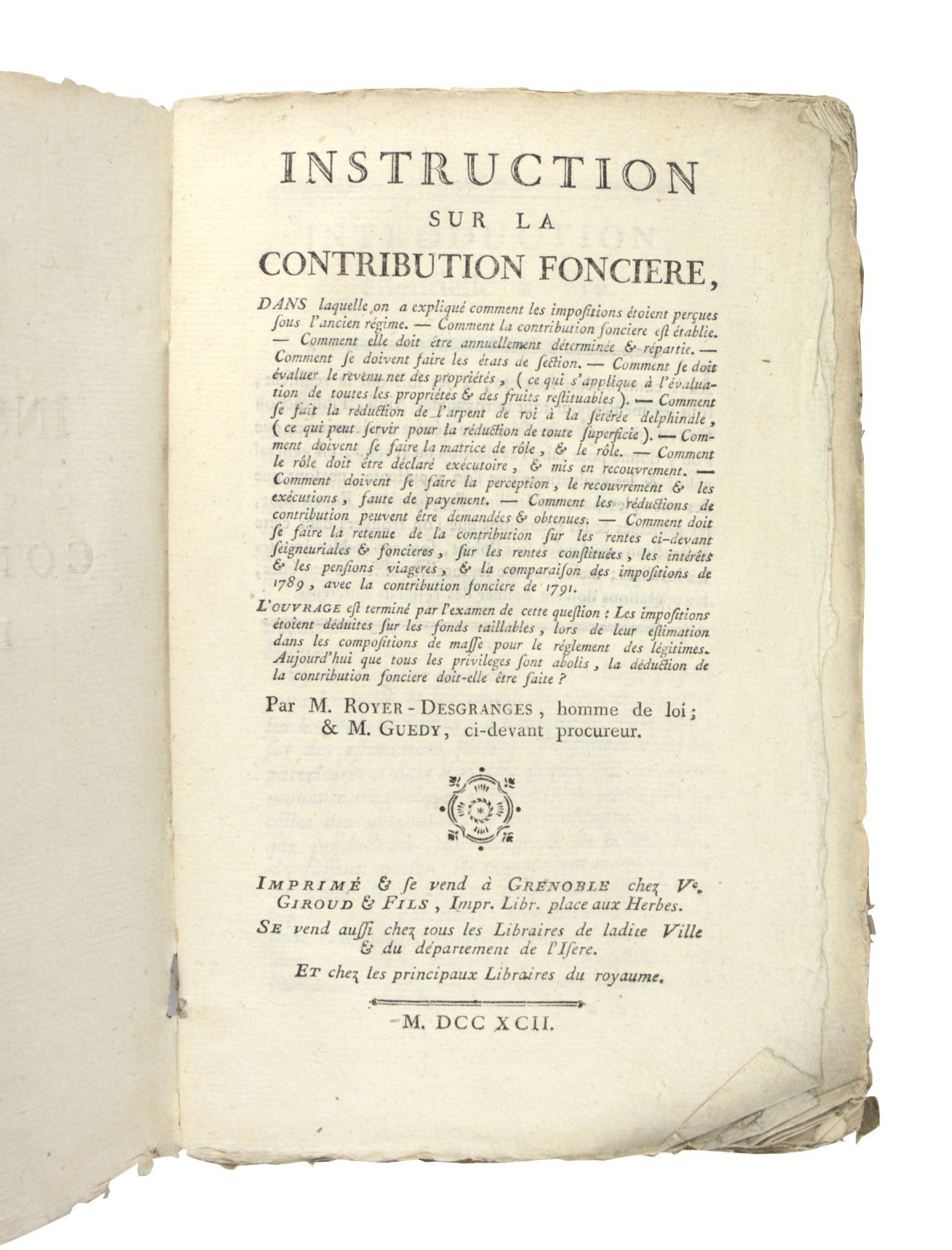
Instruction sur la Contribution Fonciere
- Grenoble: Ve. Giroud & Fils, 1792
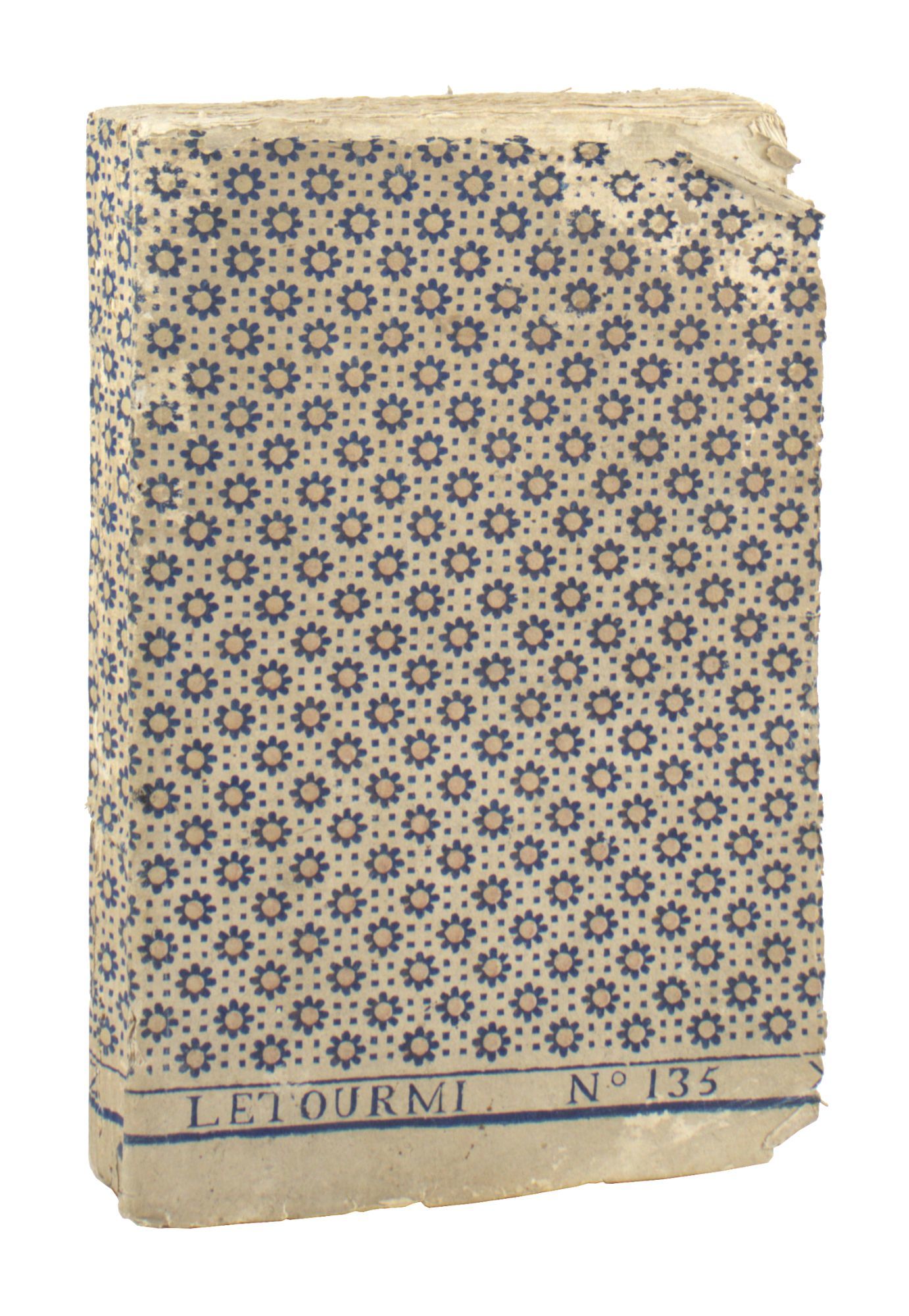
Grenoble: Ve. Giroud & Fils, 1792. Very Good. Grenoble: Imprimé & se vend...chez Ve. Giroud & Fils, Impr. Libr. place aux Herbes, 1792. First Edition. Octavo (21.5cm); blockprinted wrappers No. 135 by Orleans printer Jean-Baptiste Letourmi (a.k.a. Letourmy); xxiv,271pp.; decorative head- and tail-pieces, tables throughout text. Light wear to wrapper margins including brief biopredation along top edge of upper fore-edge corner, red portion of design faded to pink, occasional finger soil to textblock, contemporary owner's manuscript note inside upper cover referencing sections 613 to 630 on p. 253 (which has also been dog-eared), else a Very Good, fresh and uncut example.
Extensive manual on land tax published by the formidable Grenoble printer and bookseller Justine Giroud, née Souverant. Born sometime around 1730 to a local glove maker, Souverant found herself the member of one of the oldest local printing houses when she married André Giroud, whose family had been printing since the 1660s. On André's death in 1767 Justine became the proprietor of his press, which she successfully managed and expanded for the next twenty-five years, operating first out of rooms in the Palais de Parlement before moving to what appears to have been a family residence at the quaintly-named Place aux Herbes.
Though much of her output involved job printing, Justine Giroud also produced more ambitious works such as the present guide to the ever-changing land-tax laws on the eve of the Reign of Terror. Perhaps her most important output was the weekly (and later tri-weekly) Affiches du Dauphiné, which was suppressed in 1792 for its monarchist leanings. By then, however, Justine Giroud had considerably slowed down as her age caught up with her and the press was run with the help of her sons Jean Louis Antoine and Alexandre.
Of special interest is the choice of "temporary" binding, wrappers signed and numbered in print along the bottom margin of the binding by another major local printer, Jean-Baptiste Letourmy of Orleans. "Assisted by one or more skilled block-cutters, [Letourmy] produced numerous religious prints and traditional images, keeping up with current events when revolution broke out. He produced at least 321 designs of patterned paper," of which this is pattern no. 135, a repeating motif of Letourmy's favorite color, brilliant blue flowers with reddish florets. Letourmy was a shrewd businessperson with an extensive net of agents, exemplified by this volume, which was published 350 miles away from his printshop.
A beautiful marriage of two regional printers issued during a time of intense political turmoil and national transformation. OCLC locates just one copy in North America as of May, 2025, at Harvard.
References:
Dictionnaire des Journalistes (1600-1789) available online
André Jammes, "Papiers dominotés," (2010), p. 182 (Simon Beattie's translation).
Extensive manual on land tax published by the formidable Grenoble printer and bookseller Justine Giroud, née Souverant. Born sometime around 1730 to a local glove maker, Souverant found herself the member of one of the oldest local printing houses when she married André Giroud, whose family had been printing since the 1660s. On André's death in 1767 Justine became the proprietor of his press, which she successfully managed and expanded for the next twenty-five years, operating first out of rooms in the Palais de Parlement before moving to what appears to have been a family residence at the quaintly-named Place aux Herbes.
Though much of her output involved job printing, Justine Giroud also produced more ambitious works such as the present guide to the ever-changing land-tax laws on the eve of the Reign of Terror. Perhaps her most important output was the weekly (and later tri-weekly) Affiches du Dauphiné, which was suppressed in 1792 for its monarchist leanings. By then, however, Justine Giroud had considerably slowed down as her age caught up with her and the press was run with the help of her sons Jean Louis Antoine and Alexandre.
Of special interest is the choice of "temporary" binding, wrappers signed and numbered in print along the bottom margin of the binding by another major local printer, Jean-Baptiste Letourmy of Orleans. "Assisted by one or more skilled block-cutters, [Letourmy] produced numerous religious prints and traditional images, keeping up with current events when revolution broke out. He produced at least 321 designs of patterned paper," of which this is pattern no. 135, a repeating motif of Letourmy's favorite color, brilliant blue flowers with reddish florets. Letourmy was a shrewd businessperson with an extensive net of agents, exemplified by this volume, which was published 350 miles away from his printshop.
A beautiful marriage of two regional printers issued during a time of intense political turmoil and national transformation. OCLC locates just one copy in North America as of May, 2025, at Harvard.
References:
Dictionnaire des Journalistes (1600-1789) available online
André Jammes, "Papiers dominotés," (2010), p. 182 (Simon Beattie's translation).