

Sentry
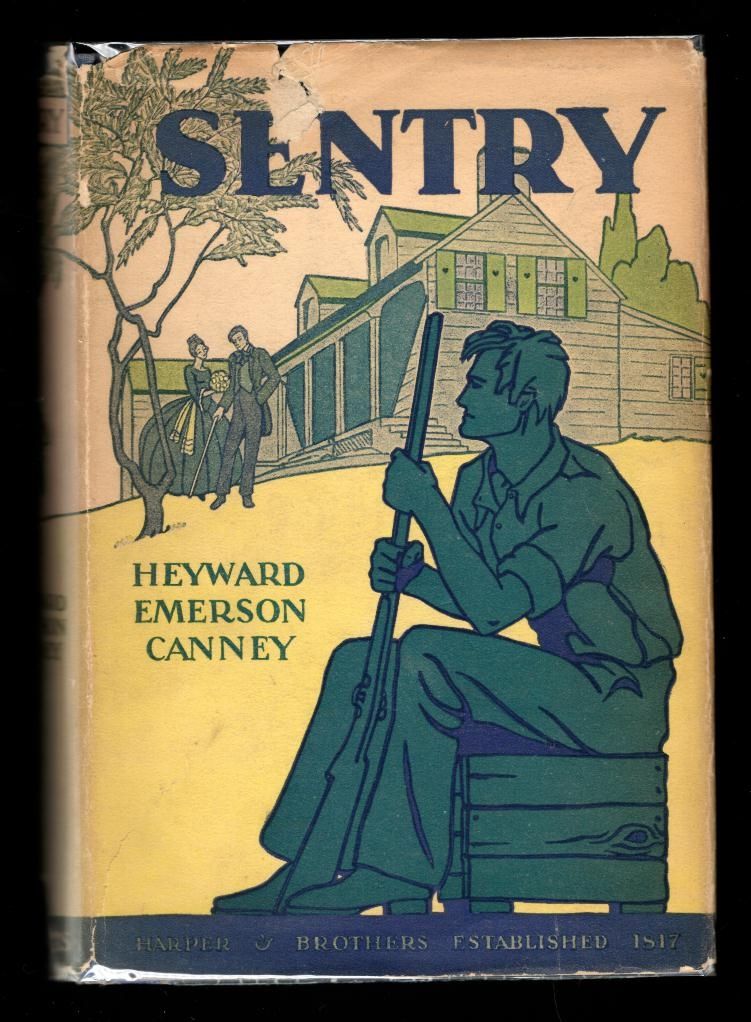
- Hardcover
- New York/London: Harper & Brothers, 1928
New York/London: Harper & Brothers. Very Good+ in Fair dj. 1928. 1st Edition (H-C). Hardcover. (price-clipped) [a good sound copy, a little fading to spine cloth, light shelfwear to bottom edges, tiny stain in front gutter with bleed-through on the first couple of pages, a couple of pages roughly opened with resulting slight raggedness to edges; the jacket is worn and age-toned, with a lengthwise crease in the spine (beginning to split), shallow chipping at the top of the spine, a small ragged tear with some associated surface-scarring at the top of the front panel, a small narrow chip at the base of the spine, and a one-inch diagonal closed tear at the lower left corner of the front panel]. Novel, "a sort of Enoch Arden romance of the Civil War," set in a New England village. The plot involves two men in love with the same woman; she marries the one, but really loves the other (who's a pacifist). The husband goes off to war, and after he's reported killed in battle, she and the first guy (who are already more or less shacked up -- "already too intimate for propriety," as a contemporary review delicately puts it) plan to marry -- but then hubby, not dead at all but having been confined to a Confederate prison camp -- returns home. Instead of booting the other guy out, however, he insists that his wife and the guy go on living together and notifies the man that "he'll kill him if he attempts to escape"; he takes up residence just across the road and assumes his "sentry" role (loaded musket at the ready), which (a) turns out to have been a plot of the husband's all along (based on some idea of his inflexible New England morality), and (b) takes a long, LONG time to play out: although this situation is put in place at the end of the Civil War in 1865, the novel doesn't actually reach its conclusion until 1927! One contemporary reviewer found it "the most original tale I have read in many years [and] one of the most arresting, [which] despite its extraordinary situations [is] wrought so deftly by the author that it seems natural and convincing." The Massachusetts-born author was reported at the time to be a private secretary in a Wall Street banking firm, a job he may well have held onto, given that this was his only published novel. (Another possible reason for its having been his solo effort: a contemporary news item reported that he suffered from "severe eye trouble," which made it necessary to dictate the greater part of the book to his wife.) .