

Megalynodia Sionia Continensa Canticum B. Mariæ Virginis, Magnificat, 5. 6. & 8. Voc., super Ut Re Mi Fa Sol La, & quædam Madrigalia ac Motectas (interpositis de Nativitate & Resurrectione Christi Cantilenis quibusdam Germanicis) accommodatum; Cui insuper accesserunt dua Compositiones aliæ quæ Motectarum etiam loco non incommodè usurpari possunt. [Quintus and Bassus parts]
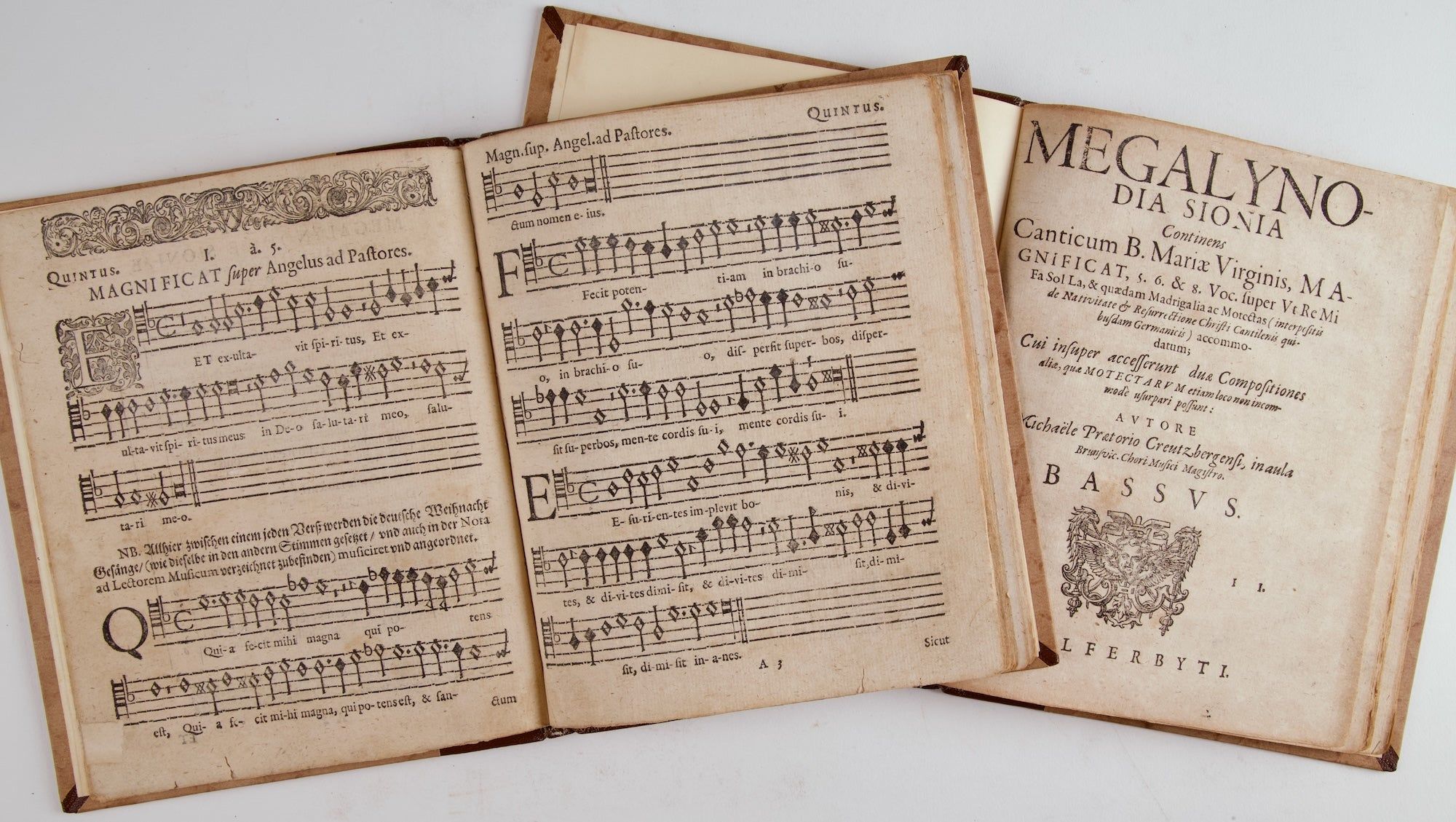
- Wolferbyti: [In Officina Typographica Principali Brunsvicensi Sumtibus Autoris], 1611
Wolferbyti: [In Officina Typographica Principali Brunsvicensi Sumtibus Autoris], 1611. Two volumes. Small quarto (144 x 189 mm). Modern quarter dark brown leather with marbled boards, composer's name gilt to spine.
Quintus: [A1]-4 - H3; 1f. (recto title, verso blank), [i] (index), 59, [i] (imprint with woodcut vignette incorporating face, ' griffins' heads, tassels, and floral motifs) pp.
Bassus: [A1]-4 - G4; 1f. (recto title, verso blank), [i] (index), 53 pp.
Titles with woodcut device incorporating a face, griffins' heads, floral motifs, and tassels. Typeset in diamond-head notation throughout.
Slightly worn, with moderate browning and occasional small stains. Quintus part with minor repairs to blank outer margins of first two leaves; dampstain to lower half of title with tears with no loss to central portion repaired with archival tape to verso; occasional small wormholes to blank lower and outer margins. Bookseller's description laid down to front pastedown of Quintus part; small bookseller's label to corner of front pastedown of Bassus part. First Edition. BUC p. 807 (two complete sets in the U.K., at Euing Musical Library and the British Museum). RISM P5365 and PP5365 (one complete set in the U.S., at Sibley Music Library, Eastman School of Music).
Praetorius, a highly distinguished German composer, theorist, and organist, "was the most versatile and wide-ranging German composer of his generation and one of the most prolific, especially of works based on Protestant hymns. He is also important as a theorist, notably through his Syntagma musicum. ... According to Blume, Praetorius’s church music, as well as his theoretical works, can be assigned to five periods, which partly overlap. The first embraces Motectae et psalmi and Megalynodia Sionia, which, according to Praetorius’s preface, originated at Regensburg in 1602. ... When making a general evaluation of Praetorius’s life and work one must bear in mind that he was largely self-taught, though he made up through his immense efficiency and self-discipline for everything that had been denied him in his education. The much-debated thesis that his work was more retrospective than forward-looking is disproved by a close study of the works from the last years of his life, when he combined with his manifest commitment to the heritage of the Reformation a great receptiveness to recent changes in musical style." Walter Blankenburg, revised by Clytus Gottwald in Grove Music Online.
Quintus: [A1]-4 - H3; 1f. (recto title, verso blank), [i] (index), 59, [i] (imprint with woodcut vignette incorporating face, ' griffins' heads, tassels, and floral motifs) pp.
Bassus: [A1]-4 - G4; 1f. (recto title, verso blank), [i] (index), 53 pp.
Titles with woodcut device incorporating a face, griffins' heads, floral motifs, and tassels. Typeset in diamond-head notation throughout.
Slightly worn, with moderate browning and occasional small stains. Quintus part with minor repairs to blank outer margins of first two leaves; dampstain to lower half of title with tears with no loss to central portion repaired with archival tape to verso; occasional small wormholes to blank lower and outer margins. Bookseller's description laid down to front pastedown of Quintus part; small bookseller's label to corner of front pastedown of Bassus part. First Edition. BUC p. 807 (two complete sets in the U.K., at Euing Musical Library and the British Museum). RISM P5365 and PP5365 (one complete set in the U.S., at Sibley Music Library, Eastman School of Music).
Praetorius, a highly distinguished German composer, theorist, and organist, "was the most versatile and wide-ranging German composer of his generation and one of the most prolific, especially of works based on Protestant hymns. He is also important as a theorist, notably through his Syntagma musicum. ... According to Blume, Praetorius’s church music, as well as his theoretical works, can be assigned to five periods, which partly overlap. The first embraces Motectae et psalmi and Megalynodia Sionia, which, according to Praetorius’s preface, originated at Regensburg in 1602. ... When making a general evaluation of Praetorius’s life and work one must bear in mind that he was largely self-taught, though he made up through his immense efficiency and self-discipline for everything that had been denied him in his education. The much-debated thesis that his work was more retrospective than forward-looking is disproved by a close study of the works from the last years of his life, when he combined with his manifest commitment to the heritage of the Reformation a great receptiveness to recent changes in musical style." Walter Blankenburg, revised by Clytus Gottwald in Grove Music Online.