

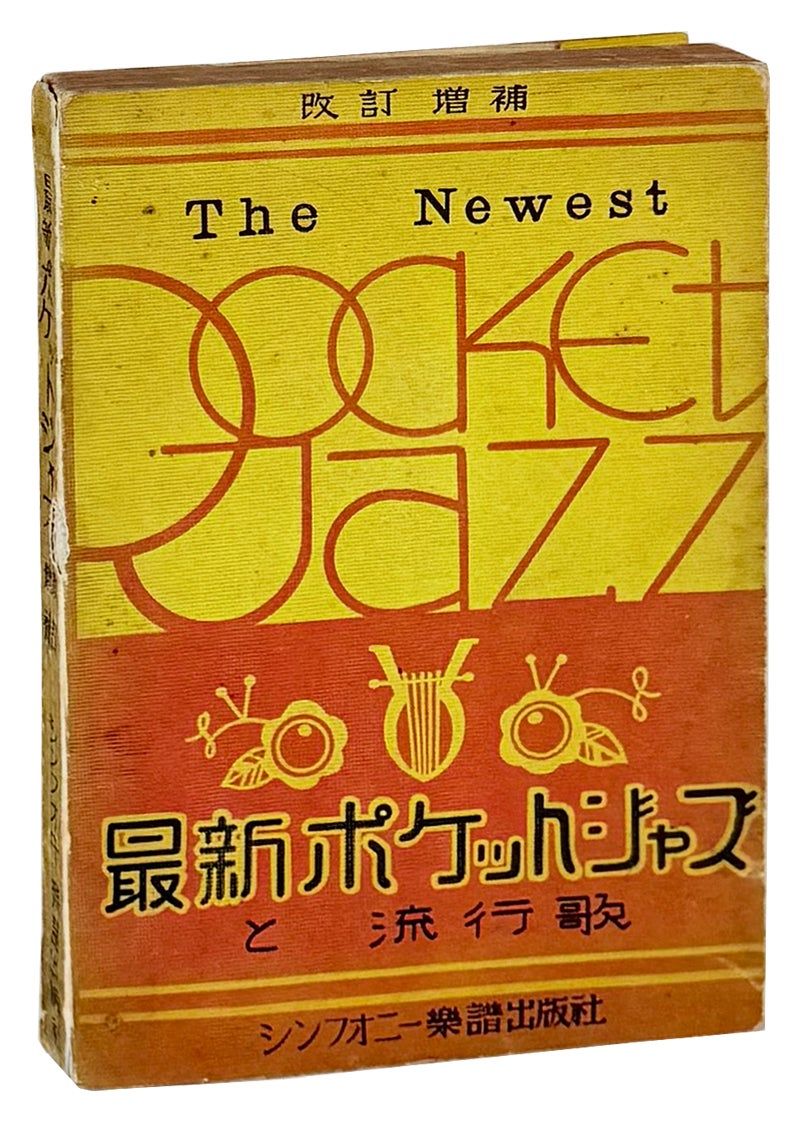
The Newest Pocket Jazz
- Tokyo: Symphony Publishing Company, 1938
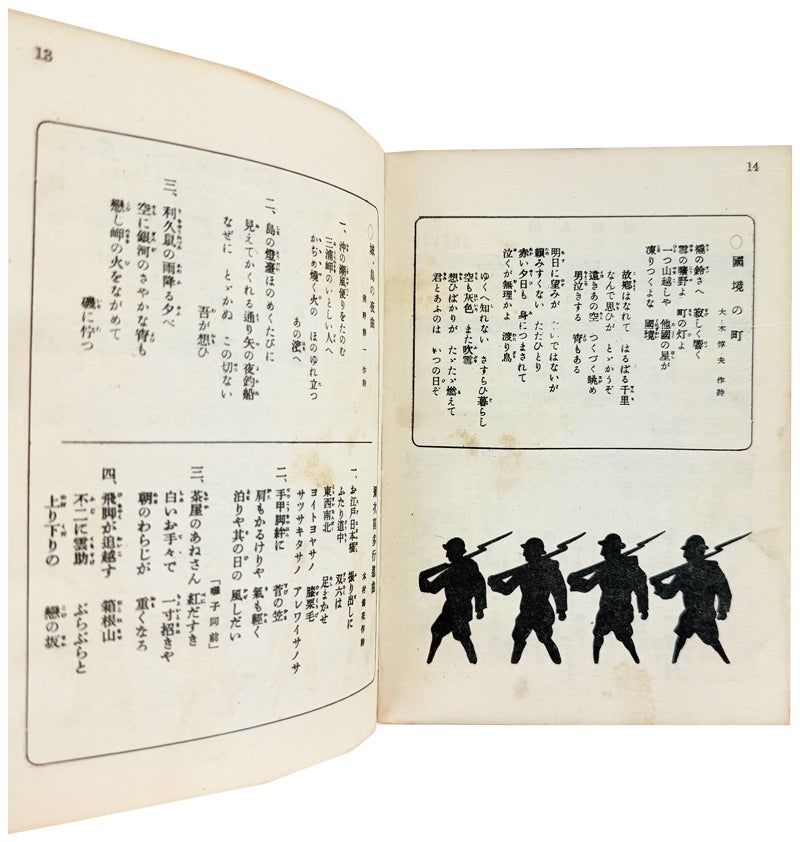
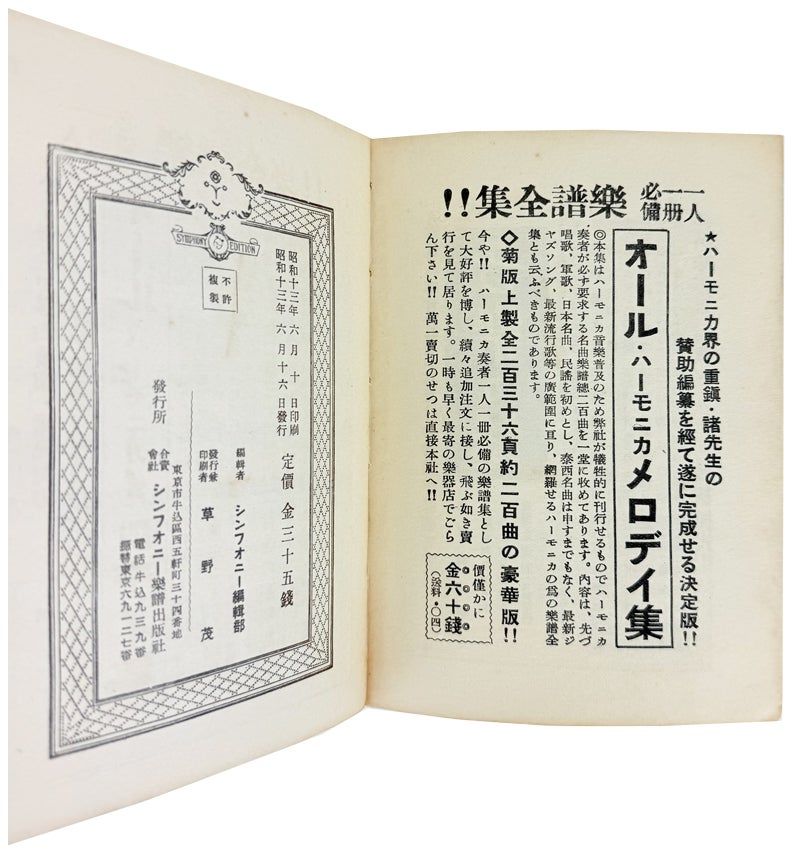
Tokyo: Symphony Publishing Company, 1938. Very Good. Tokyo: Symphony Publishing Company, 1938. Presumed First Edition. 12mo (15.5 cm); publisher's pictorial yellow and orange card wrappers lettered in black; 192,[3]pp.; brief illus., sheet music throughout. Moderate wear and dust-soiled to wrappers, small loss mid-spine briefly affecting text, textblock a bit browned and foxed, else Very Good, bright and sound.
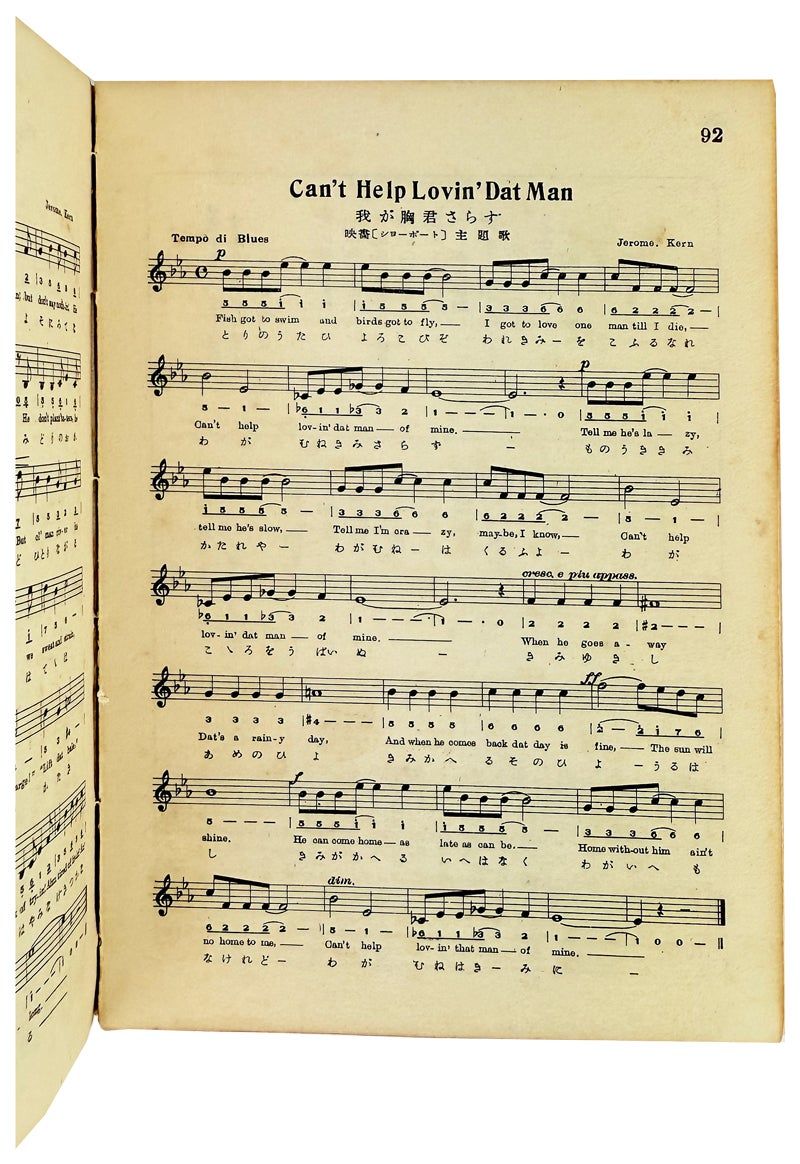
Evidently unrecorded Japanese guide to popular jazz music, the first half almost entirely in Japanese, the latter half bilingual, primarily in Japanese and English. Includes the music for classics by Jerome Kern like "Ol' Man River" and "Can't Help Lovin' Dat Man"; Romberg and Hammerstein's "Lover, Come Back To Me"; Moises Simons' Cuban rumba foxtrot "The Peanut Vendor"; instantly recognizable classics like "Blue Moon" and "La Cucaracha"; and songs by Mabel Wayne and Irving Berlin. The compilation also includes songs in Spanish, French, and German, accompanied by its Japanese translation.
A fascinating and beautiful little guide documenting the rise in popularity of Jazz music in Japan, and Tokyo in particular, issued between the devastating earthquake of 1923 and the beginning of World War II. The import of Jazz to Japan was first heralded with the rise in trans-Pacific luxury liners. A Japanese version of "My Blue Heaven" (reproduced here) became available as early as the 1920s and the popular 1929 Japanese film "Tokyo March" employed Jazz in its soundtrack. The genre was popular enough that Columbia and Victor records formed subsidiary companies in Japan.
The popularity of jazz in Japan continues to this day, touted by one of the country's most prominent public and literary figures, Haruki Murakami, who first opened his Jazz club right out of college after falling in love with the genre at an Art Blakey and the Jazz Messengers show in Kobe in 1964.
No copies of this work located in OCLC as of June, 2025.
References:
"How Japan Came To Love Jazz" (online interview with historian E. Taylor Atkins, author of "Blue Nippon")
"Jazz Messenger" by Haruki Murakami (available online).
Evidently unrecorded Japanese guide to popular jazz music, the first half almost entirely in Japanese, the latter half bilingual, primarily in Japanese and English. Includes the music for classics by Jerome Kern like "Ol' Man River" and "Can't Help Lovin' Dat Man"; Romberg and Hammerstein's "Lover, Come Back To Me"; Moises Simons' Cuban rumba foxtrot "The Peanut Vendor"; instantly recognizable classics like "Blue Moon" and "La Cucaracha"; and songs by Mabel Wayne and Irving Berlin. The compilation also includes songs in Spanish, French, and German, accompanied by its Japanese translation.
A fascinating and beautiful little guide documenting the rise in popularity of Jazz music in Japan, and Tokyo in particular, issued between the devastating earthquake of 1923 and the beginning of World War II. The import of Jazz to Japan was first heralded with the rise in trans-Pacific luxury liners. A Japanese version of "My Blue Heaven" (reproduced here) became available as early as the 1920s and the popular 1929 Japanese film "Tokyo March" employed Jazz in its soundtrack. The genre was popular enough that Columbia and Victor records formed subsidiary companies in Japan.
The popularity of jazz in Japan continues to this day, touted by one of the country's most prominent public and literary figures, Haruki Murakami, who first opened his Jazz club right out of college after falling in love with the genre at an Art Blakey and the Jazz Messengers show in Kobe in 1964.
No copies of this work located in OCLC as of June, 2025.
References:
"How Japan Came To Love Jazz" (online interview with historian E. Taylor Atkins, author of "Blue Nippon")
"Jazz Messenger" by Haruki Murakami (available online).