

Three Contracts Selling Plots of Land in Early Cobb County, Georgia, Following the Indian Removal Act
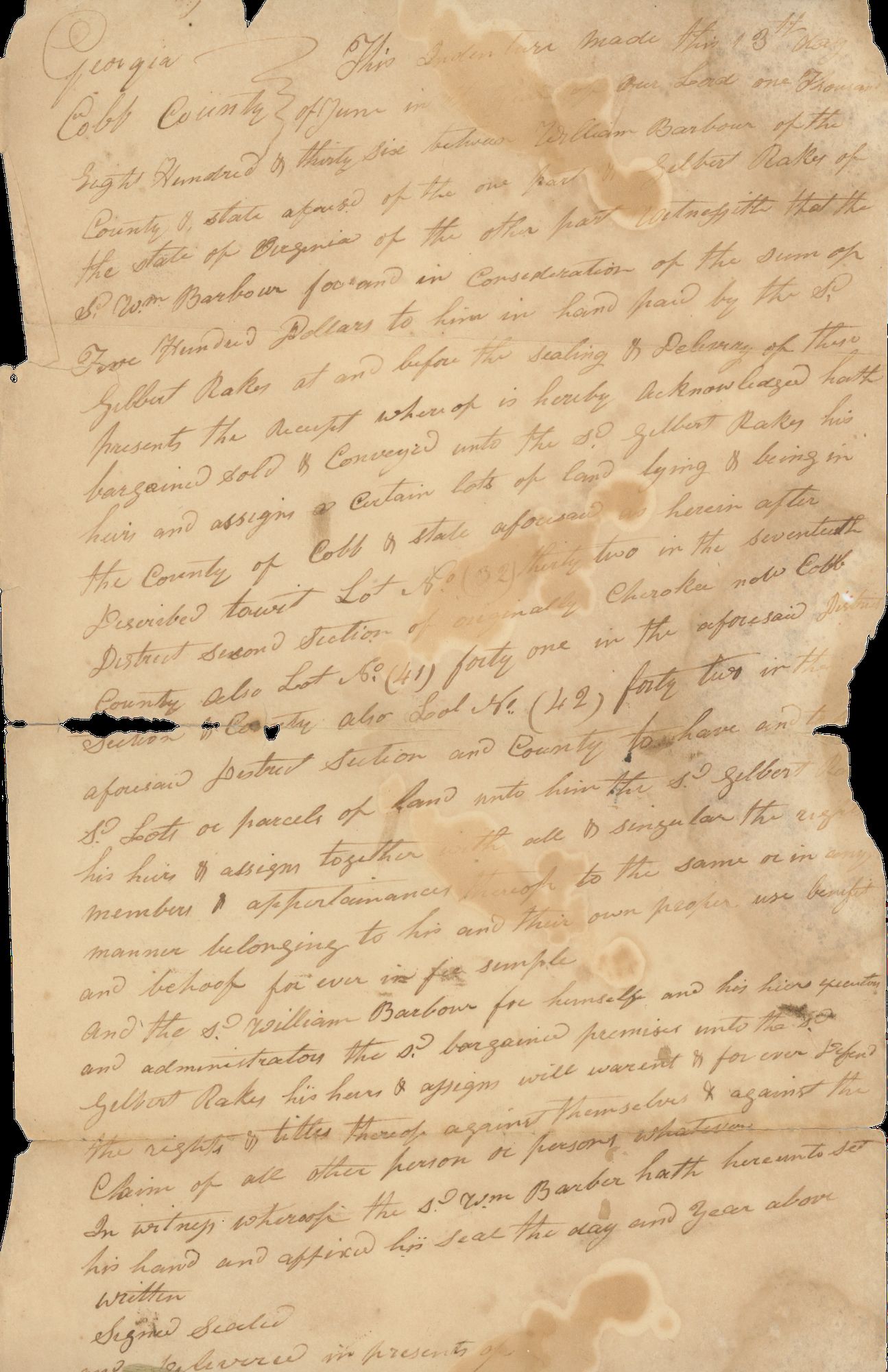
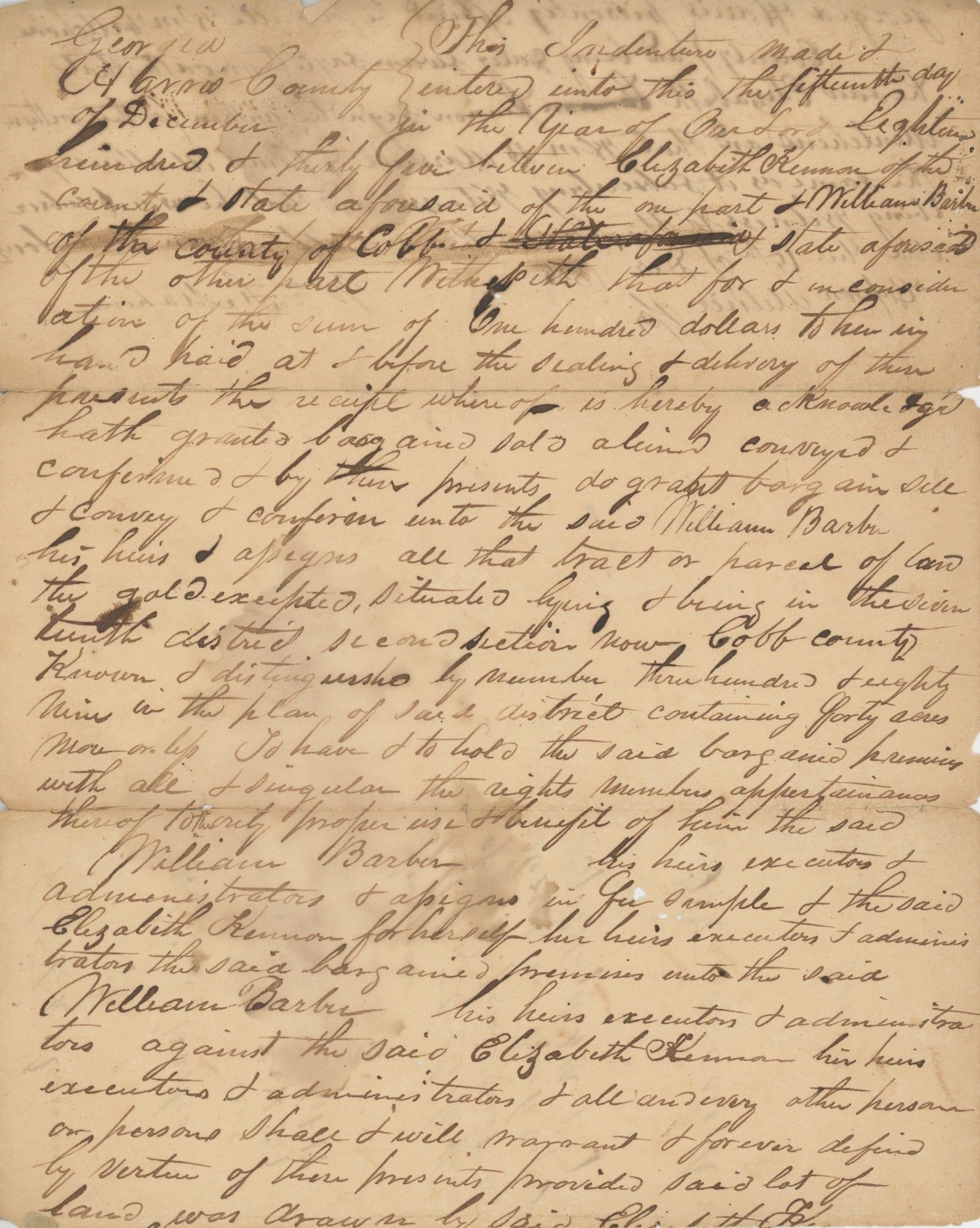
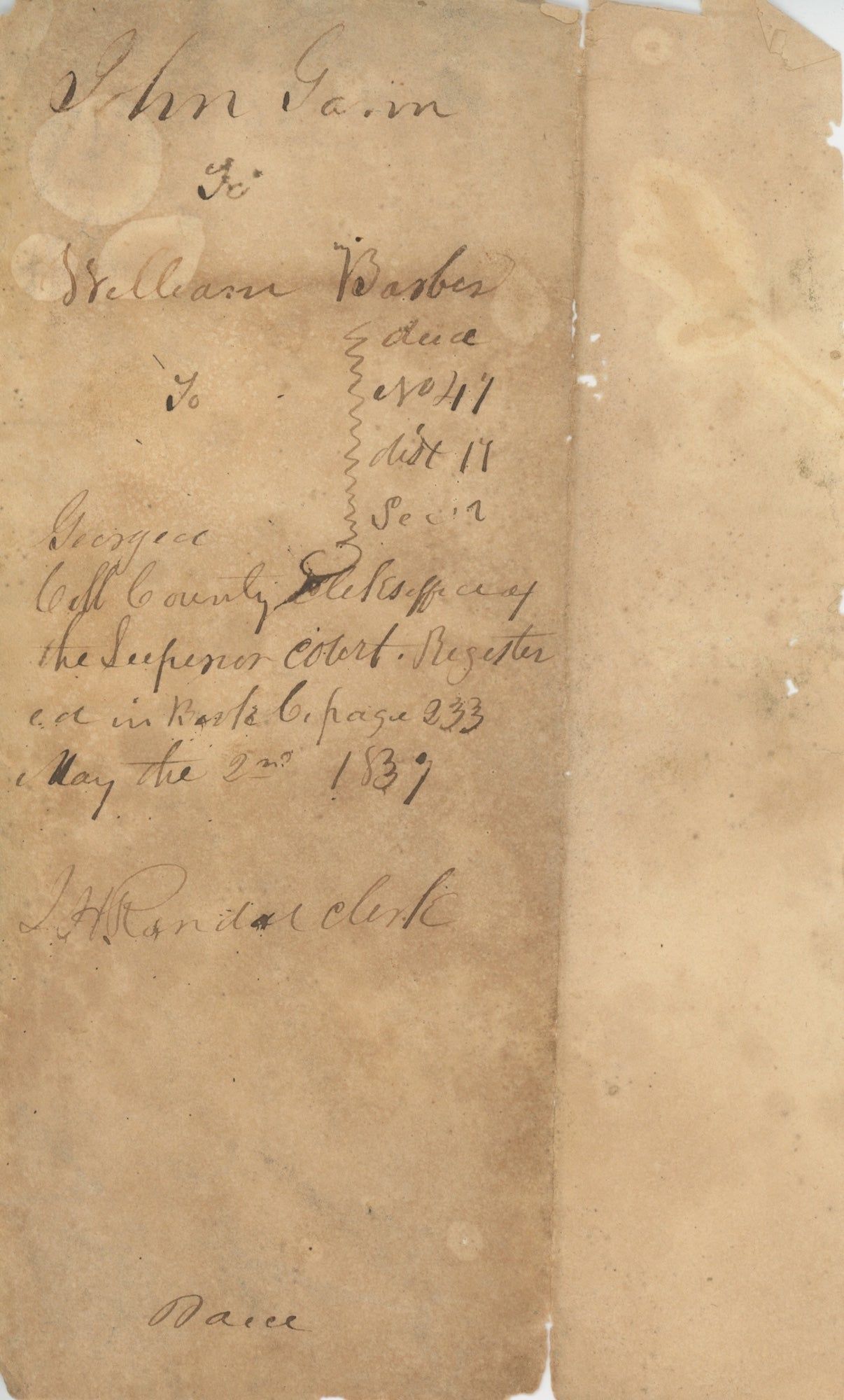
- Three documents. One four-page document measuring 5 x 8 ¾ inches, likely previously a single sheet; water stained with some tea
- Clarke, Cobb, and Harris Counties, Georgia , 1836
Clarke, Cobb, and Harris Counties, Georgia, 1836. Three documents. One four-page document measuring 5 x 8 ¾ inches, likely previously a single sheet; water stained with some tearing at folds, very good. One double-sided document measuring 8 x 10 inches; water stained and folded with large tears at folds, possibly with part missing, good. One single-sided document measuring 7 ¾ x 12 ¾ inches. Water stained and folded with large tears at folds, much damage to margins, good. Overall good.. Three legal documents in which William Barber buys and sells plots of land shortly following the establishment of Cobb County. In 1834 and 1835, Barber buys plots from John Gann and Elizabeth Kennon for $100 each, and in 1836 sells land to Gilbert Rake for $500. Gann is possibly the plantation owner, Cobb County pioneer, and State Senator.
These land contracts date to a time at which a small number of Cherokee—whose territory included present-day Cobb County—had voluntarily left the area following the Indian Removal Act of 1830, while a majority had not done so. The Indian Removal Act required Indigenous people east of the Mississippi River to cede their land to Euro-Americans and move west of it, to so-called Indian Territory (now Oklahoma). In 1835, the US government met with a group of Cherokee claiming to represent the tribe in New Echota, Georgia, and signed a removal treaty. When the majority of the tribe, viewing the treaty as illegitimate, refused to move voluntarily, the US government sent the military to intervene.
Of interest to historians of Cobb County and land dealings between its early Euro-American residents during the removal of its Indigenous population.
These land contracts date to a time at which a small number of Cherokee—whose territory included present-day Cobb County—had voluntarily left the area following the Indian Removal Act of 1830, while a majority had not done so. The Indian Removal Act required Indigenous people east of the Mississippi River to cede their land to Euro-Americans and move west of it, to so-called Indian Territory (now Oklahoma). In 1835, the US government met with a group of Cherokee claiming to represent the tribe in New Echota, Georgia, and signed a removal treaty. When the majority of the tribe, viewing the treaty as illegitimate, refused to move voluntarily, the US government sent the military to intervene.
Of interest to historians of Cobb County and land dealings between its early Euro-American residents during the removal of its Indigenous population.