

June 30, 1789 edition of the New-York Daily Gazette, with Reports on the French Revolution and Relations with Indigenous Americans, and Including an Advertisement for the Return of Two Escaped Enslaved Men

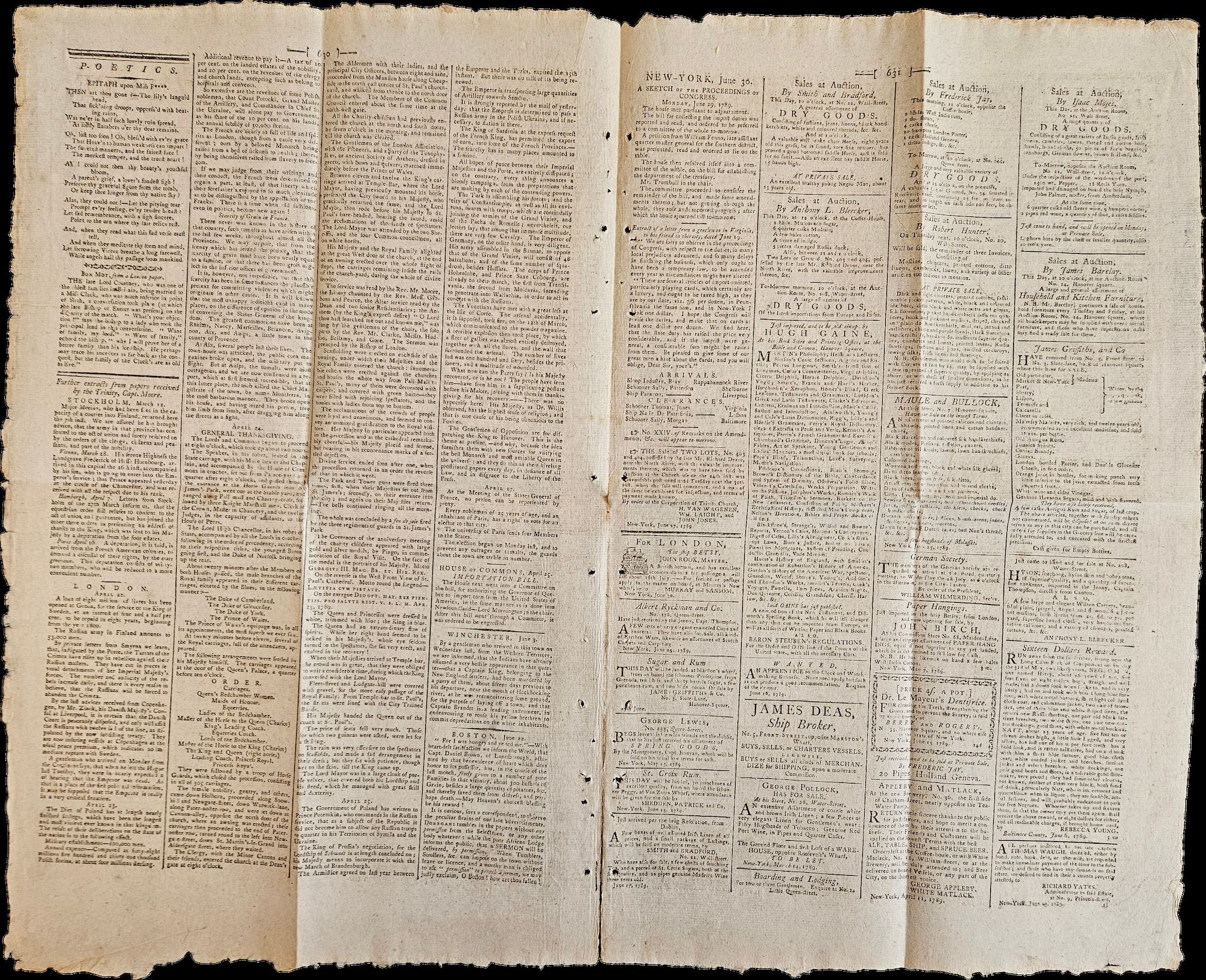
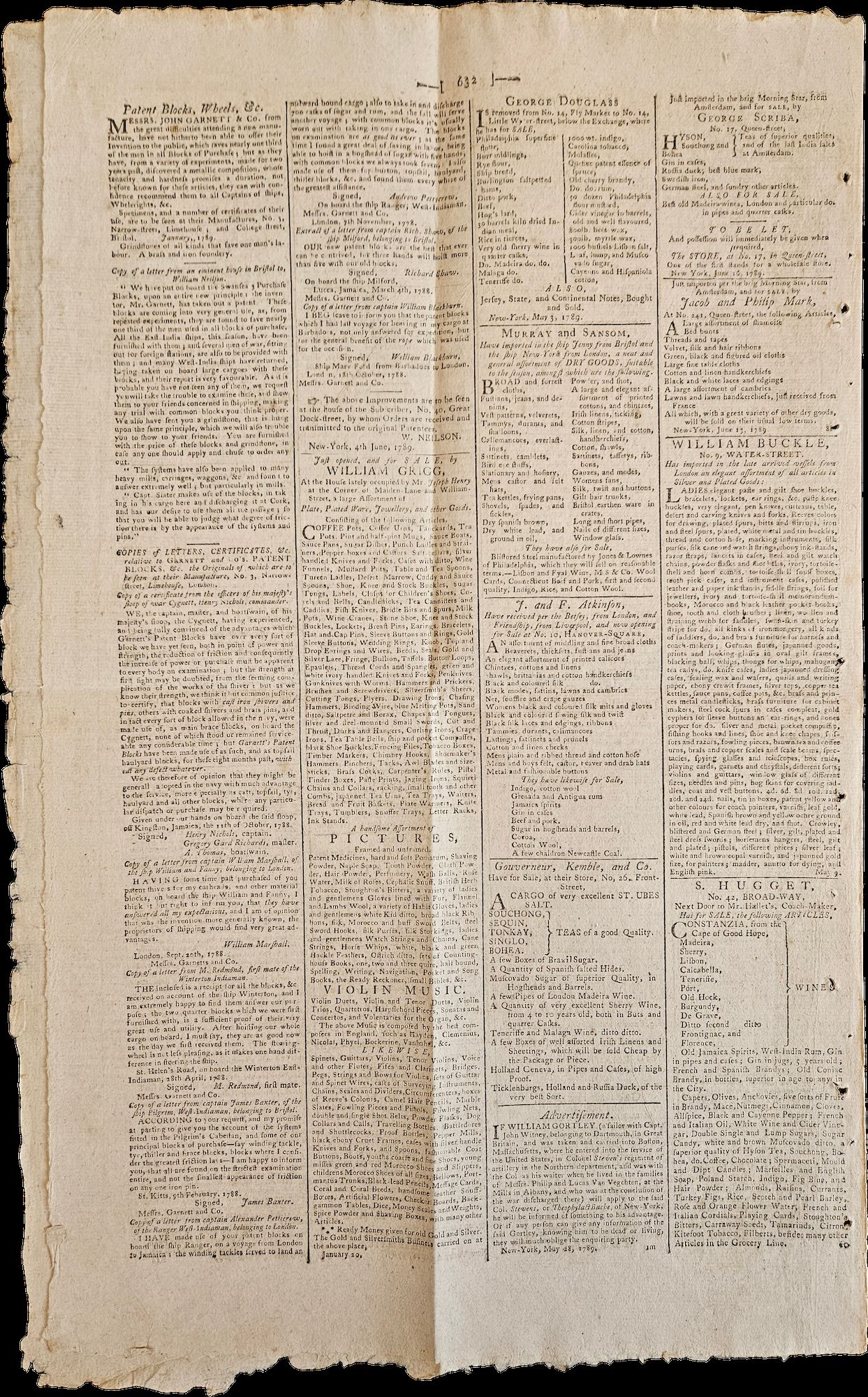
- Four pages measuring 12 ¼ x 9 ½ inches
- New York City: J. & A. M’Lean, 1789
New York City: J. & A. M’Lean, 1789. Four pages measuring 12 ¼ x 9 ½ inches. Marginal holes, folded with tear at central fold; else fine.. The New-York Daily Gazette was a newspaper published by J. and A. M’Lean, publishers best known for being the first to publish the collected Federalist papers in 1788. Of special interest in this edition of the Gazette are reports on the early days of the French Revolution and relations with Indigenous peoples in Ohio, and an advertisement for a reward of $16 for the return of two escaped enslaved men.
In France at the time, the Estates-General—wherein the National Assembly was formed—had just disbanded, and the Bastille had not yet been stormed. The Gazette’s report is baffled at the severity of violence in the country:
“There never was known in the history of that country, such tumults as have arisen within the last few weeks, throughout almost all the Provinces. We may suppose, that from the frenzy which has seized the people, that the scarcity of grain must have been nearly equal to a famine, or that there has been gross neglect in the inferior offices of governments. It is however, not impossible, but that this scarcity has been in some instances the plausible pretext for committing violences which might originate in other causes. It is well known that the most unhappy seditions exist in many places, on the difference of opinion in the mode of convening the States General of the kingdom. [...] At Alix, several people lost their lives. The town-house was attacked, the public corn magazines broke open, and the military put to flight. But at Aulps, the tumults were most outrageous, and we are now confirmed in a report, which at first seemed incredible, that at this latter place, the mob killed the Chief Magistrate of the town, by name Montserra, in the most barbarous manner. They broke open his house, and having seized his person, tore him limb from limb, after dragging him along the streets as a sight.”
The situation is violent back in the States as well. A report from the “Western Territory”—here, referring to the land that would become Ohio— tells of the “very hostile appearance” of the “Indians [...] in that quarter”:
“a Captain King, belonging to the New England settlers, had been murdered by a party of them, about fifteen days previous to his departure, near the mouth of the Hockhocking river, as he was reconnoitering some ground, for the purpose of laying off a town, and that Captain Brandtt [sic] is a leading instrument, in endeavouring to rouse his yellow bretheren to commit depredations on the white inhabitants.”
New Englanders, the first Euro-Americans to settle Ohio, had begun to do so only a year prior, when Ebenezer Sproat, Rufus Putnam, and others established the town of Marietta. By “Captain Brandtt”, the Gazette is likely referring to Thayendanegea, also known as Joseph Brant (1743–1807), a Mohawk political and military leader who allied with Great Britain during the American Revolution. Thayendanegea had recently met in Michigan with leaders from a number of Indigenous nations, and released a declaration that the Ohio River would be the eastern boundary of their territory.
Lastly, an advertisement promises a $16 reward for the return “home” of two fugitive enslaved men:
“Run away from the subscriber, living near the Long Calm Fork of Gunpowder on Sunday the 31st of May, to young NEGRO MEN, one named Harry, about 26 years of age, five feet seven or eight inches high, straight and well made, has a down look when spoke to, and is very lively [...] NATT, about 23 years of age, five feet ten or eleven inches high, a little bow legged, and very active, has lost one of his upper fore teeth has a bold look, and is rather talkative [...] neither of them very black, both fond of drink, particularly Natt, who is impertinent and quarrelsome when in liquor; they are sensible, artful fellows, and will probably endeavour to pass for free Negroes.”.
In France at the time, the Estates-General—wherein the National Assembly was formed—had just disbanded, and the Bastille had not yet been stormed. The Gazette’s report is baffled at the severity of violence in the country:
“There never was known in the history of that country, such tumults as have arisen within the last few weeks, throughout almost all the Provinces. We may suppose, that from the frenzy which has seized the people, that the scarcity of grain must have been nearly equal to a famine, or that there has been gross neglect in the inferior offices of governments. It is however, not impossible, but that this scarcity has been in some instances the plausible pretext for committing violences which might originate in other causes. It is well known that the most unhappy seditions exist in many places, on the difference of opinion in the mode of convening the States General of the kingdom. [...] At Alix, several people lost their lives. The town-house was attacked, the public corn magazines broke open, and the military put to flight. But at Aulps, the tumults were most outrageous, and we are now confirmed in a report, which at first seemed incredible, that at this latter place, the mob killed the Chief Magistrate of the town, by name Montserra, in the most barbarous manner. They broke open his house, and having seized his person, tore him limb from limb, after dragging him along the streets as a sight.”
The situation is violent back in the States as well. A report from the “Western Territory”—here, referring to the land that would become Ohio— tells of the “very hostile appearance” of the “Indians [...] in that quarter”:
“a Captain King, belonging to the New England settlers, had been murdered by a party of them, about fifteen days previous to his departure, near the mouth of the Hockhocking river, as he was reconnoitering some ground, for the purpose of laying off a town, and that Captain Brandtt [sic] is a leading instrument, in endeavouring to rouse his yellow bretheren to commit depredations on the white inhabitants.”
New Englanders, the first Euro-Americans to settle Ohio, had begun to do so only a year prior, when Ebenezer Sproat, Rufus Putnam, and others established the town of Marietta. By “Captain Brandtt”, the Gazette is likely referring to Thayendanegea, also known as Joseph Brant (1743–1807), a Mohawk political and military leader who allied with Great Britain during the American Revolution. Thayendanegea had recently met in Michigan with leaders from a number of Indigenous nations, and released a declaration that the Ohio River would be the eastern boundary of their territory.
Lastly, an advertisement promises a $16 reward for the return “home” of two fugitive enslaved men:
“Run away from the subscriber, living near the Long Calm Fork of Gunpowder on Sunday the 31st of May, to young NEGRO MEN, one named Harry, about 26 years of age, five feet seven or eight inches high, straight and well made, has a down look when spoke to, and is very lively [...] NATT, about 23 years of age, five feet ten or eleven inches high, a little bow legged, and very active, has lost one of his upper fore teeth has a bold look, and is rather talkative [...] neither of them very black, both fond of drink, particularly Natt, who is impertinent and quarrelsome when in liquor; they are sensible, artful fellows, and will probably endeavour to pass for free Negroes.”.