

1899 Letter from a Soldier on His Way to the Philippines Describing Sri Lanka, Singapore, and Life Aboard the Transport Ship


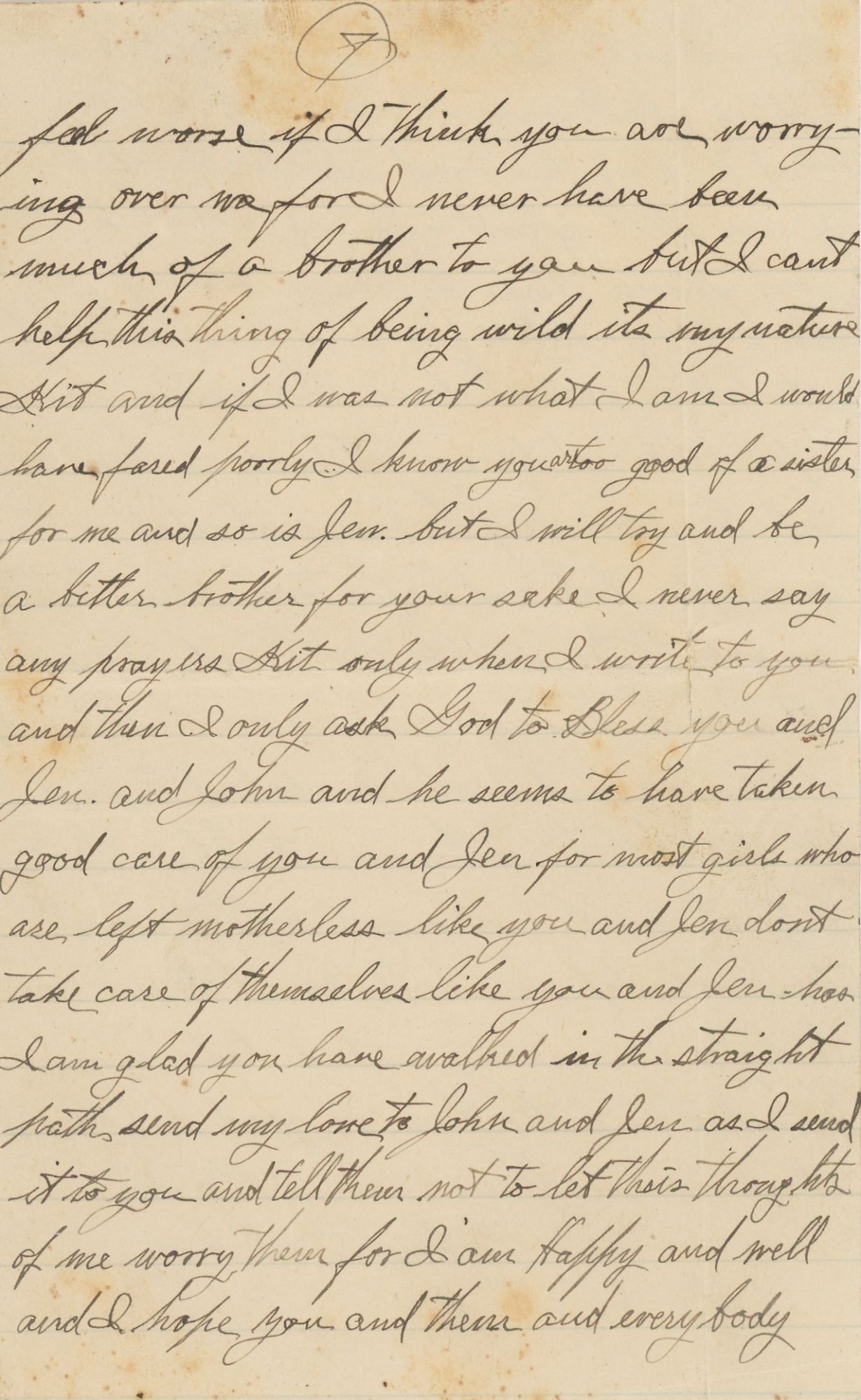
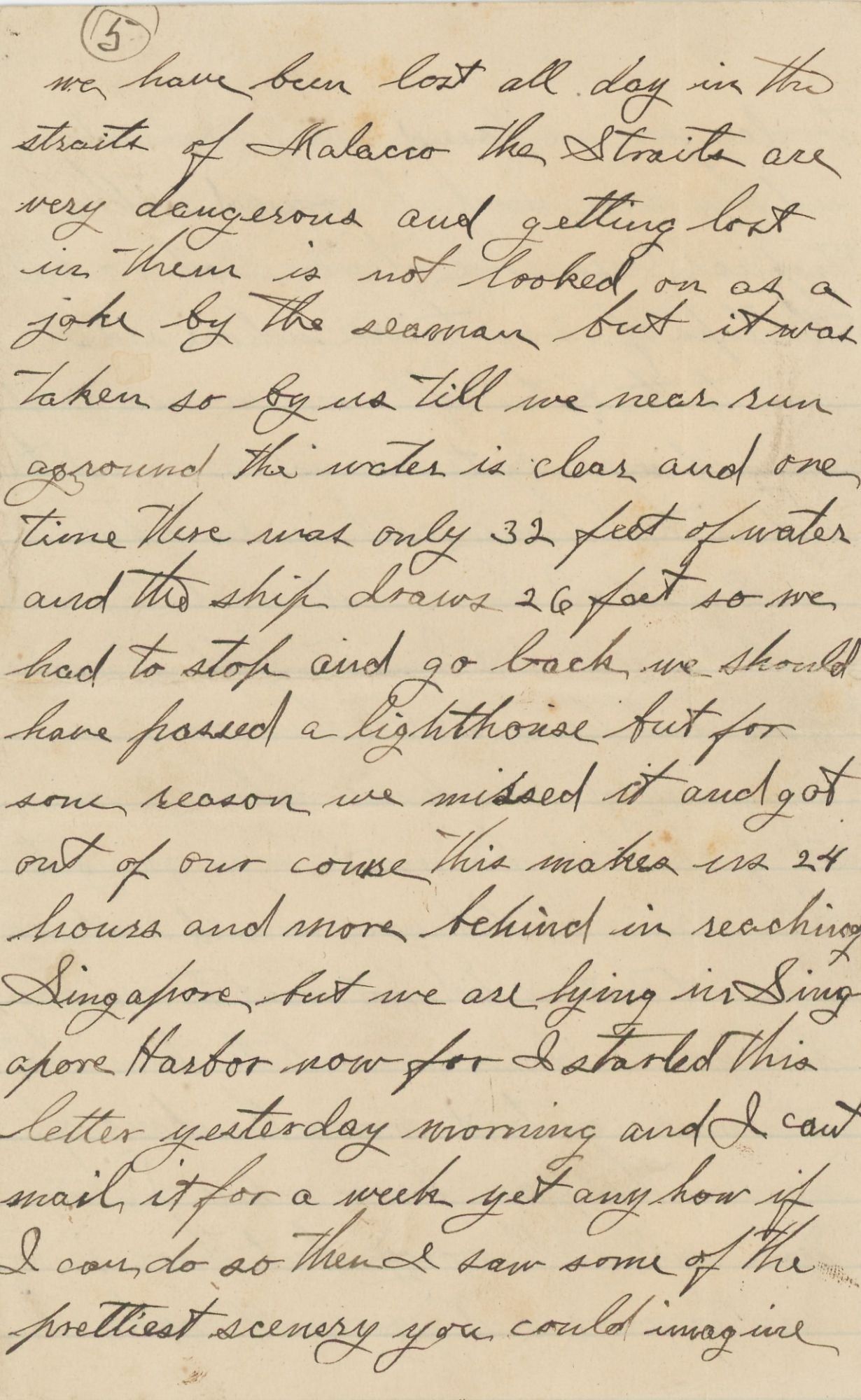


- Eight-page single letter of two double-sided pages measuring 7 ¾ x 10 inches and two double sided pages measuring 4 ½ x 7 inch
- Malacca Strait , 1899
Malacca Strait, 1899. Eight-page single letter of two double-sided pages measuring 7 ¾ x 10 inches and two double sided pages measuring 4 ½ x 7 inches. Folded with small tears at folds; near fine.. A letter from James McIntyre (1874–deceased) to his sister Kit, sent from aboard the transport ship Grant on the way to the Philippines in March of 1899. McIntyre, who enlisted in Pittsburgh in July 1898, had just passed Sri Lanka and was traveling through the Malacca Strait on his way to Singapore, their last stop before Manila. McIntyre describes his impressions of the region and the locals, and the attitudes of his fellow soldiers.
The previous week, the Grant had stopped at Colombo in Sri Lanka (then British Ceylon):
“it is a nice place where the Elephant is used in place of horses and they had all kinds of tropical fruits that we could buy for a song and you ought to have heard some of the Hindoes sing the song of Tarra Ra boom Dea and Daisy Bell and several other popular songs we could understand each other quite well when they tried to speak English but when they spoke their native tongue it was the same as Dutch to us”.
Note that, by “Hindoes,” McIntyre probably just means Sri Lankans generally, not Tamils in particular. In Sri Lanka, as in other places along their route, the locals would impress the American soldiers by diving for coins:
“since we left Gibraltar the poorer of natives would swim to our ship and holler trow shiney me dive in ketch im then some one would throw a nickel or a dime and they would go under the water and they seldom came up without the coin that was thrown”.
McIntyre, seemingly in a bid to reassure his sister, explains to her that the soldiers see the war as a game or joke:
“we are doing our best to get to the Philipines so we can take hand in the game they are playing over there what do you think of the war in the Philipines we take it as a joke and I dont think that there is a soldier on this boat who is sorry he came although every body is not looking for a chance to go home again some one will be sure to get back and my chance is as good as any we laugh and joke with [each] other about getting shot so dont think I am not taking the best of it and I will continue to enjoy my self till a Philipine stops me if one should be so fortunate”.
He also jokes about the food on board:
“there are a great many other dishes that are new to me that I never heard of before I came in the Army here is another dish we only got on Geo. Washingtons Birthday it is called ‘Cosomme’, which is a french word for Slum you take one doz. of broken skylights and four bbls. of Whitewash one Tea spoonfull of baking powder and stir one half doz. assorted railroad tunnels in serve this on crutches if I dont stop here you will be leaving home to join the Army”.
Meanwhile, the ship had missed a lighthouse and “been lost all day in the straits of Malacco” (Malacca), which was “taken [as a joke] by us till we near run aground”. In the strait are “a great many Chinese boats”, and the men are entertained by “the capers the Chinese cut”. When they finally reach Singapore, McIntyre is impressed by how advanced it is:
“I have been writing since before dark and during that time we have run into Singapore one of the boys just asked me to come up on deck and see the town when he told me of the Electric lights and Trowley [trolley] Cars I told him he was trying to guy me but he said it was true and I was surprised to find it true but this is the nearest like a U.S. City at night I saw yet”.
Of interest to historians of the Philippine-American war, especially American soldiers’ attitudes towards the conflict.
The previous week, the Grant had stopped at Colombo in Sri Lanka (then British Ceylon):
“it is a nice place where the Elephant is used in place of horses and they had all kinds of tropical fruits that we could buy for a song and you ought to have heard some of the Hindoes sing the song of Tarra Ra boom Dea and Daisy Bell and several other popular songs we could understand each other quite well when they tried to speak English but when they spoke their native tongue it was the same as Dutch to us”.
Note that, by “Hindoes,” McIntyre probably just means Sri Lankans generally, not Tamils in particular. In Sri Lanka, as in other places along their route, the locals would impress the American soldiers by diving for coins:
“since we left Gibraltar the poorer of natives would swim to our ship and holler trow shiney me dive in ketch im then some one would throw a nickel or a dime and they would go under the water and they seldom came up without the coin that was thrown”.
McIntyre, seemingly in a bid to reassure his sister, explains to her that the soldiers see the war as a game or joke:
“we are doing our best to get to the Philipines so we can take hand in the game they are playing over there what do you think of the war in the Philipines we take it as a joke and I dont think that there is a soldier on this boat who is sorry he came although every body is not looking for a chance to go home again some one will be sure to get back and my chance is as good as any we laugh and joke with [each] other about getting shot so dont think I am not taking the best of it and I will continue to enjoy my self till a Philipine stops me if one should be so fortunate”.
He also jokes about the food on board:
“there are a great many other dishes that are new to me that I never heard of before I came in the Army here is another dish we only got on Geo. Washingtons Birthday it is called ‘Cosomme’, which is a french word for Slum you take one doz. of broken skylights and four bbls. of Whitewash one Tea spoonfull of baking powder and stir one half doz. assorted railroad tunnels in serve this on crutches if I dont stop here you will be leaving home to join the Army”.
Meanwhile, the ship had missed a lighthouse and “been lost all day in the straits of Malacco” (Malacca), which was “taken [as a joke] by us till we near run aground”. In the strait are “a great many Chinese boats”, and the men are entertained by “the capers the Chinese cut”. When they finally reach Singapore, McIntyre is impressed by how advanced it is:
“I have been writing since before dark and during that time we have run into Singapore one of the boys just asked me to come up on deck and see the town when he told me of the Electric lights and Trowley [trolley] Cars I told him he was trying to guy me but he said it was true and I was surprised to find it true but this is the nearest like a U.S. City at night I saw yet”.
Of interest to historians of the Philippine-American war, especially American soldiers’ attitudes towards the conflict.