

Archive of Letters, with Some Photographs, of Scottish-Canadian Farmer James Macfarlane and His Nephew Dr. Alexander Macfarlane, With Much Concerning Farming in Ontario and the Founding of the University of Dundee


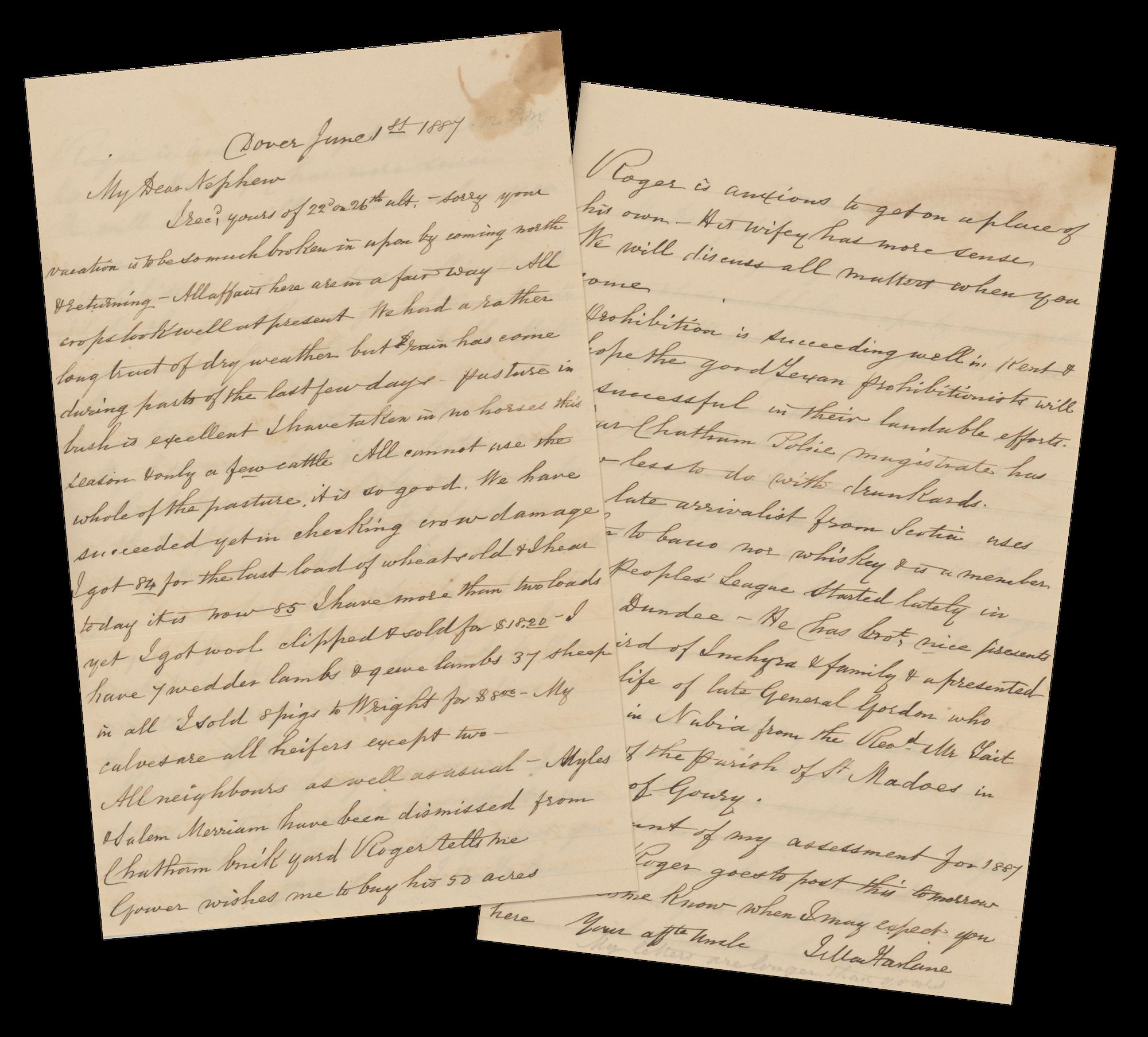
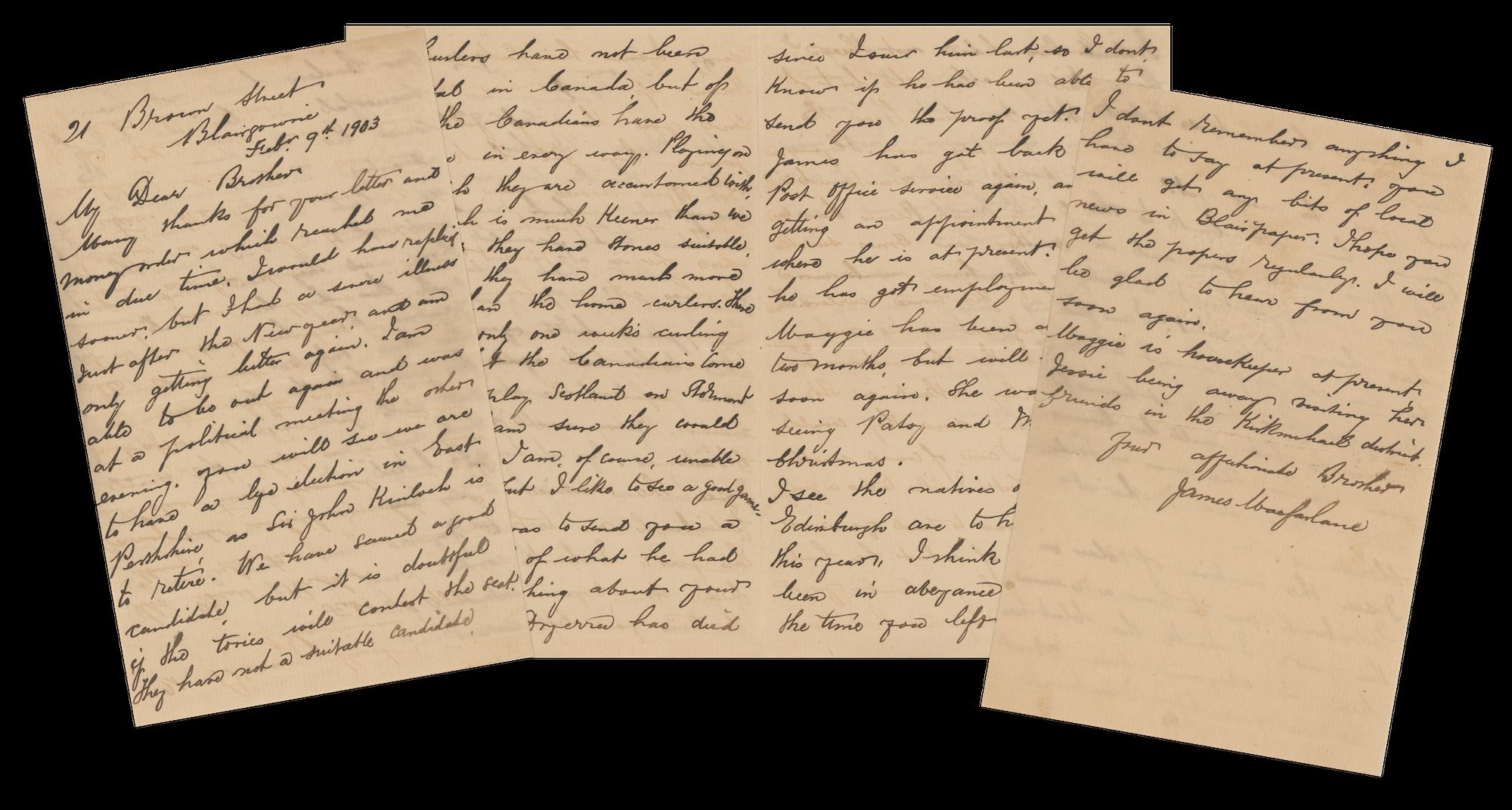
- Seventy-eight pieces: seven 2.5 x 4” photographs mounted on heavy cardstock; with seventeen letters from Alexander to James Ma
- Dover and Chatham, Ontario; Edinburgh and Blairgowrie, Scotland , 1903
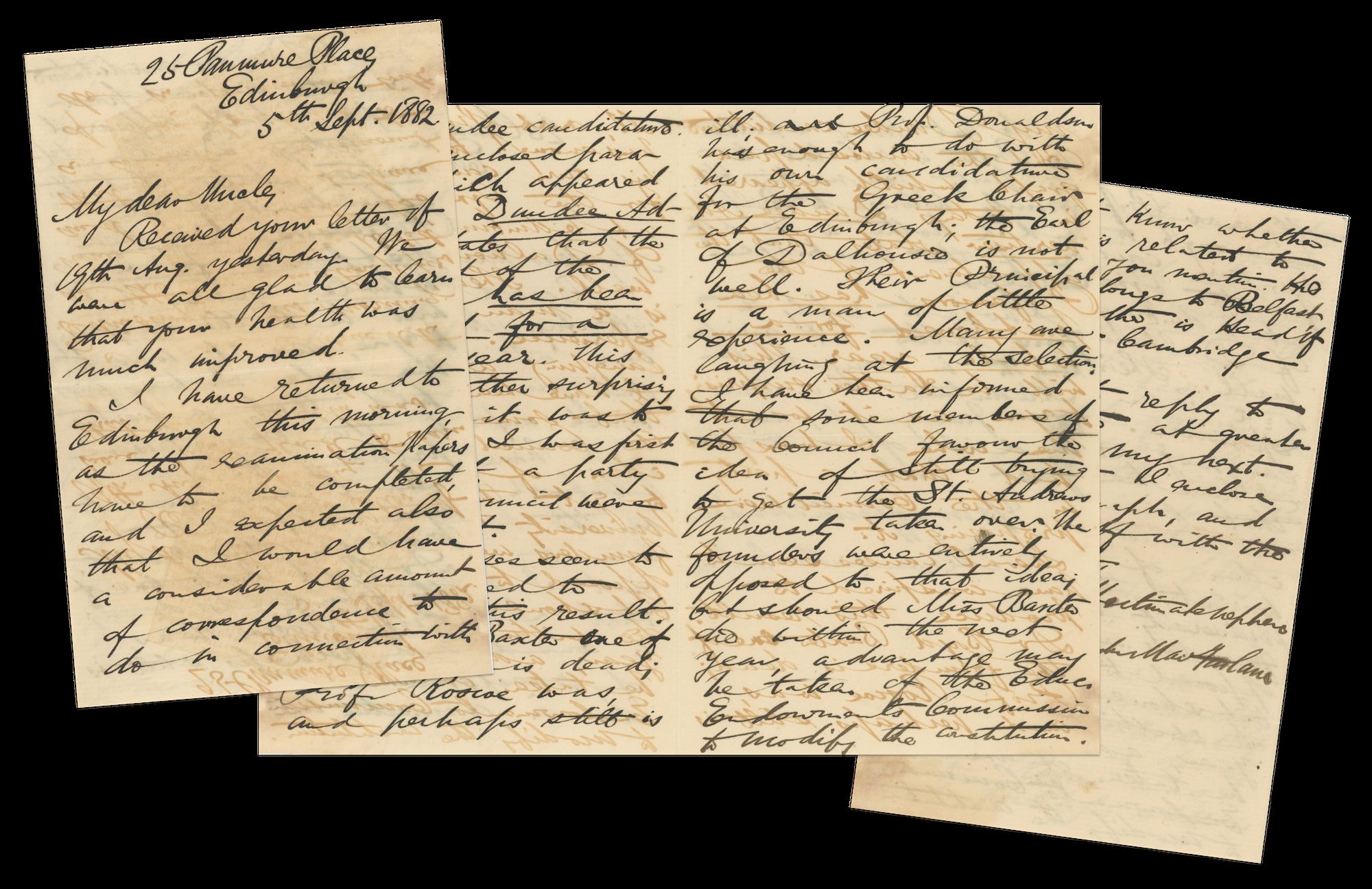
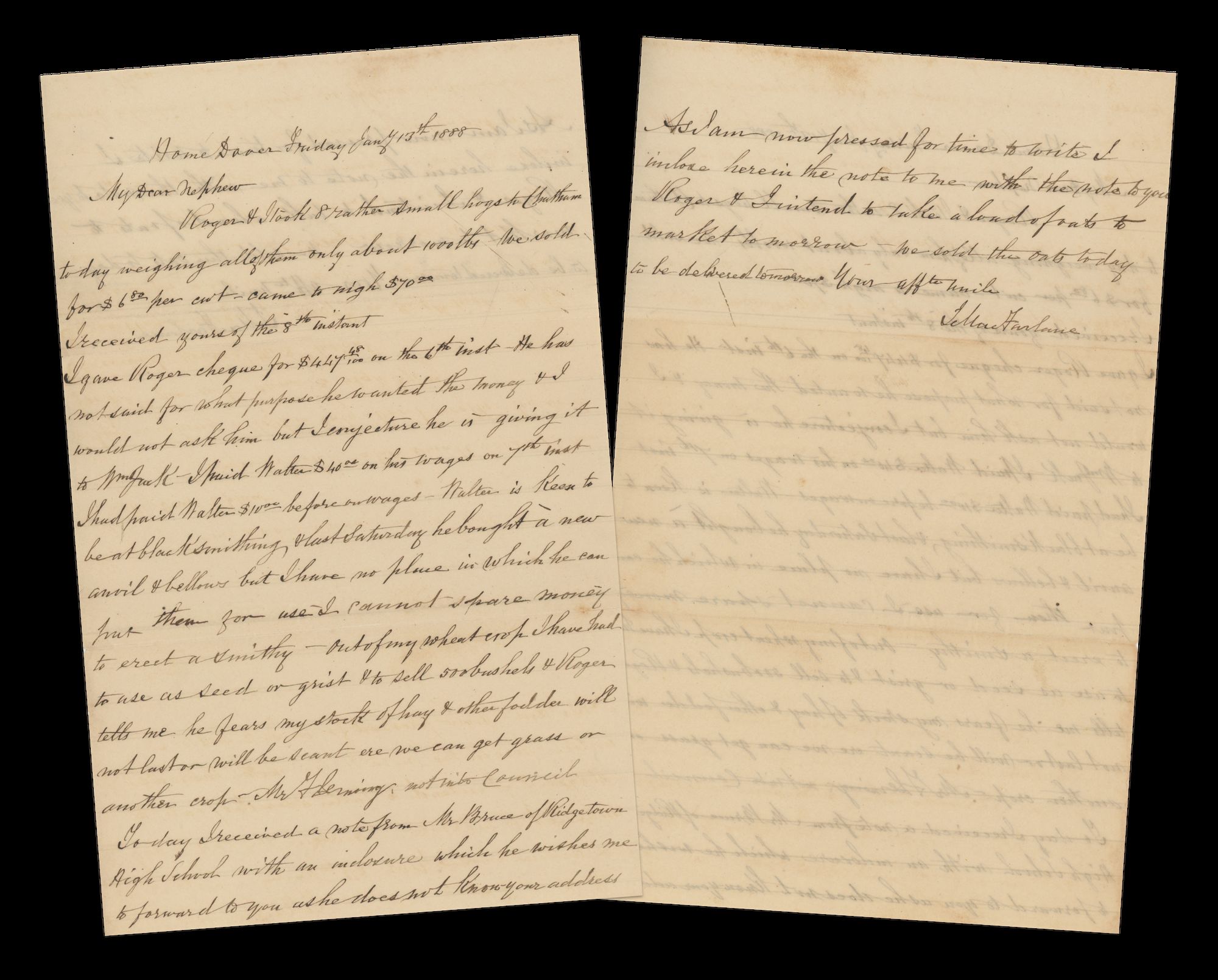
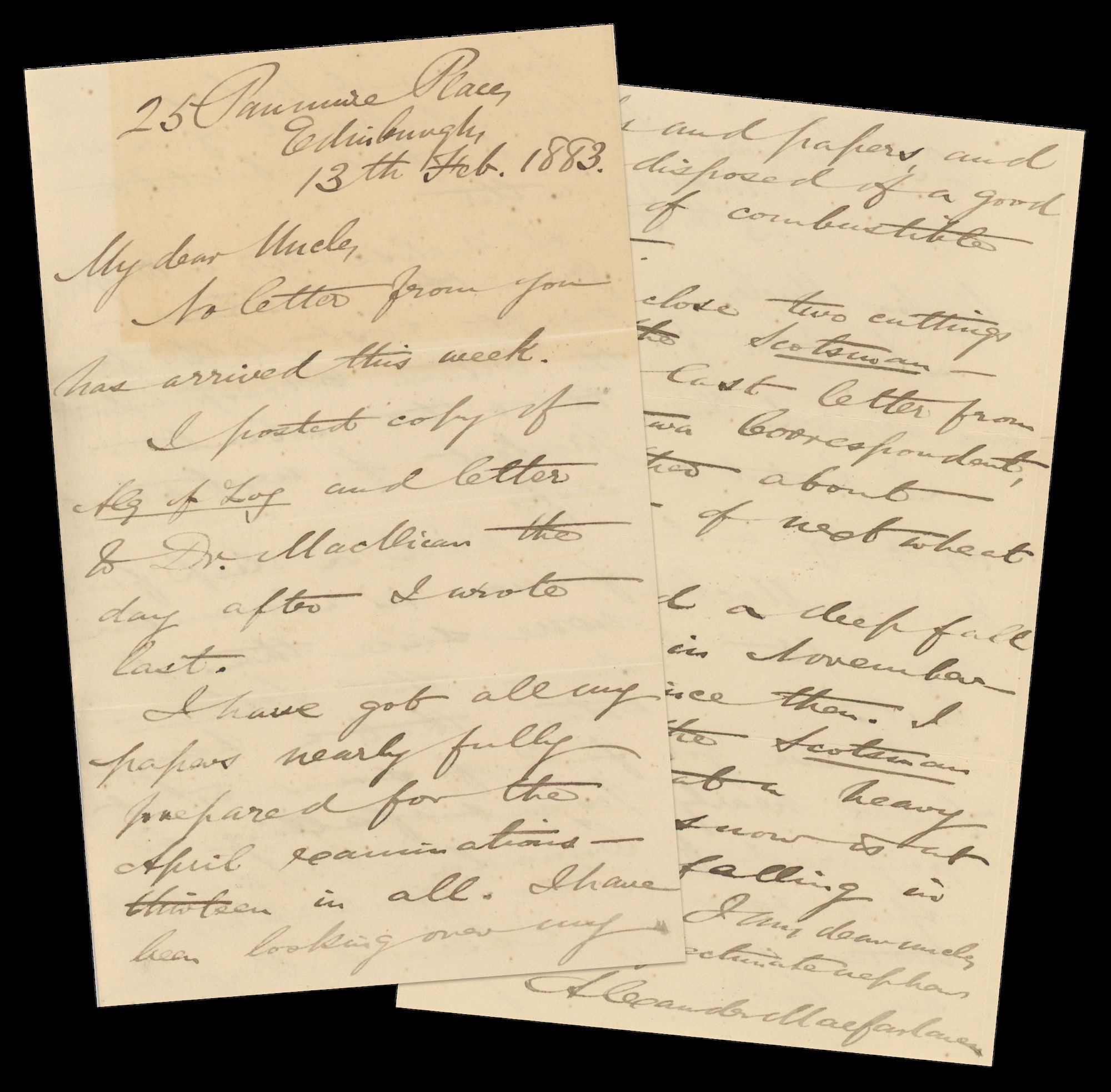
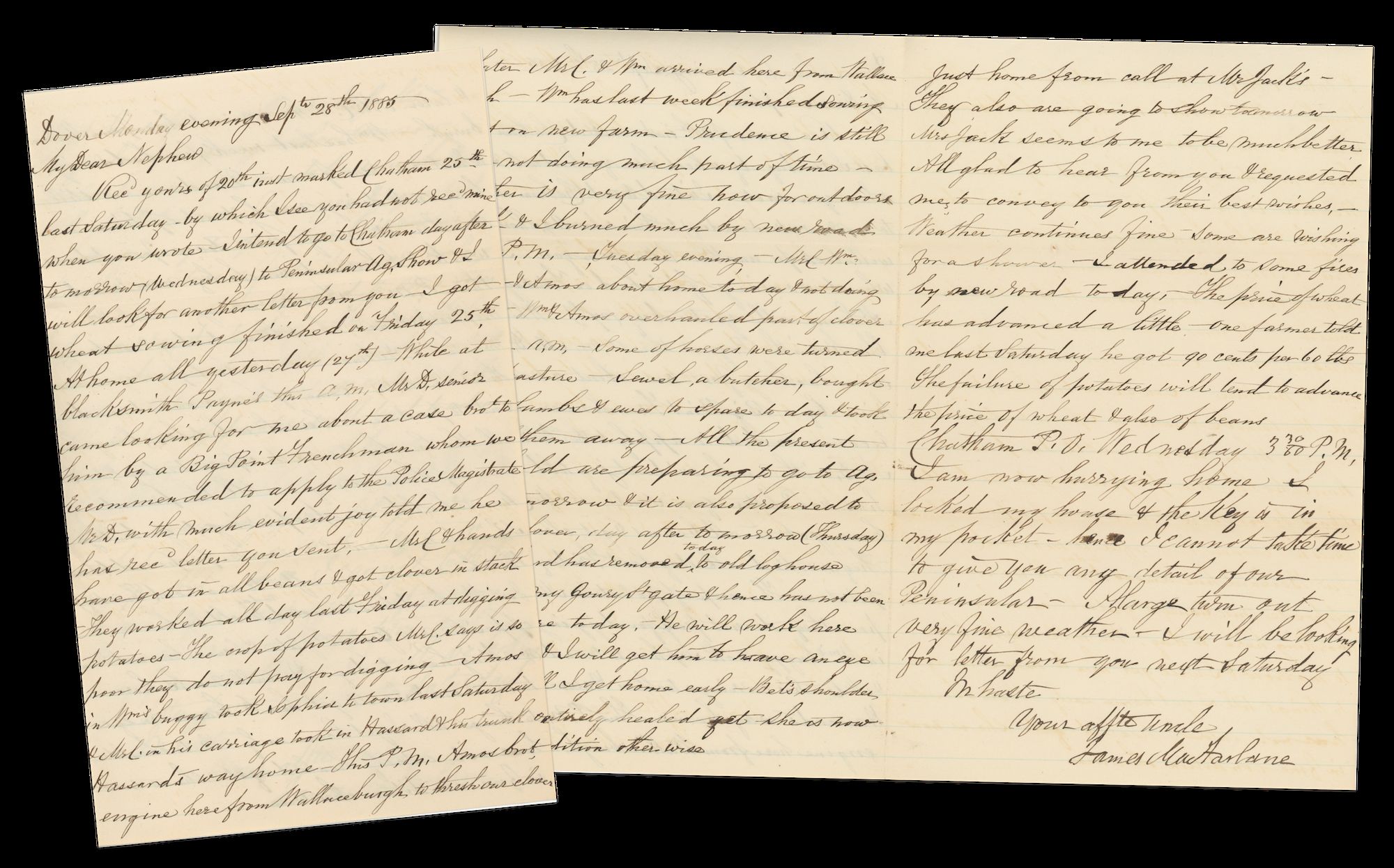
Dover and Chatham, Ontario; Edinburgh and Blairgowrie, Scotland, 1903. Seventy-eight pieces: seven 2.5 x 4” photographs mounted on heavy cardstock; with seventeen letters from Alexander to James Macfarlane, fifty-two from James to Alexander Macfarlane, and two from others to Alexander Macfarlane. Fourteen from 1853–1882; eleven from 1883–1885; thirteen from 1886; twelve from 1887; thirteen from 1888; eight from 1889–1903. Sorted chronologically. Envelopes good to very good; letters generally near fine.. Alexander Macfarlane (1851–1913) was a Scottish physicist, mathematician, and logician. He earned a D.Sc. from the University of Edinburgh in 1878; following this, he would teach at the University of St. Andrews, the University of Edinburgh, the University of Texas at Austin, and Lehigh University. Macfarlane earned a number of accolades, including elections to many scientific and mathematical societies and an honorary doctorate from the University of Michigan. After his retirement in 1894, Alexander Macfarlane moved to a farm in Ontario left to him by his uncle James, who is his correspondent herein. Much less is known about James Macfarlane; born in Scotland in 1806, he immigrated to North America by way of New York in 1835. He purchased land in Dover Township (now Chatham) Ontario in 1853, and was elected the town’s reeve in 1879. At the time of this correspondence, he was a farmer by occupation. The photographs in the collection—portraits of unknown individuals—are likely his, as they are from photography studios in the Brantford and Toronto area and seem to date from before Alexander Macfarlane’s arrival in the colony.
James Macfarlane’s letters to his nephew, mainly written between 1886 and 1889, give detailed descriptions of farm life and logistics in 19th-century Ontario. He grew corn, wheat, beans, clover, and hay, raised pigs and cows, and kept a number of workhorses alongside a few seasonal employees. The elder Macfarlane describes the state of his crops, the health of his animals, and especially his finances, taxes, and employees’ wages; he writes of “a constant fear of running aground” (March 17, 1887). However, he also occasionally discusses academic or political affairs – it is unclear what education Macfarlane had, or what political experience besides his reeveship, but from his writing it seems not insignificant. One prohibition-related incident in 1887 especially stands out:
“During the night between last Saturday & Sunday there was a dynamite explosion in front of the handsome residence of H. Cummings Esq. of Chatham – damage but no one hurt[.] It is believed it was the doing of the Chatham grogocracy – Mr. C. favours prohibition – Tories do not”. (August 10, 1887)
This letter dates the incident to late on the 6th or early on the 7th of August, 1887; we do not find the explosion mentioned in local newspapers from the time.
Alexander Macfarlane’s letters, which comprise most of the earlier letters in the group, focus on his burgeoning academic career. In 1882, when the majority of his letters were written, he had applied and was waiting to hear about a position as Chair of Mathematics at University College Dundee (now the University of Dundee), which was then just being formed. Besides occasional discussions of work in which he is currently engaged, Macfarlane writes about his tactics for bettering his chances at the Chair; for example:
“I have just received some information, which indicates that I shall have an excellent chance of being successful. Rev. Mr. Tait, who was our minister before he left Blairgowrie for Newport (opposite Dundee) happens to be a very intimate friend of the founder of the College, Miss Baxter of Balgavies. I saw from the first that it would be important to secure his cooperation; he has been very active in his support. Recently he was staying at Balgavies, and when the College was discussed he spoke highly in my favour. He has persuaded Miss Baxter to take some active steps in my favour. Copies of all the applications, etc. are sent to her, which seems to indicate that a proposed appointment is submitted to her for approval.” (September 19, 1882)
The wait is difficult for Macfarlane, and he frequently comments with displeasure on related workplace politics. For instance, he is upset by the choice of William Peterson—whom he describes as “a fop” (October 3, 1882)—for Principal of the new university:
“[Peterson] had this advantage that many of the electors had a bias in favour of a Classical man for the office [of Principal]. He got only a second class at Oxford. I say nothing on the subject, but I have heard others express an opinion that a mistake has been made.” (August 13, 1882)
And later:
“Most people express themselves as greatly surprised at the choice the Dundee Council made of a Principal. My theory of the matter is that Professor Donaldson with the view of furthering his own candidature wished to ingratiate himself with Professor Sellars after he saw that Mr Porter would not be accepted by the Council. I feel that the Council may do anything, as they seem nearly incapable of forming an independent opinion.” (September 27, 1882)
When he does not receive the Chair, Macfarlane shares his thoughts with his uncle about the state of Scottish Universities, especially that they “have no reputation for scholarship” and that the Scottish people “need not expect learning to flourish at their Universities” (November 23, 1882).
Of course, Macfarlane’s career turned out fine despite this setback; in 1895 he tells James, not unfairly, that “I am considered one of the foremost thinkers of the day in the field of exact science” (March 21).
Overall, a look at the lives and activities of an uncle and nephew with extremely different careers; of interest both to scholars of Ontario history and farming and to historians of science and higher education.
James Macfarlane’s letters to his nephew, mainly written between 1886 and 1889, give detailed descriptions of farm life and logistics in 19th-century Ontario. He grew corn, wheat, beans, clover, and hay, raised pigs and cows, and kept a number of workhorses alongside a few seasonal employees. The elder Macfarlane describes the state of his crops, the health of his animals, and especially his finances, taxes, and employees’ wages; he writes of “a constant fear of running aground” (March 17, 1887). However, he also occasionally discusses academic or political affairs – it is unclear what education Macfarlane had, or what political experience besides his reeveship, but from his writing it seems not insignificant. One prohibition-related incident in 1887 especially stands out:
“During the night between last Saturday & Sunday there was a dynamite explosion in front of the handsome residence of H. Cummings Esq. of Chatham – damage but no one hurt[.] It is believed it was the doing of the Chatham grogocracy – Mr. C. favours prohibition – Tories do not”. (August 10, 1887)
This letter dates the incident to late on the 6th or early on the 7th of August, 1887; we do not find the explosion mentioned in local newspapers from the time.
Alexander Macfarlane’s letters, which comprise most of the earlier letters in the group, focus on his burgeoning academic career. In 1882, when the majority of his letters were written, he had applied and was waiting to hear about a position as Chair of Mathematics at University College Dundee (now the University of Dundee), which was then just being formed. Besides occasional discussions of work in which he is currently engaged, Macfarlane writes about his tactics for bettering his chances at the Chair; for example:
“I have just received some information, which indicates that I shall have an excellent chance of being successful. Rev. Mr. Tait, who was our minister before he left Blairgowrie for Newport (opposite Dundee) happens to be a very intimate friend of the founder of the College, Miss Baxter of Balgavies. I saw from the first that it would be important to secure his cooperation; he has been very active in his support. Recently he was staying at Balgavies, and when the College was discussed he spoke highly in my favour. He has persuaded Miss Baxter to take some active steps in my favour. Copies of all the applications, etc. are sent to her, which seems to indicate that a proposed appointment is submitted to her for approval.” (September 19, 1882)
The wait is difficult for Macfarlane, and he frequently comments with displeasure on related workplace politics. For instance, he is upset by the choice of William Peterson—whom he describes as “a fop” (October 3, 1882)—for Principal of the new university:
“[Peterson] had this advantage that many of the electors had a bias in favour of a Classical man for the office [of Principal]. He got only a second class at Oxford. I say nothing on the subject, but I have heard others express an opinion that a mistake has been made.” (August 13, 1882)
And later:
“Most people express themselves as greatly surprised at the choice the Dundee Council made of a Principal. My theory of the matter is that Professor Donaldson with the view of furthering his own candidature wished to ingratiate himself with Professor Sellars after he saw that Mr Porter would not be accepted by the Council. I feel that the Council may do anything, as they seem nearly incapable of forming an independent opinion.” (September 27, 1882)
When he does not receive the Chair, Macfarlane shares his thoughts with his uncle about the state of Scottish Universities, especially that they “have no reputation for scholarship” and that the Scottish people “need not expect learning to flourish at their Universities” (November 23, 1882).
Of course, Macfarlane’s career turned out fine despite this setback; in 1895 he tells James, not unfairly, that “I am considered one of the foremost thinkers of the day in the field of exact science” (March 21).
Overall, a look at the lives and activities of an uncle and nephew with extremely different careers; of interest both to scholars of Ontario history and farming and to historians of science and higher education.