

Joseph II. And His Court [Four Volumes in One]
![Joseph II. And His Court [Four Volumes in One]](https://d3525k1ryd2155.cloudfront.net/h/319/556/1687556319.0.x.jpg)
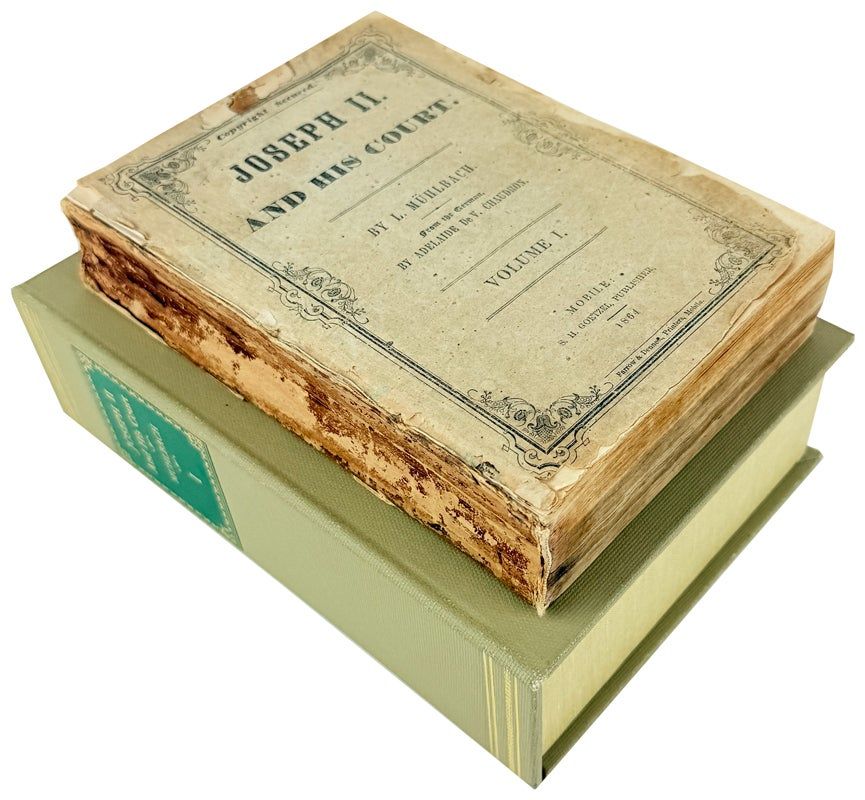
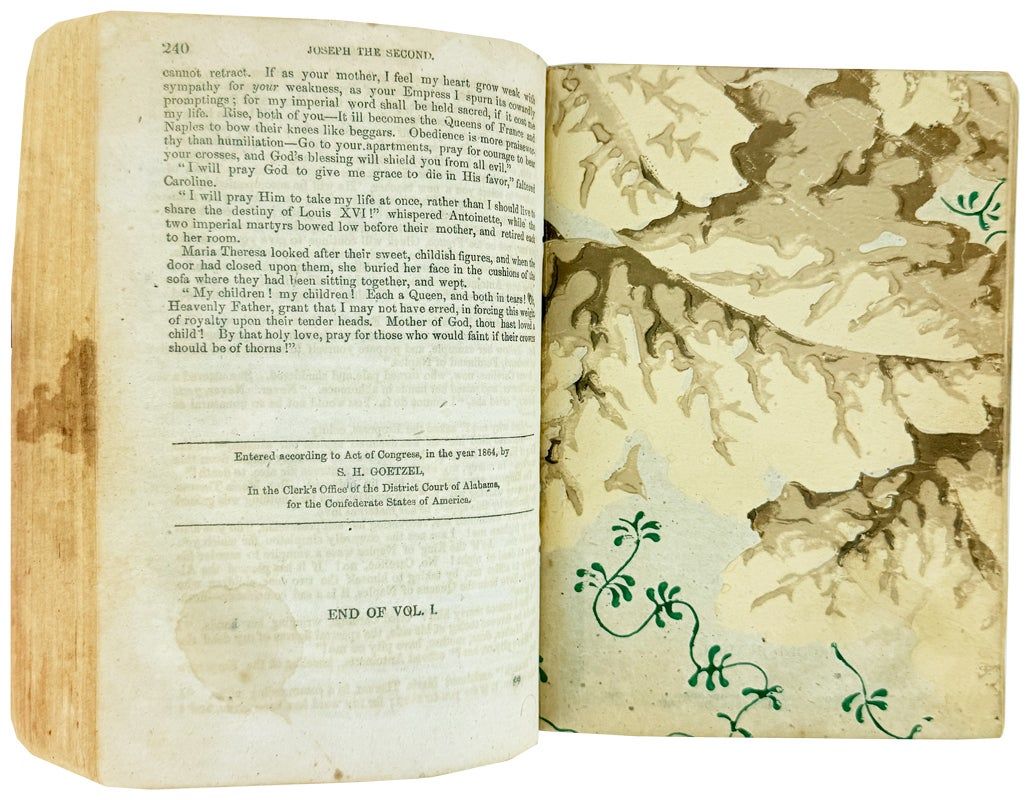
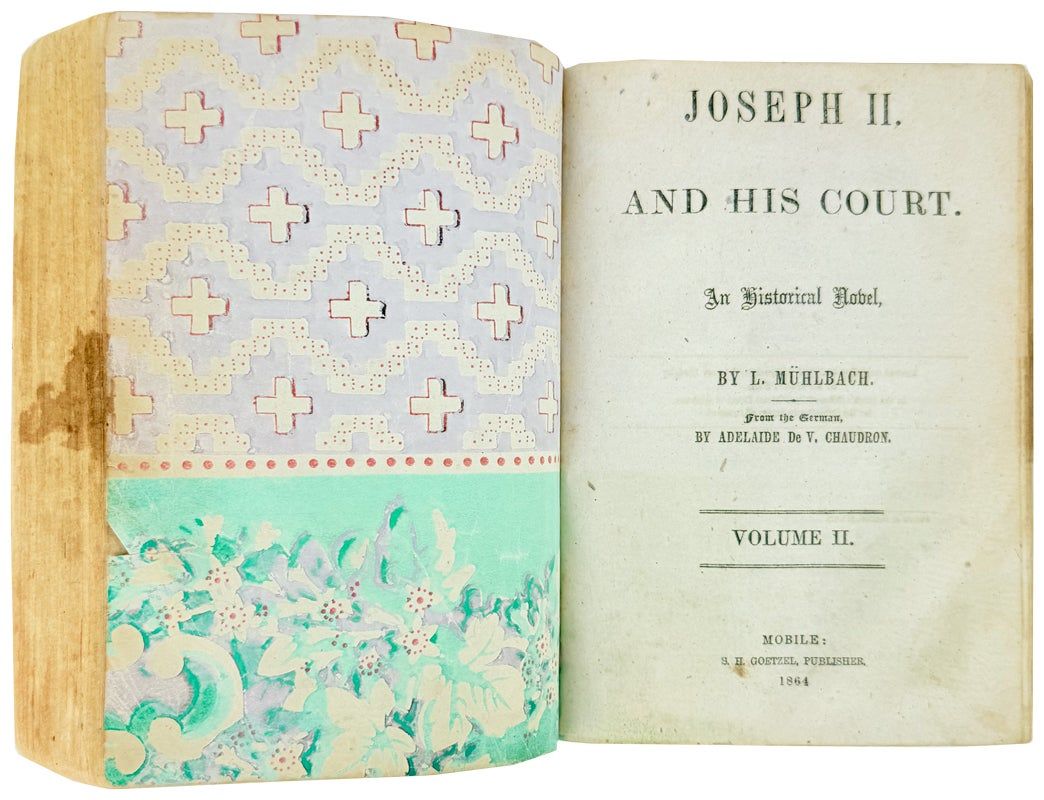
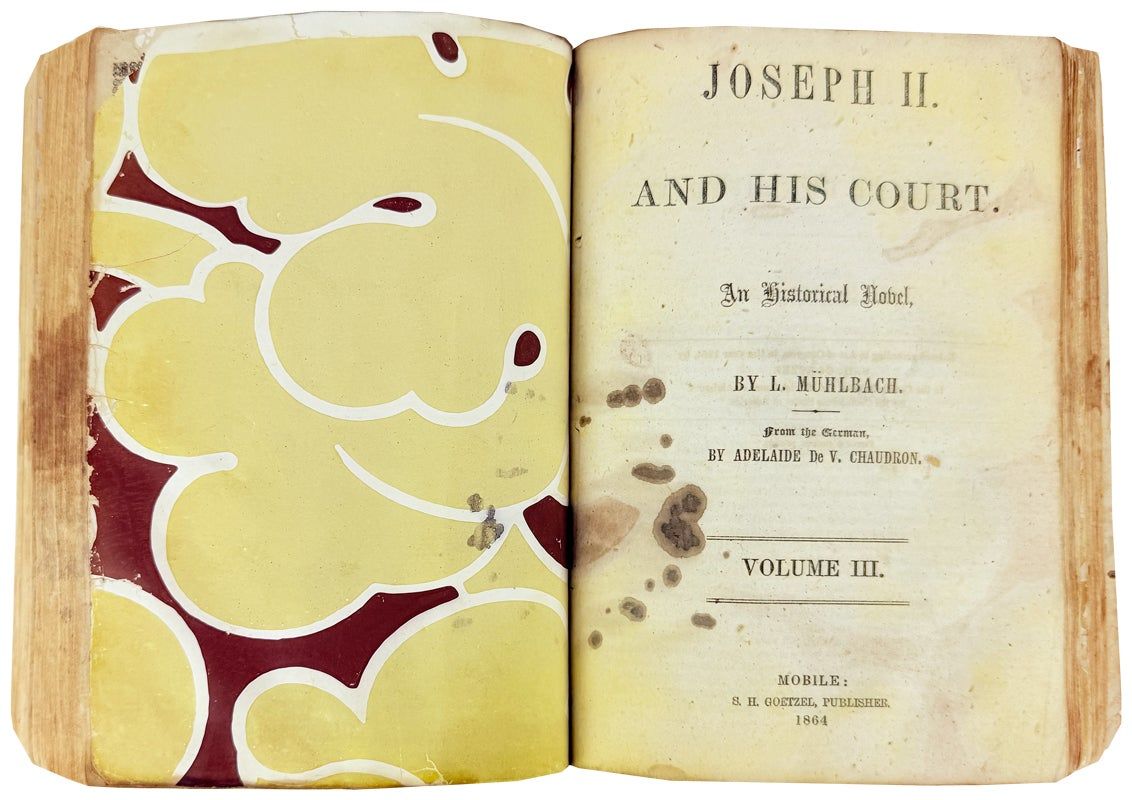
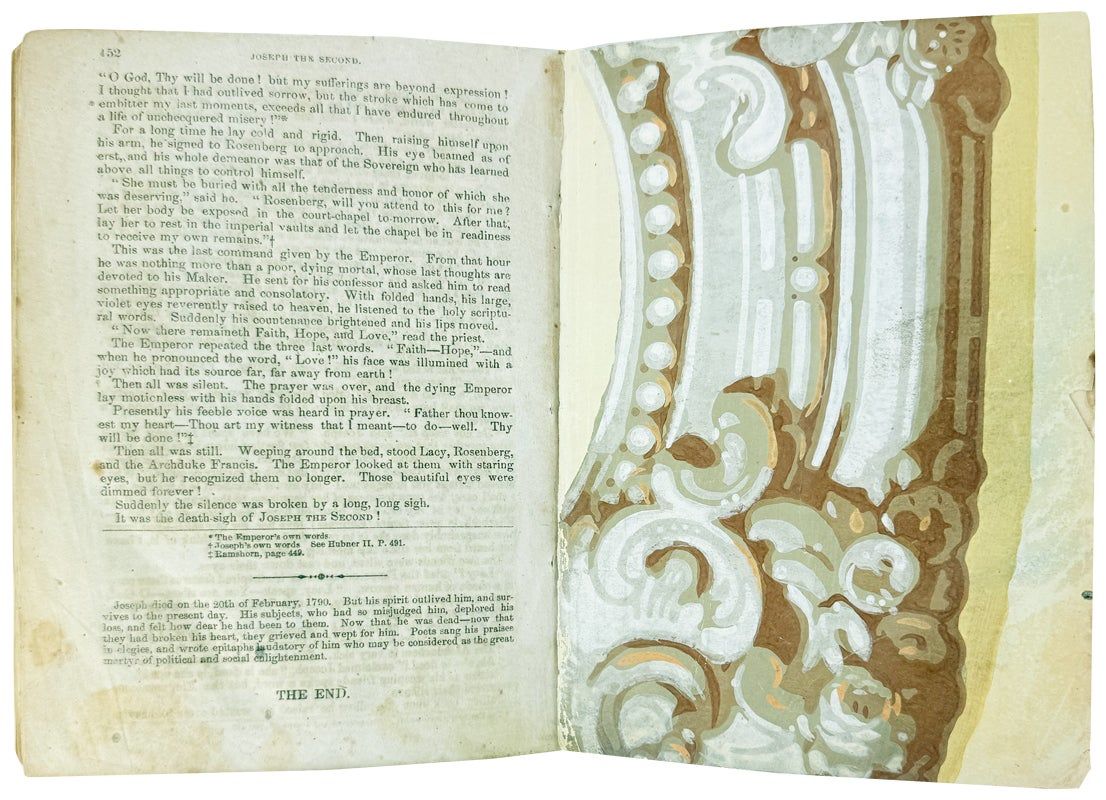
- Mobile, AL: S.H. Goetzel / Farrow & Dennett, 1864
Mobile, AL: S.H. Goetzel / Farrow & Dennett, 1864. Good +. Mobile, AL: S.H. Goetzel / Farrow & Dennet, Printers, 1864. First American Edition. Four volumes bound in one; octavo (19cm); removed from old binding but retaining all eight of the publisher's wallpaper wrappers, housed in custom cloth clamshell box, green gilt spine label; 240; 240; 139,[1]; 152pp. Margins and wrappers rather worn and soiled, old tale remnant to top edge of Vol. I front wrapper, long shallow loss along fore-edge of Vol. I, pp. 97/8 affecting text with loss of meaning, long closed tear to Vol. III, pp. 81/2 affecting text without loss of meaning. A Good to Very Good, still bright example of this rare Confederate publishing oddity.
Records indicate that the Austria-born publisher Sigmund Heinrich Goetzel first opened his bookshop Cotton County in Mobile, Alabama, in 1854. Around the same time several attempts had been made to open a paper mill in the city, though all quickly failed and by the middle of the Civil War the area's main distributor Rock Island Mill had very short supplies for non-CSA government business. As early as 1862 Goetzel had begun producing his own paper, though he appears to be one of just a handful of publishers who succumbed to using gaudy unsold sheets of wallpaper on which to print their wrappers. A survey of the Goetzel Confederate-era imprints indicate that only the six novels published by the firm (five of them by female authors) were given the wallpaper treatment, indicating that the publisher had made the conscious decision to relegate to his primarily female home front readership with works printed on colorful and cheaply-sourced materials.
Which brings us to the author Luisa Mülhbach, the pseudonym of Clara Mundt (1814-1873). Of the novelists published by Goetzel during the Civil War (Mary Elizabeth Braddon, Charles Dickens, George Eliot, and Sally Rochester), Mühlbach and Dickens were arguably the most popular of their time. In her career Mühlbach published two-hundred and ninety (!!) novels, many dealing with historical figures of royalty. The present work first appeared in her native German under the title "Kaiser Joseph und Maria Theresa" between 1856 and 1857, though it is worth pointing out that in the American translation, also by a woman, Maria Theresa has been excised from the title altogether.
However, reading the text reveals that Maria Theresa is given equal billing to her husband Emperor Joseph, the first page of Volume One opening the scene in her, not his, chambers: "In the council-chamber of the Empress Maria Theresa, the six lords who composed her cabinet-council, awaited the entrance of their imperial mistress to open the sitting." As scholar Elizabeth Kimmer argues, Mulhbach "clearly savour[s] fantasies of female power." Perhaps this explains why Maria Theresa had to be removed from the title altogether and the author's first name be shortened to the gender-ambiguous initial "L." Only the translator Adelaide De V. Chaudron gets full billing on the covers and title pages, arguably because her Confederate-era early reader, "Chaudron's Spelling Book," was a Goetzel bestseller, going through three printings in two years.
References:
Cathleen A. Baker. "The Enterprising S.H. Goetzel: Antebellum and Civil War Publisher in Mobile, Alabama."
Elizabeth Kimmer. "Royal Housewives and Female Tyrants: Gender and Sovereignty in Works by Benedikte Naubert and Luise Mulhbach," published in "Strategic Imaginations: Women and the Gender of Sovereignty in European Culture" (2020).
T. Michael Parrish & Robert M. Willingham, Jr. "Confederate Imprints," 6437.
Records indicate that the Austria-born publisher Sigmund Heinrich Goetzel first opened his bookshop Cotton County in Mobile, Alabama, in 1854. Around the same time several attempts had been made to open a paper mill in the city, though all quickly failed and by the middle of the Civil War the area's main distributor Rock Island Mill had very short supplies for non-CSA government business. As early as 1862 Goetzel had begun producing his own paper, though he appears to be one of just a handful of publishers who succumbed to using gaudy unsold sheets of wallpaper on which to print their wrappers. A survey of the Goetzel Confederate-era imprints indicate that only the six novels published by the firm (five of them by female authors) were given the wallpaper treatment, indicating that the publisher had made the conscious decision to relegate to his primarily female home front readership with works printed on colorful and cheaply-sourced materials.
Which brings us to the author Luisa Mülhbach, the pseudonym of Clara Mundt (1814-1873). Of the novelists published by Goetzel during the Civil War (Mary Elizabeth Braddon, Charles Dickens, George Eliot, and Sally Rochester), Mühlbach and Dickens were arguably the most popular of their time. In her career Mühlbach published two-hundred and ninety (!!) novels, many dealing with historical figures of royalty. The present work first appeared in her native German under the title "Kaiser Joseph und Maria Theresa" between 1856 and 1857, though it is worth pointing out that in the American translation, also by a woman, Maria Theresa has been excised from the title altogether.
However, reading the text reveals that Maria Theresa is given equal billing to her husband Emperor Joseph, the first page of Volume One opening the scene in her, not his, chambers: "In the council-chamber of the Empress Maria Theresa, the six lords who composed her cabinet-council, awaited the entrance of their imperial mistress to open the sitting." As scholar Elizabeth Kimmer argues, Mulhbach "clearly savour[s] fantasies of female power." Perhaps this explains why Maria Theresa had to be removed from the title altogether and the author's first name be shortened to the gender-ambiguous initial "L." Only the translator Adelaide De V. Chaudron gets full billing on the covers and title pages, arguably because her Confederate-era early reader, "Chaudron's Spelling Book," was a Goetzel bestseller, going through three printings in two years.
References:
Cathleen A. Baker. "The Enterprising S.H. Goetzel: Antebellum and Civil War Publisher in Mobile, Alabama."
Elizabeth Kimmer. "Royal Housewives and Female Tyrants: Gender and Sovereignty in Works by Benedikte Naubert and Luise Mulhbach," published in "Strategic Imaginations: Women and the Gender of Sovereignty in European Culture" (2020).
T. Michael Parrish & Robert M. Willingham, Jr. "Confederate Imprints," 6437.