

Zhenshchiny i ekonomicheskoe otnoshenie: issledovanie ekonomicheskikh otnoshenii mezhdu muzhchinami i zhenshchinami kak faktora sotsialnoi evoliutsii [=] Women and Economics: An examination of the economic relations between men and women, as a factor in their social evolution
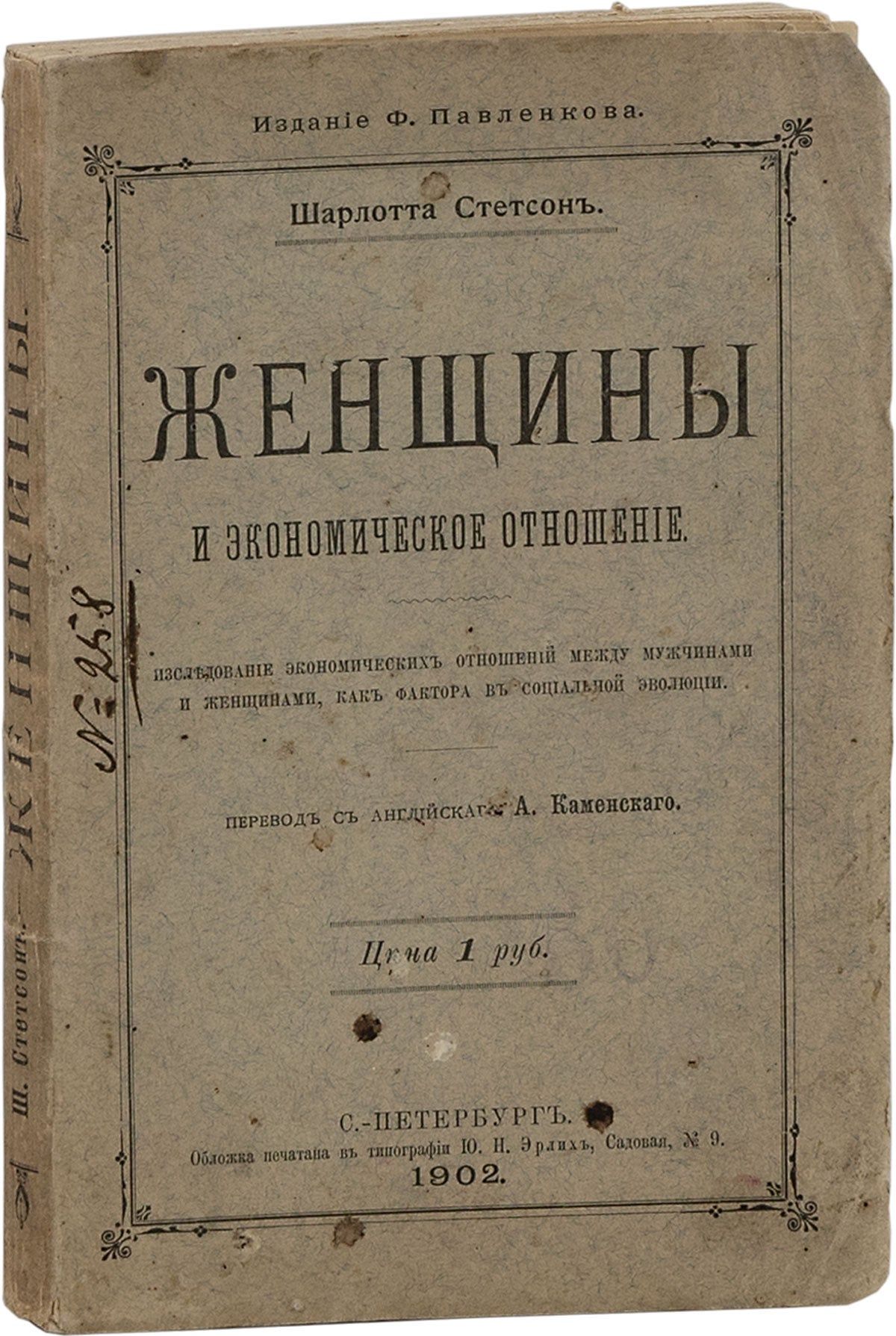
- St. Petersburg: F. Pavlenkov, 1902
St. Petersburg: F. Pavlenkov, 1902. First Russian-Language Edition. Octavo (18.7 × 12.3 cm). Original printed wrappers; 367, [1] pp. Very light wear to wrappers; private inventory number and a few ink spots to title and front wrapper; else Very Good; text uncut and unopened.
Women and Economics, generally considered Gilman's most important theoretical work (described by one historian as "the first real, substantial contribution made by a woman to the science of economics"), first appeared in Boston in 1898; by 1911 no fewer than eight foreign translations had been published, including editions in Hungarian (1906), Polish (1909) and Japanese (1911). Of the two contemporary Russian editions, this, by Andrei Vasil'evich Kamenskii, was the first; it was followed in less than a year by a competing translation by one M. Mamurovskii, about whom we can discover very little. Kamenskii (1843-1914), trained as an engineer, was also a prolific translator and biographer; he wrote at least six entries for Florenty Pavlenkov's massive biographical dictionary Жизнь замечательных людей ("Lives of Remarkable People"), begun in 1890 and still being updated in the 21st century. As Pavlenkov was also the publisher behind the current work, it makes sense that Kamenskii, already on his payroll, would have undertaken the translation.
Kamenskii's Preface to this volume provides insight to the reception of Gilman's ideas – and to the topic of feminism more generally – in pre-Revolutionary Russia. Kamenskii does not stint in his praise for the theoretical importance of the book, praising the author's "...inimitable simplicity and clarity and....amazing logical force;" noting that "...the author examines the abnormal economic situation of women with all of its negative consequences, not as a woman's question but above all from the point of view of social evolution – as a human question..." Yet, in an earlier passage, Kamenskii takes pains to ground his subject as a relatably "feminine" – and perhaps less threatening – figure: "...Stetson is still a relatively young and good looking woman. In addition to her literary gifts and enormous erudition, she has other, more modest talents. She draws well, she is an excellent dressmaker and in addition and excellent and in a pinch, can substitute for the domestic help..."
Extremely uncommon. Of this translation, we can trace no holdings in American or European libraries (per OCLC and KVK); the copy referenced in Feinberg (below) appears to have been digitized from a private Russian library.
References:
How Did Eight Translations of Charlotte Perkins Gilman’s WOMEN AND ECONOMICS Transmit Feminist Thought across National Boundaries in the Years before World War I?, Documents selected and interpreted by Harriet Feinberg (on-line resource)
Mary A. Hill, Charlotte Perkins Gilman: The Making of a Radical Feminist, 1860-1896, p. 295.
Women and Economics, generally considered Gilman's most important theoretical work (described by one historian as "the first real, substantial contribution made by a woman to the science of economics"), first appeared in Boston in 1898; by 1911 no fewer than eight foreign translations had been published, including editions in Hungarian (1906), Polish (1909) and Japanese (1911). Of the two contemporary Russian editions, this, by Andrei Vasil'evich Kamenskii, was the first; it was followed in less than a year by a competing translation by one M. Mamurovskii, about whom we can discover very little. Kamenskii (1843-1914), trained as an engineer, was also a prolific translator and biographer; he wrote at least six entries for Florenty Pavlenkov's massive biographical dictionary Жизнь замечательных людей ("Lives of Remarkable People"), begun in 1890 and still being updated in the 21st century. As Pavlenkov was also the publisher behind the current work, it makes sense that Kamenskii, already on his payroll, would have undertaken the translation.
Kamenskii's Preface to this volume provides insight to the reception of Gilman's ideas – and to the topic of feminism more generally – in pre-Revolutionary Russia. Kamenskii does not stint in his praise for the theoretical importance of the book, praising the author's "...inimitable simplicity and clarity and....amazing logical force;" noting that "...the author examines the abnormal economic situation of women with all of its negative consequences, not as a woman's question but above all from the point of view of social evolution – as a human question..." Yet, in an earlier passage, Kamenskii takes pains to ground his subject as a relatably "feminine" – and perhaps less threatening – figure: "...Stetson is still a relatively young and good looking woman. In addition to her literary gifts and enormous erudition, she has other, more modest talents. She draws well, she is an excellent dressmaker and in addition and excellent and in a pinch, can substitute for the domestic help..."
Extremely uncommon. Of this translation, we can trace no holdings in American or European libraries (per OCLC and KVK); the copy referenced in Feinberg (below) appears to have been digitized from a private Russian library.
References:
How Did Eight Translations of Charlotte Perkins Gilman’s WOMEN AND ECONOMICS Transmit Feminist Thought across National Boundaries in the Years before World War I?, Documents selected and interpreted by Harriet Feinberg (on-line resource)
Mary A. Hill, Charlotte Perkins Gilman: The Making of a Radical Feminist, 1860-1896, p. 295.