

Operation Bughouse
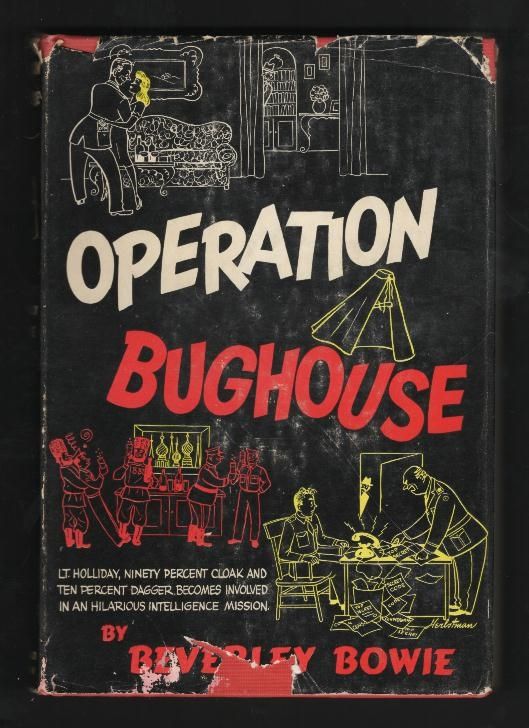
- Hardcover
- New York: Dodd, Mead & Company, 1947
New York: Dodd, Mead & Company. Very Good+ in Good dj. 1947. First Edition. Hardcover. (price-clipped) [good sound copy, lower front corner bumped, minor white stain at bottom of front cover; the jacket is well-worn, somewhat scraped and scuffed, with an M-shaped chip at the bottom of the front panel, some mostly-internal dampstaining surrounding the base of the spine, and a number of small chips and nicks along the top edge]. A "fast-moving, hilarious satire of the cloak-and-dagger business," set in the late stages of World War II, involving one Lt. Holliday "of America's oh-so-secret Force 99," who is dispatched to the fictional Russian-occupied Balkan nation of "Carpathia," where he is charged with ferreting out a document "vital to the Joint Chiefs of Staff" and finds himself getting entangled with a sexy Baroness, among other wacky adventures. The author certainly knew the territory: from 1942 he served in the O.S.S. under the legendary "Wild Bill" Donovan; per his NYT obituary, "he was the first United States soldier to enter Rumania in the closing days of World War II, [parachuting] into Bucharest several days before the [Russian] troops arrived." The jacket blurb further elaborates on this exploit, which (despite its deadly serious nature) clearly provided much of the inspiration for his novel: "He flew into the Balkans in August, 1944, the day the Russians marched in, and there combed P.W. camps, blew safes, hunted holed-up Germans and interrogated internees," all of which earned him a decoration from Col. Donovan. His only novel, this might well be the earliest example of a satirical take on World War II espionage activities (one has to wonder what Donovan thought of it!); its farcical tone qualifies it (in my opinion) as a kind of spiritual precursor to Heller's "Catch-22," and its scarcity today suggests that it may have a bit of an underground reputation amongst spy-fans. Following the war, Bowie worked in various capacities in the federal government (as he had before his wartime service), and in 1951 became an editor at National Geographic Magazine, a position he still held at the time of his death in 1958 at age 44. .