

Walk Hard -- Talk Loud
- Hardcover
- Indianapolis/New York: The Bobbs-Merrill Company, (c.1940)
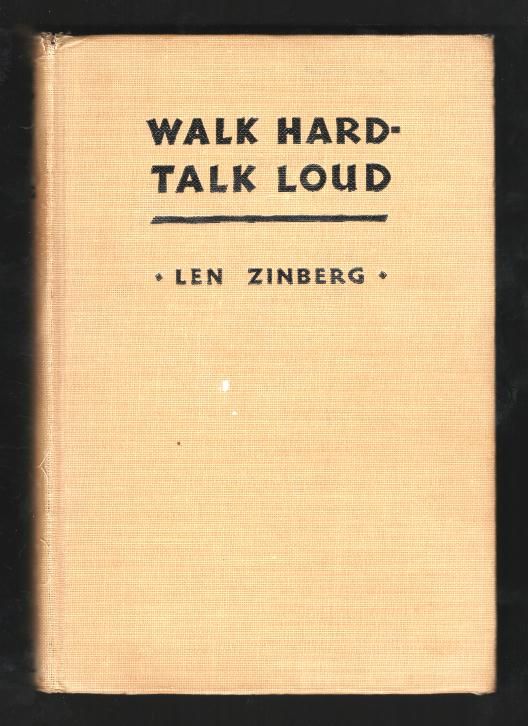
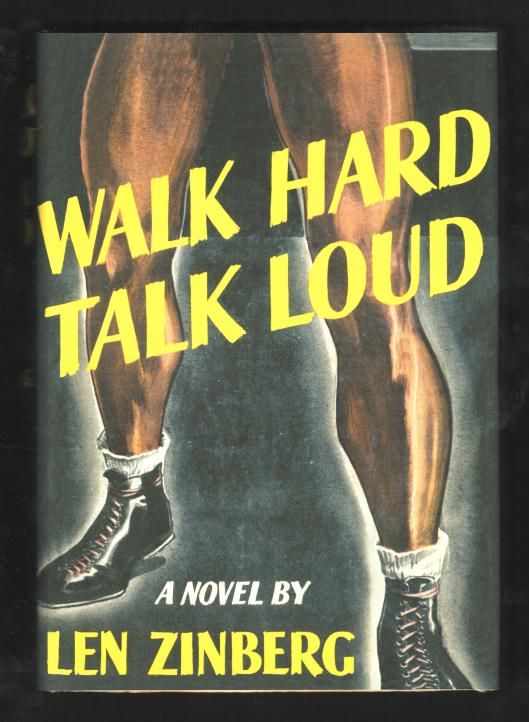
Indianapolis/New York: The Bobbs-Merrill Company. Good. (c.1940). First Edition. Hardcover. (lacking the original dust jacket, but encased in a nice-looking facsimile reproduction of same; see 2nd image posted with this listing) [solid but shelfworn copy, slight bumping and minor fraying at most corners (fraying most prounounced at top of spine), age-toning to edges of text block, tiny white spot on front cover, slight pucker in cloth in middle of rear cover, one-time owner's name at top of front endpaper]. Hardboiled novel about an African-American prizefighter who "wanted very little -- a better place to live in than the Harlem dump he was born in and freedom for himself and his girl from the burden of Jim Crow discrimination," but (of course) had to contend with the usual venality and corruption of the boxing racket. The first novel by Zinberg, who had already established himself as a notable writer of short stories and had even ventured west to Hollywood for a brief stint as a screenwriter, at least according to the jacket blurb. (He left no credit trail behind him, but he gathered enough material for a punchy Hollywood novel with a great title, "What D'ya Know for Sure," published in 1947.) His early fiction, much of it appearing in leftish publications, reflected his liberal/Jewish intellectual background and revealed his concerns with social justice, particularly with regard to racial issues. But it wasn't just his writing that gained him street cred in the black community: he was a longtime resident of Harlem himself, and was married to an African-American woman, to boot. He was also, for a time, a member of the Communist Party, which fact was probably not entirely unrelated to the glowing review "Walk Hard--Talk Loud" received in The New Masses -- by none other than Ralph Ellison, who praised him as a writer "whose approach to Negro life is uncolored by condescension, stereotyped ideas, and other faults growing out of race prejudice." Zinberg was a prolific writer of detective genre fiction as well, mostly under the pseudonym "Ed Lacy," which he adopted in the early 1950s -- in part, it seems, to achieve a McCarthy-era distance from his left-wing political associations. Ironically, it was as Ed Lacy that he became much better known (even his main-entry Wikipedia page is under that name), turning out nearly thirty novels under the pseudonym (as opposed to a mere three as Zinberg), the majority of them paperback originals. The Lacy books included the 1958 Edgar Award-winning "Room to Swing," which featured Toussaint Moore, described by one latter-day critic as "the first credible African-American PI." And lest there be any doubt that he was still a Zinberg in Lacy clothing, the same critic also remarked on his "literate, plausible, and often inventive use of African-American and minority characters." Today, alas, much of his work under both names is out of print. .