

Memoire pour le Sieur Bergasse, dans la cause du Sieur Kornmann, contre le Sieur de Beaumarchais, et contre le Prince de Nassau
- Paris: s.i., 1788
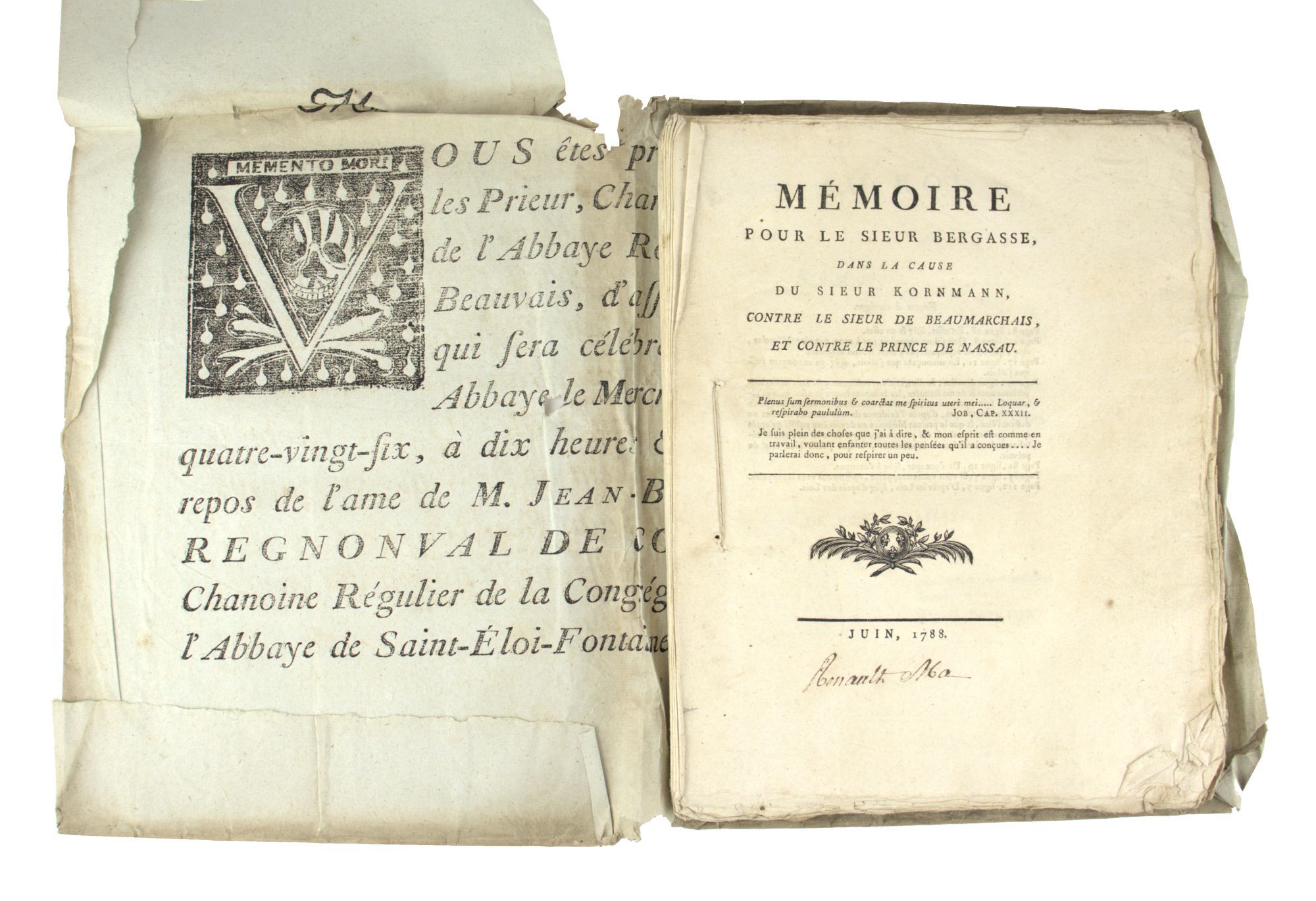
Paris: s.i., 1788. Very Good. [Paris?] s.i., 1788. First Edition. Quarto (27.5cm); original stitched self-wrappers, margins untrimmed, retaining the two original waste wrappers (see below), loose as issued; viii,139pp. Light wrinkling and wear, contemporary signature at bottom edge of title page, else a Very Good, marvelously preserved example.
Account of the Kornmann Affair by the prosector Nicolas Bergasse (1750–1832), a disciple of Franz Mesmer who became an important figure of the Monarchien Party at the beginning of the French Revolution a year later. This exposé of the Kornmann Affair, which has all the salient elements of a Zola novel, was widely disseminated and brought Bergasse the celebrity that launched his political career.
Madame Kornmann was a wealthy fifteen-year-old heiress when she was married off, against her wishes, to her husband the Alsatian banker Guillaume Kornmann, bringing with her a considerably dowry. The marriage was a difficult one from the beginning and Madame Kornmann began an affair with one of her husband's associates, Daudet de Jossan. Kornmann, who benefited greatly from his business with Daudet, turned a blind eye. That is, until Daudet ceased to be useful to him and he found himself with an unfaithful wife who refused to hand her dowry over to him. She was also pregnant with her third child. Still, Kornmann resolved to throw her in prison.
The Prince of Nassau, aware of these sordid events, turned to his friend, the author of the three Figaro plays and an influential politician, Pierre-Augustin de Beaumarchais. After reviewing the situation, Beaumarchais promptly went to the chief of police and had Madame Kornmann released to a maison d'accouchement to give birth. Kornmann, in the meantime, lawyered up, hiring Bergasse as his representative, and the present pamphlet was circulated widely to denigrate Beaumarchais' reputation for meddling in Kornmann's affairs. Bergasse and Kornmann were eventually condemned for slander, but the damage to Beaumarchais had been done.
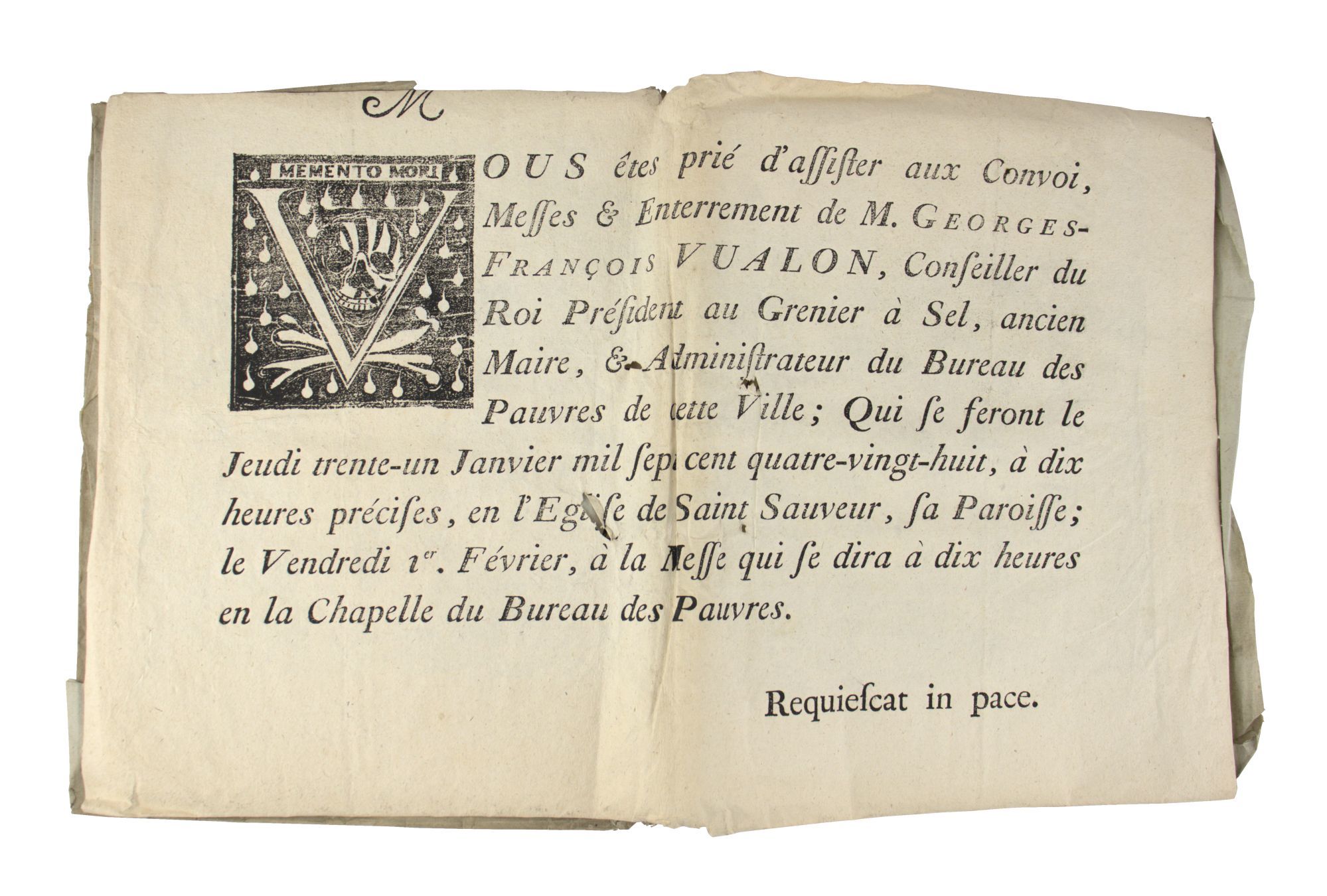
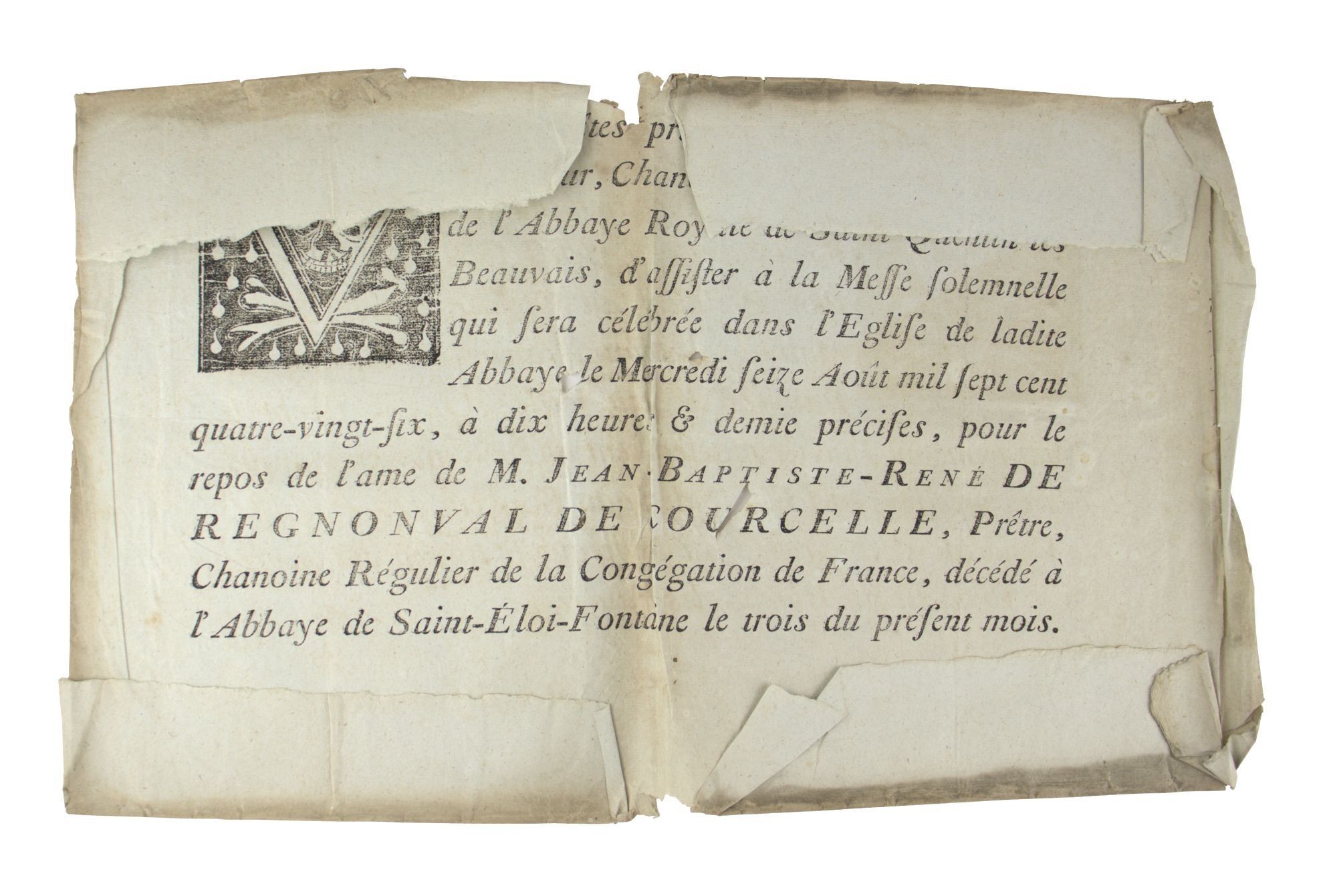
Of special note on this copy, however, is the rare presence of the original wrappers (one could anachronistically call them vernacular dust jackets), fashioned out of two different unrecorded Memento Mori issued the same year as the Kornmann Affair. The pamphlet would have been wrapped in these castoff job printed broadsides for distribution, to be removed before sale. That a copy of this common pamphlet retains its original temporary binding is exceptionally rare.
Both broadsides employ the oversized woodcut initial "V" decorated with a death's head surrounded by little sperm-like raindrops. The exterior Memento, printed on pale blue paper, announces the obsequies for Jean-Baptiste-Rene de Regnonval de Courcelle, a priest and canon to the Congregation of France. The interior Memento, printed on white paper, announces the burial of Georges-François Vualon (Vaulon?), a counselor to the king and former head of the Bureau for the Poor, as well as the president of the grenier a sel, a network of salt granaries significant as a tax source until the Revolution.
While the pamphlet itself is common (denuded of its temporary wrappers), we find no copies of either Memento mori on the market or OCLC as of August, 2025.
For an English-language summation of the Kornmann Affair, see Joseph Sungolowsky's biography Beaumarchais (1974), pp. 20–21.
Account of the Kornmann Affair by the prosector Nicolas Bergasse (1750–1832), a disciple of Franz Mesmer who became an important figure of the Monarchien Party at the beginning of the French Revolution a year later. This exposé of the Kornmann Affair, which has all the salient elements of a Zola novel, was widely disseminated and brought Bergasse the celebrity that launched his political career.
Madame Kornmann was a wealthy fifteen-year-old heiress when she was married off, against her wishes, to her husband the Alsatian banker Guillaume Kornmann, bringing with her a considerably dowry. The marriage was a difficult one from the beginning and Madame Kornmann began an affair with one of her husband's associates, Daudet de Jossan. Kornmann, who benefited greatly from his business with Daudet, turned a blind eye. That is, until Daudet ceased to be useful to him and he found himself with an unfaithful wife who refused to hand her dowry over to him. She was also pregnant with her third child. Still, Kornmann resolved to throw her in prison.
The Prince of Nassau, aware of these sordid events, turned to his friend, the author of the three Figaro plays and an influential politician, Pierre-Augustin de Beaumarchais. After reviewing the situation, Beaumarchais promptly went to the chief of police and had Madame Kornmann released to a maison d'accouchement to give birth. Kornmann, in the meantime, lawyered up, hiring Bergasse as his representative, and the present pamphlet was circulated widely to denigrate Beaumarchais' reputation for meddling in Kornmann's affairs. Bergasse and Kornmann were eventually condemned for slander, but the damage to Beaumarchais had been done.
Of special note on this copy, however, is the rare presence of the original wrappers (one could anachronistically call them vernacular dust jackets), fashioned out of two different unrecorded Memento Mori issued the same year as the Kornmann Affair. The pamphlet would have been wrapped in these castoff job printed broadsides for distribution, to be removed before sale. That a copy of this common pamphlet retains its original temporary binding is exceptionally rare.
Both broadsides employ the oversized woodcut initial "V" decorated with a death's head surrounded by little sperm-like raindrops. The exterior Memento, printed on pale blue paper, announces the obsequies for Jean-Baptiste-Rene de Regnonval de Courcelle, a priest and canon to the Congregation of France. The interior Memento, printed on white paper, announces the burial of Georges-François Vualon (Vaulon?), a counselor to the king and former head of the Bureau for the Poor, as well as the president of the grenier a sel, a network of salt granaries significant as a tax source until the Revolution.
While the pamphlet itself is common (denuded of its temporary wrappers), we find no copies of either Memento mori on the market or OCLC as of August, 2025.
For an English-language summation of the Kornmann Affair, see Joseph Sungolowsky's biography Beaumarchais (1974), pp. 20–21.