

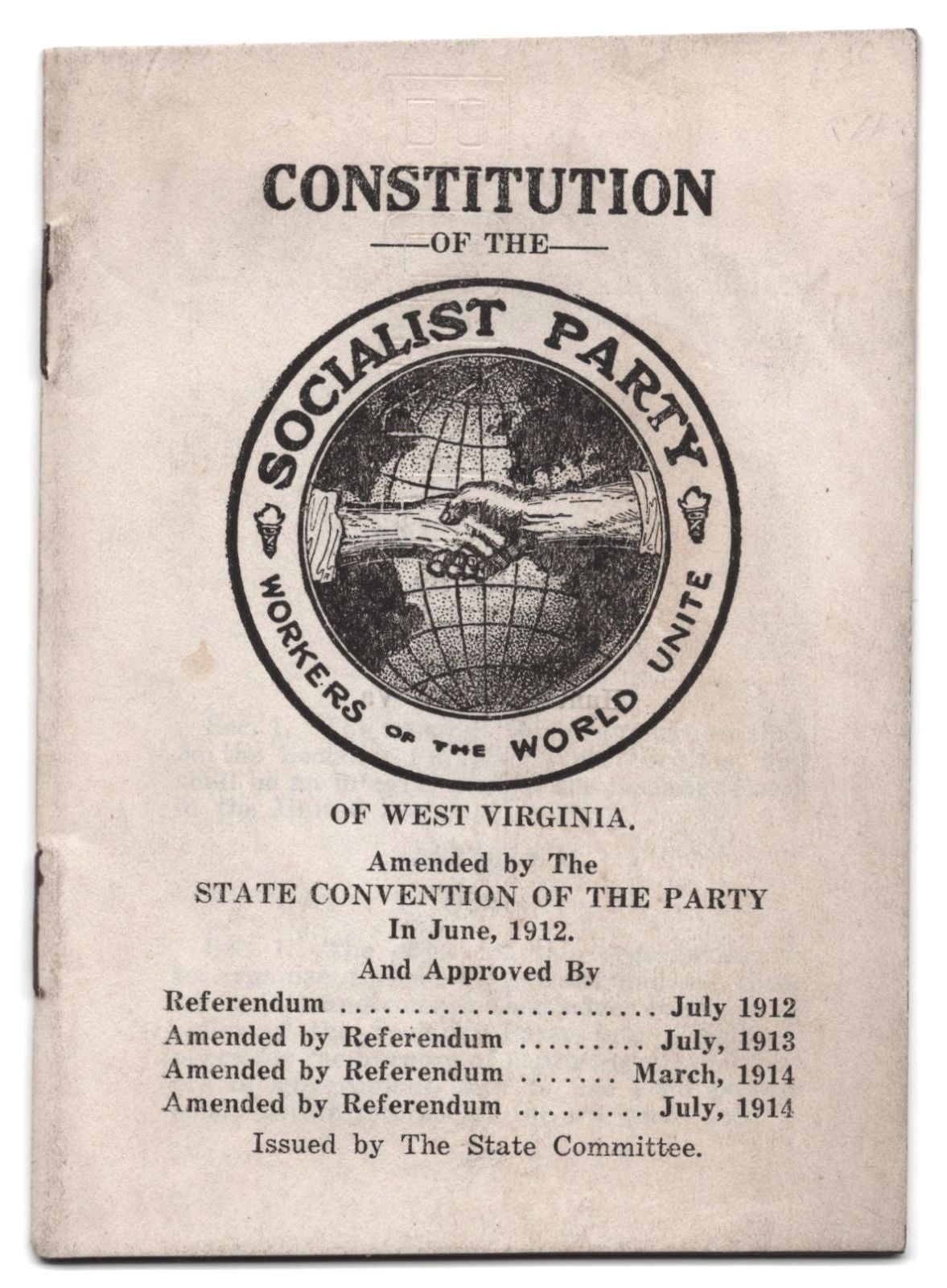
Constitution of the Socialist Party of West Virginia. Amended by The State Convention of the Party In June, 1912. And Approved By Referendum..
- Pamphlet
- Huntington, [West Virginia]: Issued by The State Committee. Printed by The Labor Star, 1914
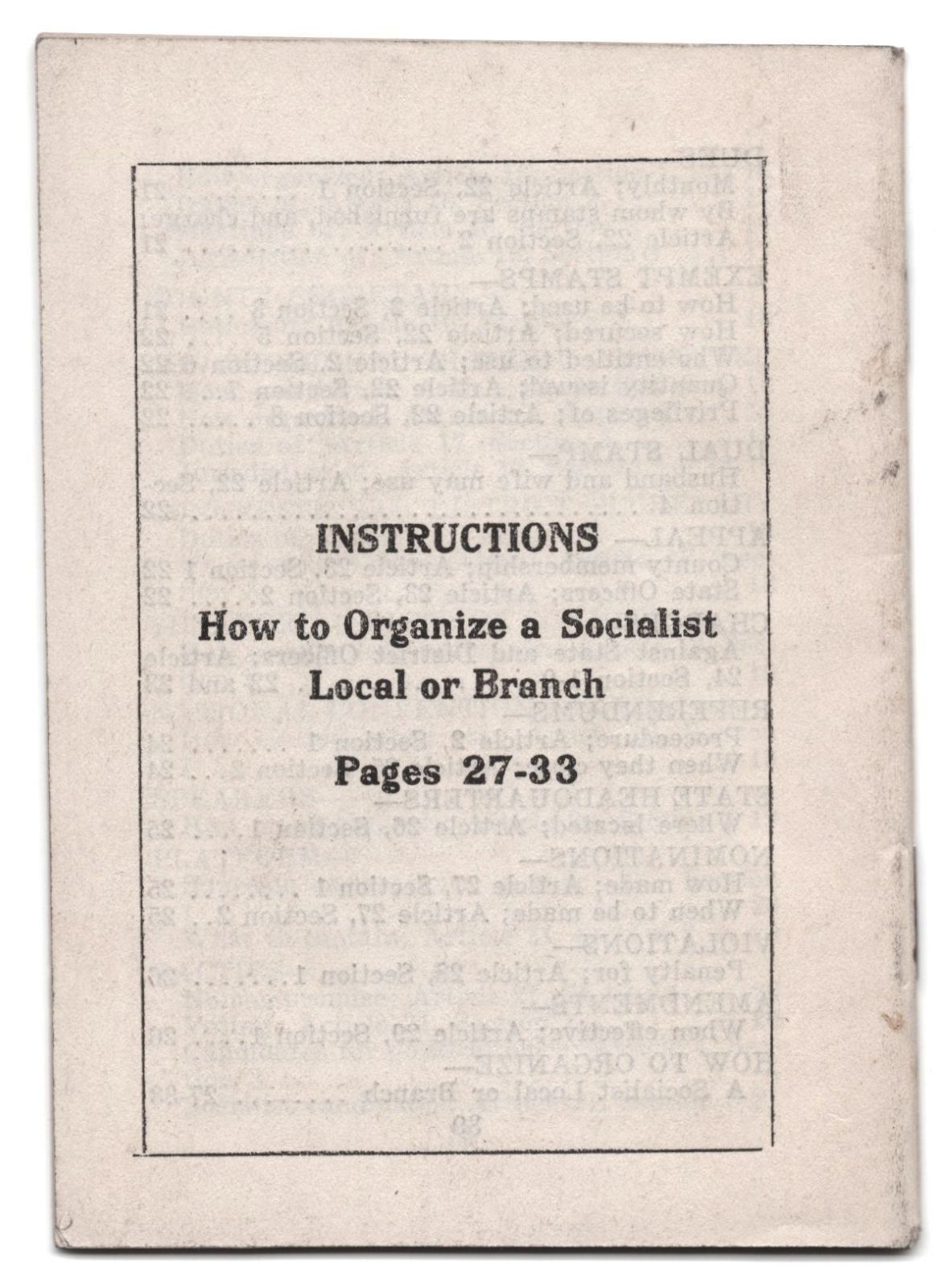
Huntington, [West Virginia]: Issued by The State Committee. Printed by The Labor Star, 1914. Pamphlet. Near Fine. 39 [+1] pp. Small pamphlet. 24mo [13 cm]; saddle-stapled in self-wrappers. Front and rear covers are very lightly tanned and soiled, else Near Fine. Rare. The Socialist Party Logo is printed on the front (with globe, two hands shaking, and "Socialist Party – Workers of the World Unite" in a circular border). "Referendum" and "Amended by Referendum" dates listed up to July, 1914. Printed within are the twenty-nine articles of this constitution of the Socialist Party of West Virginia (pages 3-26), instructions on "How to Organize a Socialist Local or Branch" (pages 27-33), and an index (pages 35-39).
"The first local branch of the West Virginia Socialist Party was established in Wheeling in 1901. With the assistance of Socialist organizers from Pennsylvania and Kentucky, the West Virginia movement spread by 1908 to Huntington, Parkersburg, Clarksburg, Charleston, and a number of smaller communities throughout the state. By 1914, several thousand West Virginians were dues-paying members of the party's 86 local branches. As early as 1910, local Socialists began to elect candidates to office, and in 1912 more than 15,000 West Virginia voters cast their ballots for Socialist Eugene Debs for president. By 1914, West Virginians had elected Socialist Party candidates to more than 40 local offices, including virtually the entire administrations of such widely scattered communities as Miami, Eskdale, Adamston, Cameron, and Hendricks. Star City, near Morgantown, would ultimately have the longest-lived Socialist municipal government in the United States. In addition, Socialists controlled Cabin Creek, Paint Creek, and Washington districts in the Kanawha County coalfields and the Falls Magisterial District of Fayette County. To a great extent, the progress that the West Virginia Socialists achieved on the electoral front was a reflection of the party's strategy of increasing class consciousness by working with existing unions to build the power of the labor movement. The party appealed to a fairly broad cross section of wage earners. There were important concentrations among skilled craftsmen in the pottery, window glass, machine tools, cigar making, and building construction trades. Socialists from these crafts and others held leadership positions in their own unions and in a number of the state's central labor bodies. Party members had special influence in the Ohio Valley Trades and Labor Assembly, the Huntington Trades and Labor Assembly, and most important of all, the West Virginia State Federation of Labor. Socialists were especially popular with coal miners and were able by 1916 to control both District 29 and District 17 of the United Mine Workers in West Virginia. The steady growth of West Virginia's Socialist Party also owed much to the fact that many members of the middle class were attracted to the cause..." (from "e-WV: The West Virginia Encyclopedia Online, a project of the West Virginia Humanities Council" retrieved at https://www.wvencyclopedia.org/entries/476 on 2/27/25).
"The first local branch of the West Virginia Socialist Party was established in Wheeling in 1901. With the assistance of Socialist organizers from Pennsylvania and Kentucky, the West Virginia movement spread by 1908 to Huntington, Parkersburg, Clarksburg, Charleston, and a number of smaller communities throughout the state. By 1914, several thousand West Virginians were dues-paying members of the party's 86 local branches. As early as 1910, local Socialists began to elect candidates to office, and in 1912 more than 15,000 West Virginia voters cast their ballots for Socialist Eugene Debs for president. By 1914, West Virginians had elected Socialist Party candidates to more than 40 local offices, including virtually the entire administrations of such widely scattered communities as Miami, Eskdale, Adamston, Cameron, and Hendricks. Star City, near Morgantown, would ultimately have the longest-lived Socialist municipal government in the United States. In addition, Socialists controlled Cabin Creek, Paint Creek, and Washington districts in the Kanawha County coalfields and the Falls Magisterial District of Fayette County. To a great extent, the progress that the West Virginia Socialists achieved on the electoral front was a reflection of the party's strategy of increasing class consciousness by working with existing unions to build the power of the labor movement. The party appealed to a fairly broad cross section of wage earners. There were important concentrations among skilled craftsmen in the pottery, window glass, machine tools, cigar making, and building construction trades. Socialists from these crafts and others held leadership positions in their own unions and in a number of the state's central labor bodies. Party members had special influence in the Ohio Valley Trades and Labor Assembly, the Huntington Trades and Labor Assembly, and most important of all, the West Virginia State Federation of Labor. Socialists were especially popular with coal miners and were able by 1916 to control both District 29 and District 17 of the United Mine Workers in West Virginia. The steady growth of West Virginia's Socialist Party also owed much to the fact that many members of the middle class were attracted to the cause..." (from "e-WV: The West Virginia Encyclopedia Online, a project of the West Virginia Humanities Council" retrieved at https://www.wvencyclopedia.org/entries/476 on 2/27/25).