

Songs of a Pagan (Inscribed by the author, and with a TLS laid in)

- SIGNED Hardcover
- Caldwell, ID: The Caxton Printers, Ltd, 1949
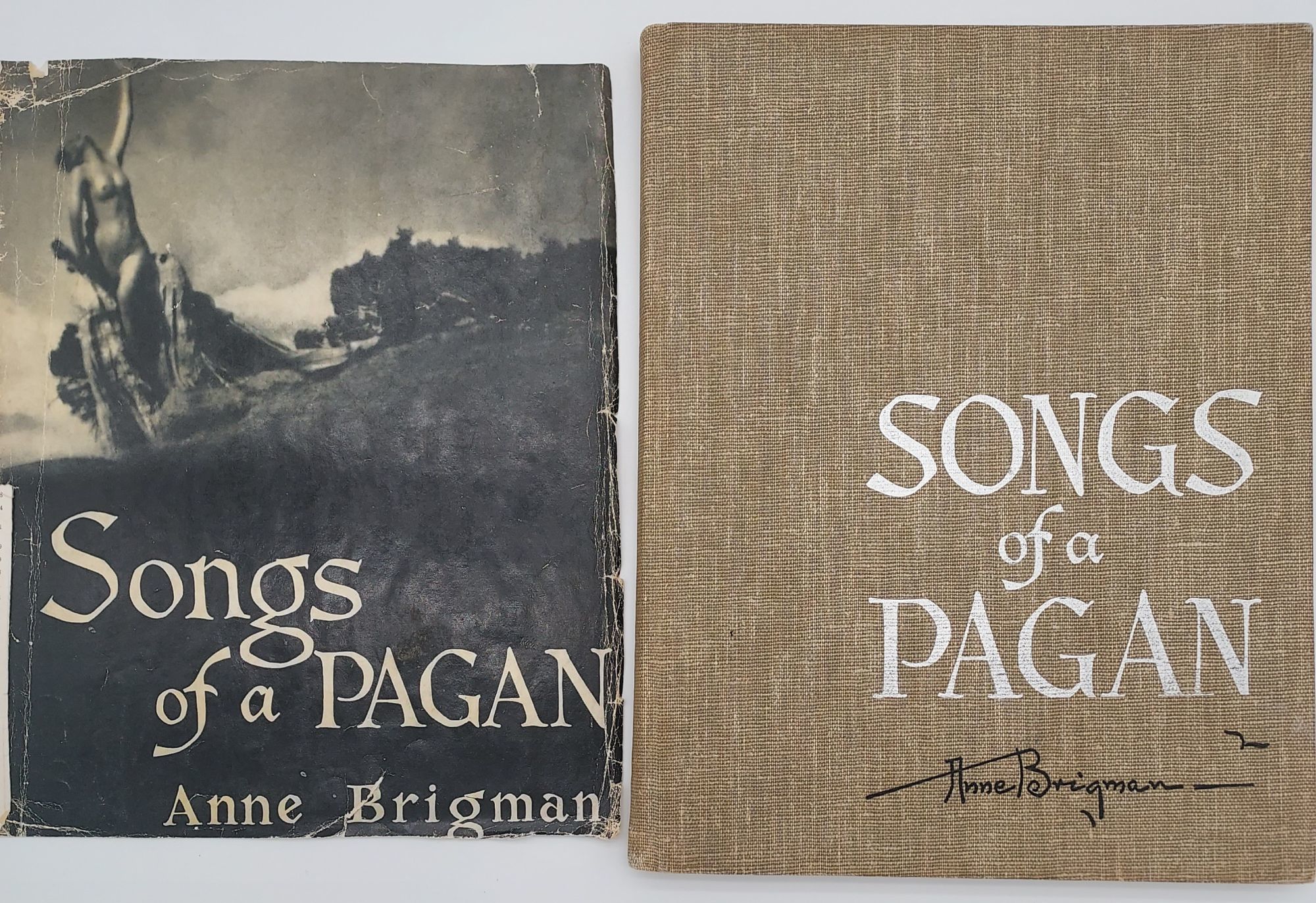
Caldwell, ID: The Caxton Printers, Ltd, 1949. First edition, inscribed association copy. Hardcover. Good. SIGNED. 90pp. Quarto [27.5 cm] Tan cloth over boards with the title and author in silver and black on the front board. With light moisture damage to the margins of the preliminary and terminal leaves. "Origins of Art Research Foundation" label and "M. Blanding" Altadenal address label on the front free endpaper. Front and rear panel, and flaps of the dust jacket tucked in. Illustrated with photographs by the author. A collection of poetry and photography.
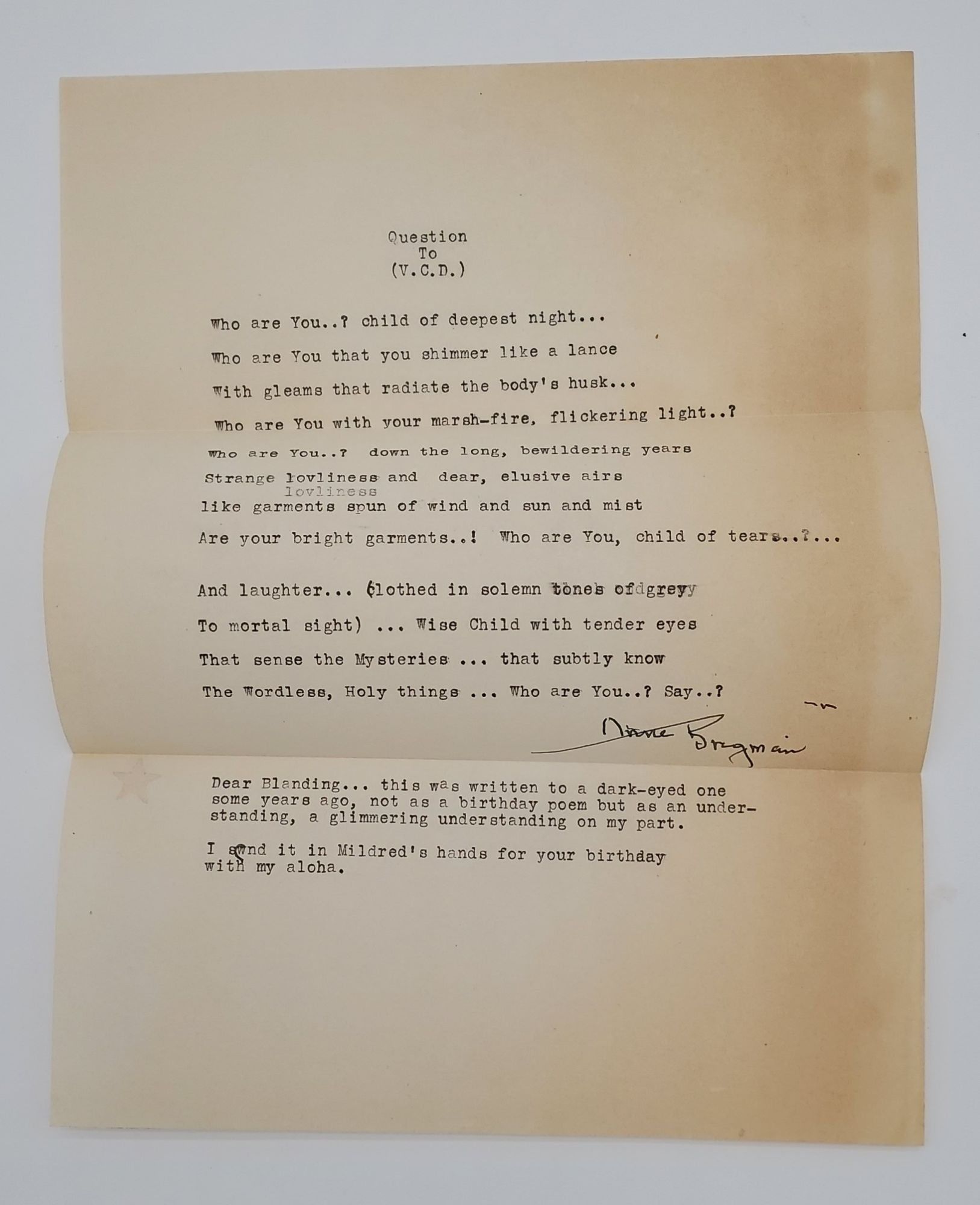
Warmly inscribed by the author, in the year of publication, and one year before her death, to artist, theatrical designer and puppeteer Blanding Sloan and his wife Mildred Taylor, on the reverse of the front free endpaper: "For the / Third Point / of the / Blessed Trinity / of / Blanding and Mildred / and (Tayton?) / Aloha / Anne Brigman / 1949." Additionally laid in, is a poem for Blanding- "Question to (V. C. D.)" typed on a sheet of 8 1/2" by 11" paper and signed by Brigman at the foot. Blanding Sloan (1886-1975) designed stage sets in New York, and had a puppet theater on Montgomery Street in San Francisco in the 1920s. In 1934, he became the director of the WPA Federal Theater in Los Angeles.
Hawaiian-born, self-taught artist Anne Brigman (1869-1950), lived in California, and was most known for her legendary landscape photographs depicting herself and other female nudes outdoors in the Sierra Nevada. She was a proponent of the Arts and Crafts philosophy, as well as a member of the Pictorialist photography movement. Anne knew the renowned photographer Alfred Stieglitz, who promoted her work on the East coast, and with whom she corresponded via letters frequently. Her photography was considered radical in its day.
"To objectify her own nude body as the subject of her photographs at the turn of the twentieth century was groundbreaking; to do so outdoors in a near-desolate wilderness setting was revolutionary. Although the term feminist art was not coined until nearly seventy years after Brigman made her first photographs, the suggestion that her camera gave her the power to redefine her place as a woman in society establishes her as an important forerunner in the field." (from Nevada Museum of Art website).
Warmly inscribed by the author, in the year of publication, and one year before her death, to artist, theatrical designer and puppeteer Blanding Sloan and his wife Mildred Taylor, on the reverse of the front free endpaper: "For the / Third Point / of the / Blessed Trinity / of / Blanding and Mildred / and (Tayton?) / Aloha / Anne Brigman / 1949." Additionally laid in, is a poem for Blanding- "Question to (V. C. D.)" typed on a sheet of 8 1/2" by 11" paper and signed by Brigman at the foot. Blanding Sloan (1886-1975) designed stage sets in New York, and had a puppet theater on Montgomery Street in San Francisco in the 1920s. In 1934, he became the director of the WPA Federal Theater in Los Angeles.
Hawaiian-born, self-taught artist Anne Brigman (1869-1950), lived in California, and was most known for her legendary landscape photographs depicting herself and other female nudes outdoors in the Sierra Nevada. She was a proponent of the Arts and Crafts philosophy, as well as a member of the Pictorialist photography movement. Anne knew the renowned photographer Alfred Stieglitz, who promoted her work on the East coast, and with whom she corresponded via letters frequently. Her photography was considered radical in its day.
"To objectify her own nude body as the subject of her photographs at the turn of the twentieth century was groundbreaking; to do so outdoors in a near-desolate wilderness setting was revolutionary. Although the term feminist art was not coined until nearly seventy years after Brigman made her first photographs, the suggestion that her camera gave her the power to redefine her place as a woman in society establishes her as an important forerunner in the field." (from Nevada Museum of Art website).