

Alex Haley’s Genealogical and Historical Notes on His Father’s Side of the Family, Likely for His Posthumous Novel Queen
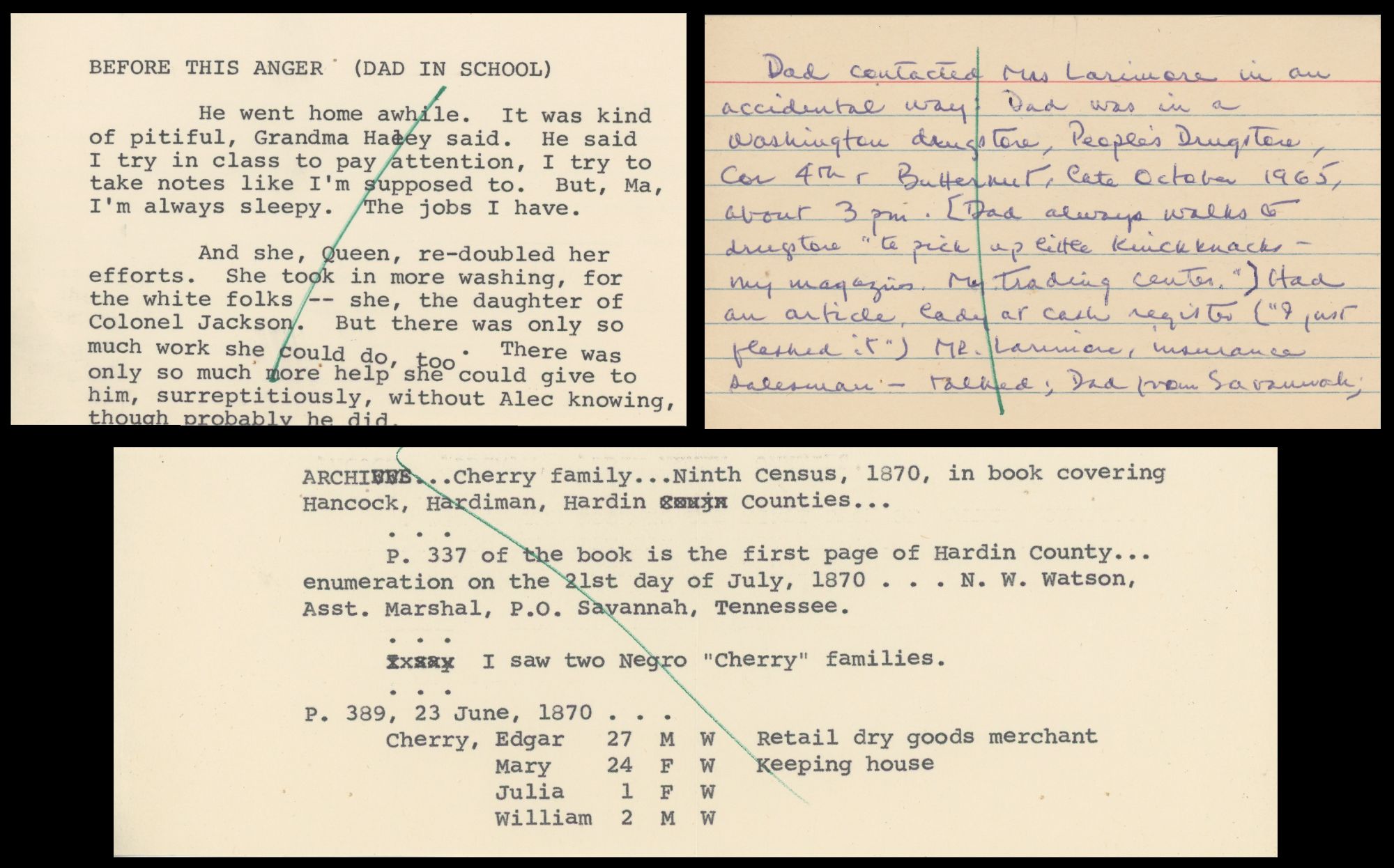
- Thirty-one pages: three typed pages with editorial marks measuring 8 ½ x 11 inches; twenty-eight pages of handwritten notes mea
- United States , N.d.
United States, N.d.. Thirty-one pages: three typed pages with editorial marks measuring 8 ½ x 11 inches; twenty-eight pages of handwritten notes measuring 6 ½ x 8 ½ and smaller. Typed pages fragile with damage; others near fine. Overall excellent.. Content warning: This description mentions sexual assault.
Alex Haley (1921–1992) was an African American author, known for his bestselling 1976 semi-genealogical book Roots: The Saga of an American Family. Roots follows the story of Kunta Kinte, a young Mandinka man in 18th-century Gambia who is sold into enslavement, and of his descendants in the US. The historical novel was based upon Haley’s genealogical research into his family history; Kunta Kinte is ostensibly Haley’s ancestor on his mother’s side. At the time of his death in 1992, Haley had been working with Australian writer David Stevens on a novel about his father’s side of the family. The novel was published in 1993 as Queen: The Story of an American Family.
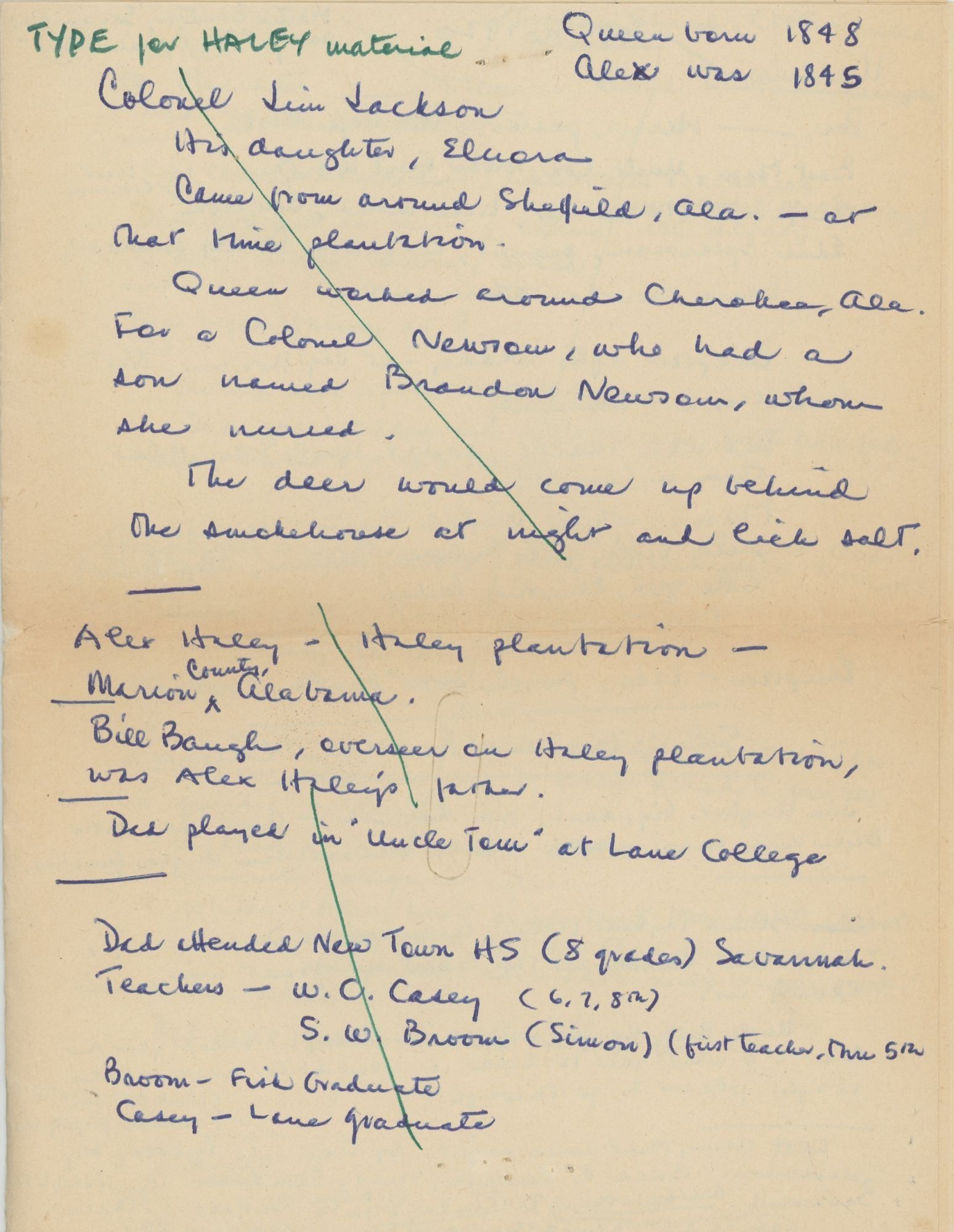
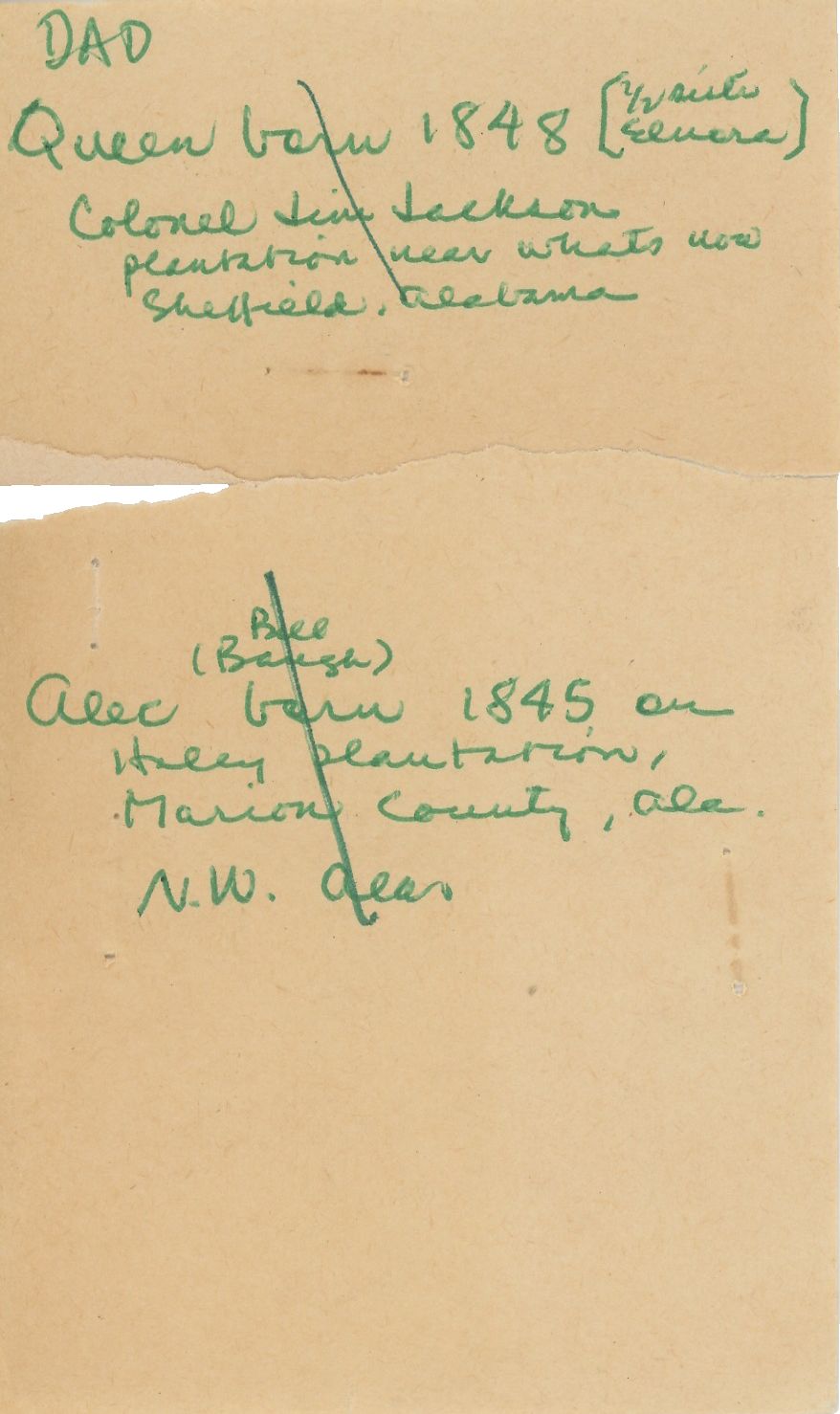
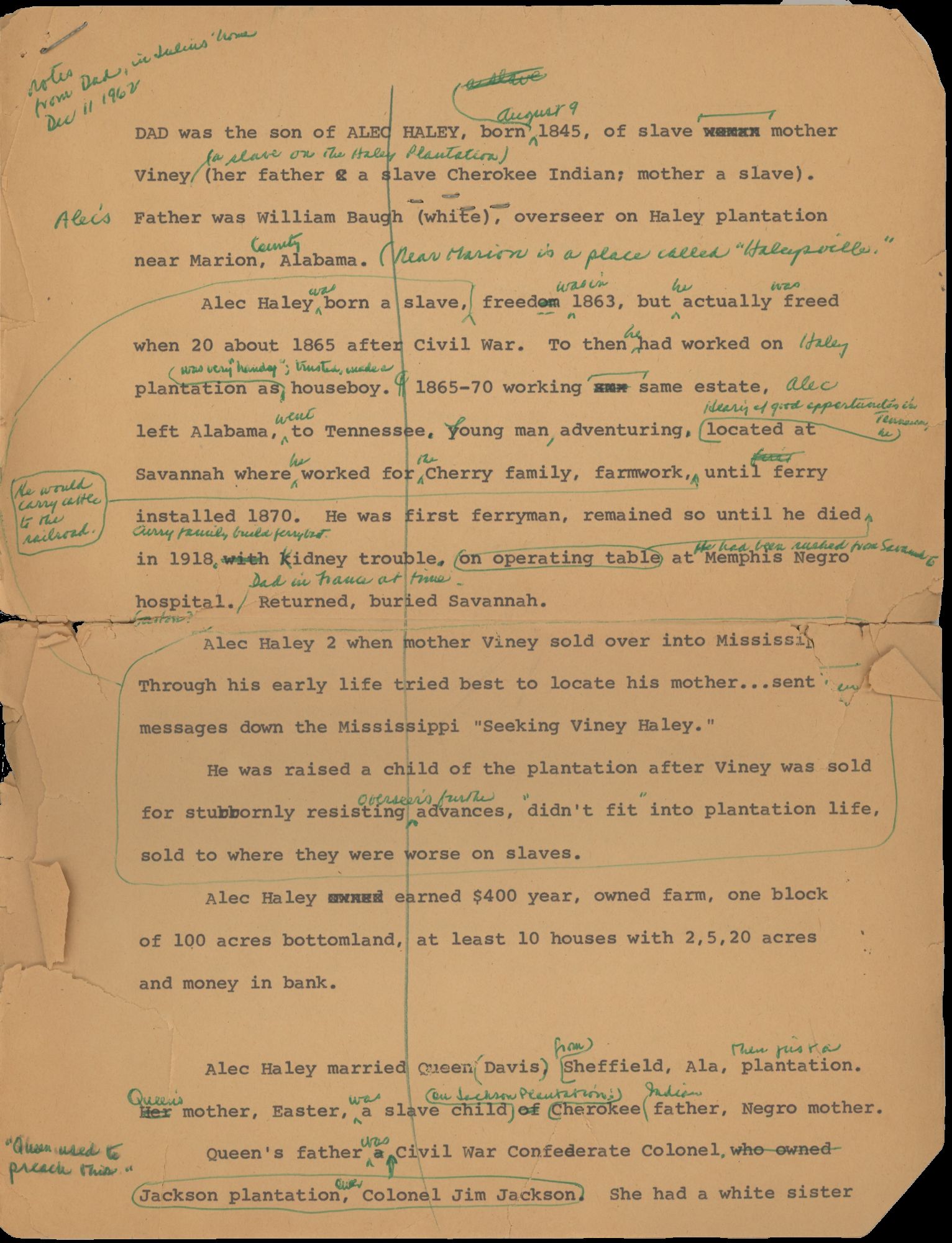
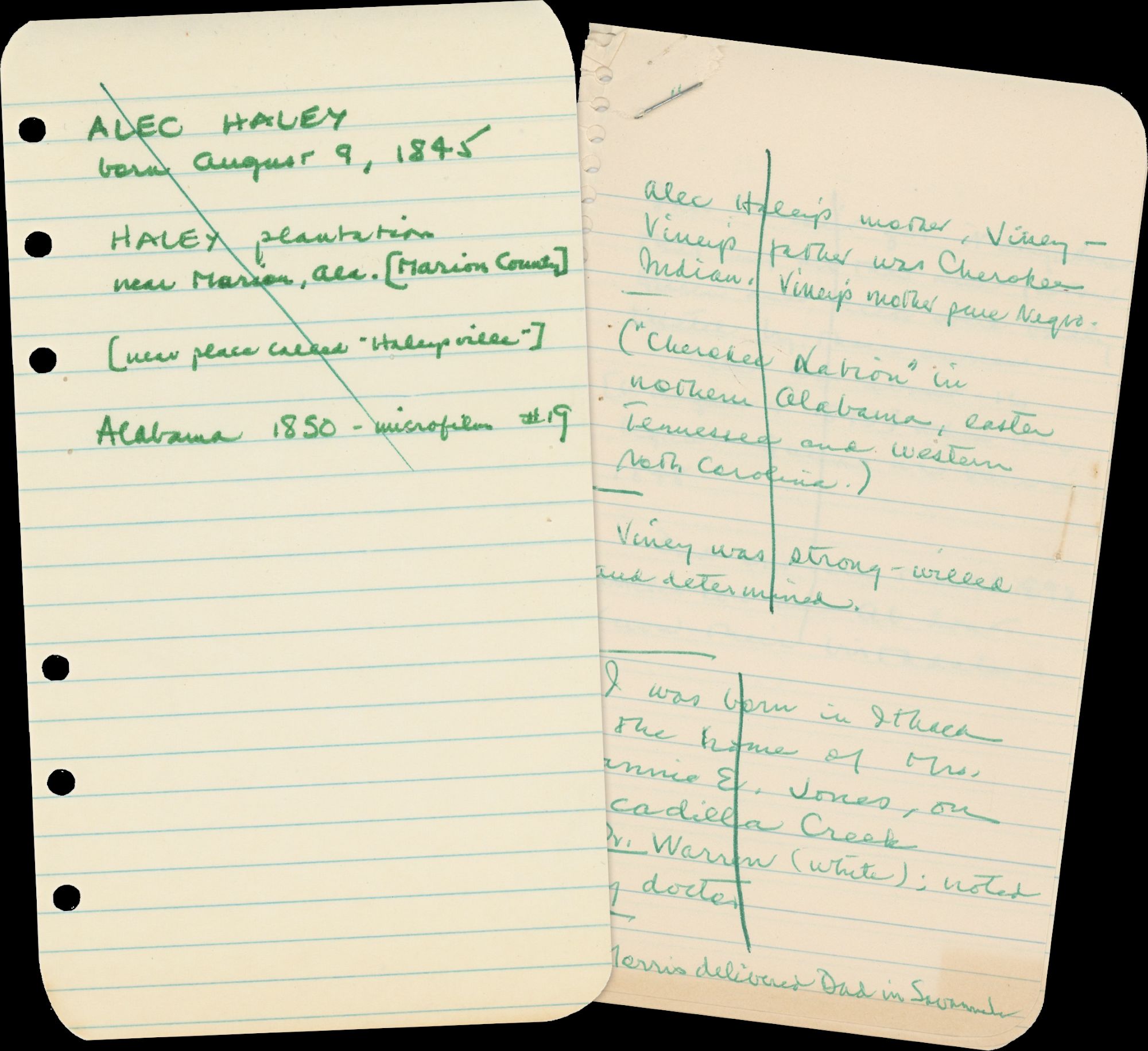
Offered here is a collection of Haley’s own notes that, based on the subject matter, were likely used in the writing of Queen. The notes discuss Haley’s grandparents Alec Haley and Queen Jackson—the latter being the book’s namesake—and their son, Alex’s father, Simon Haley.
Simon Haley was a professor of agriculture, and most of his son’s notes about him concern his struggle to obtain an education. The elder Haley worked as a Pullman porter and attended Lane College, an HBCU in Tennessee; he was on the brink of having to drop out when “one night [he] delivered hot milk to [an] insomniac industrialist who, finding Dad was a student, financially helped him enter A&T at Greensboro.”
Haley’s notes on Alec and Queen are disturbing and sometimes graphic. Both were children of sexual assault between enslaved African American women and white men. Alec’s father was Haley plantation overseer William Baugh and Queen’s was James Jackson, the owner of Jackson plantation; Haley describes how Alec’s mother, Viney, was sold away from her family “for stubbornly resisting [the] overseer’s further advances”. Haley describes a scene that occurred when Queen was 18 after a “white woman said she’d ‘sassed’ her” and a mob “had gathered to catch” her:
“Queen Haley tells white mob she’s as white as they, and why – her father raped her mother … and they cannot bear the intolerable reproach … and try [to] rape or kill her.”
These events, and witnessing another lynch mob, have permanent effects on Queen’s psyche, which Haley’s notes illustrate with anecdotes: Queen “looking out of windows ‘all those lights, they’re after me --’”, running off and “crawl[ing] under [the] bed”, and even disappearing for an entire day and being found hiding “in a deep ravine”. However, Queen apparently plays the relationship between Jackson and Queen’s mother Easter as a forbidden love affair.
Of interest to scholars of reconstruction narratives and African American nonfiction novels and historical fiction.
Alex Haley (1921–1992) was an African American author, known for his bestselling 1976 semi-genealogical book Roots: The Saga of an American Family. Roots follows the story of Kunta Kinte, a young Mandinka man in 18th-century Gambia who is sold into enslavement, and of his descendants in the US. The historical novel was based upon Haley’s genealogical research into his family history; Kunta Kinte is ostensibly Haley’s ancestor on his mother’s side. At the time of his death in 1992, Haley had been working with Australian writer David Stevens on a novel about his father’s side of the family. The novel was published in 1993 as Queen: The Story of an American Family.
Offered here is a collection of Haley’s own notes that, based on the subject matter, were likely used in the writing of Queen. The notes discuss Haley’s grandparents Alec Haley and Queen Jackson—the latter being the book’s namesake—and their son, Alex’s father, Simon Haley.
Simon Haley was a professor of agriculture, and most of his son’s notes about him concern his struggle to obtain an education. The elder Haley worked as a Pullman porter and attended Lane College, an HBCU in Tennessee; he was on the brink of having to drop out when “one night [he] delivered hot milk to [an] insomniac industrialist who, finding Dad was a student, financially helped him enter A&T at Greensboro.”
Haley’s notes on Alec and Queen are disturbing and sometimes graphic. Both were children of sexual assault between enslaved African American women and white men. Alec’s father was Haley plantation overseer William Baugh and Queen’s was James Jackson, the owner of Jackson plantation; Haley describes how Alec’s mother, Viney, was sold away from her family “for stubbornly resisting [the] overseer’s further advances”. Haley describes a scene that occurred when Queen was 18 after a “white woman said she’d ‘sassed’ her” and a mob “had gathered to catch” her:
“Queen Haley tells white mob she’s as white as they, and why – her father raped her mother … and they cannot bear the intolerable reproach … and try [to] rape or kill her.”
These events, and witnessing another lynch mob, have permanent effects on Queen’s psyche, which Haley’s notes illustrate with anecdotes: Queen “looking out of windows ‘all those lights, they’re after me --’”, running off and “crawl[ing] under [the] bed”, and even disappearing for an entire day and being found hiding “in a deep ravine”. However, Queen apparently plays the relationship between Jackson and Queen’s mother Easter as a forbidden love affair.
Of interest to scholars of reconstruction narratives and African American nonfiction novels and historical fiction.