

1795 Contract between Merchant John Godfried Wachsmuth and US Treasury Secretary Oliver Wolcott Jr., Arranging a Large Sale of Goods through a Prominent Amsterdam Banking Firm
- Two pages measuring 10 x 16 ¼ inches
- Philadelphia, Pennsylvania , 1795
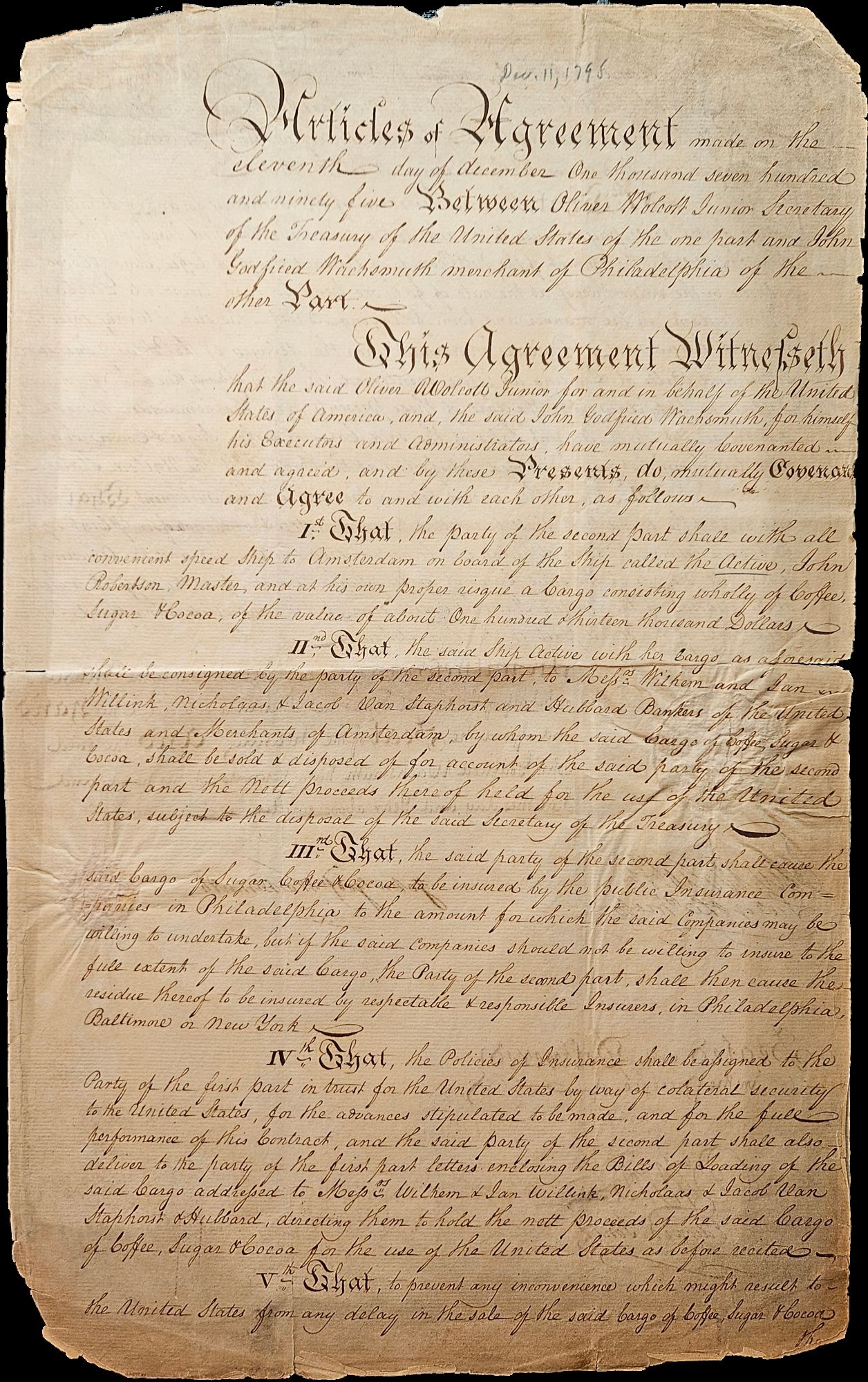
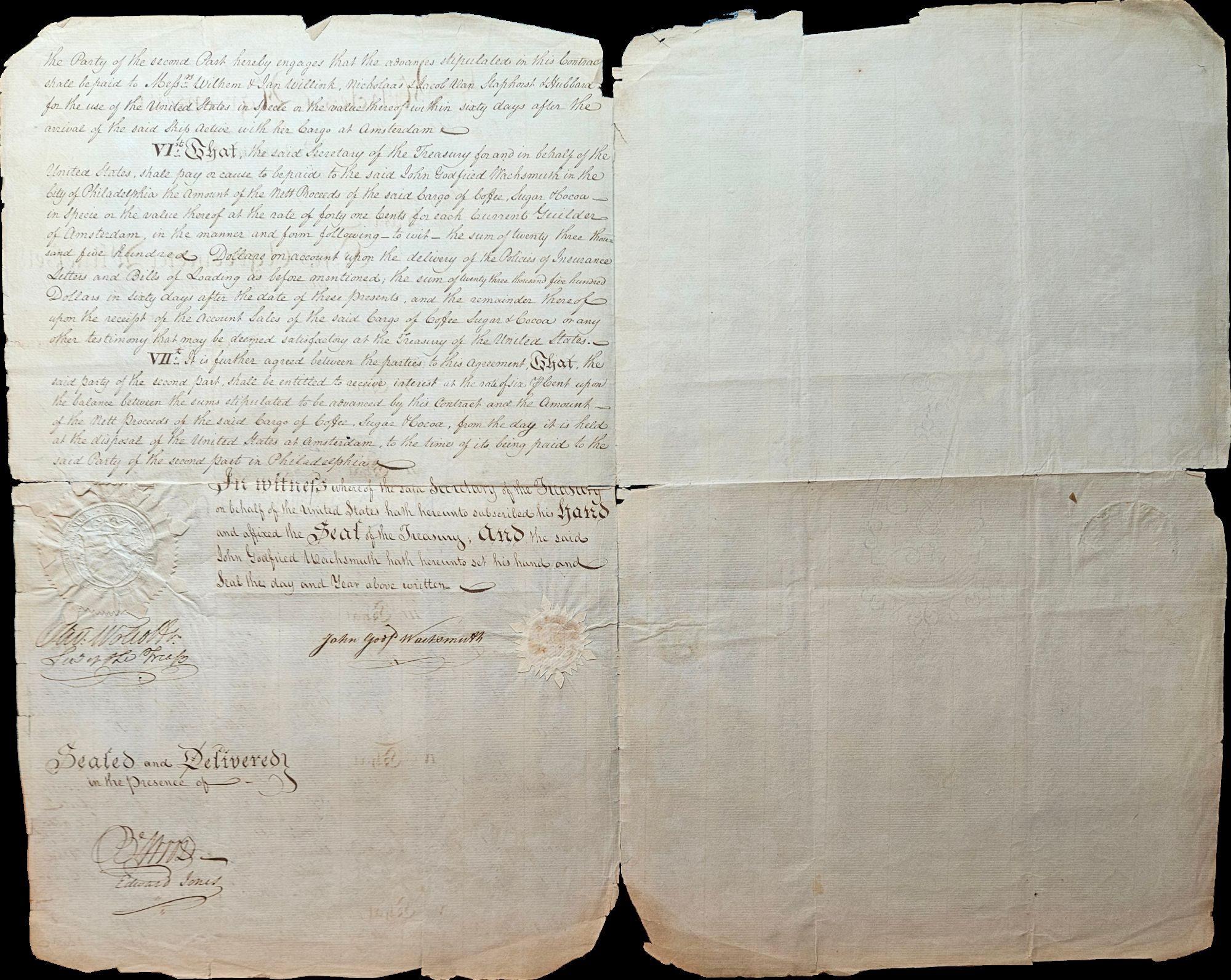
Philadelphia, Pennsylvania, 1795. Two pages measuring 10 x 16 ¼ inches. Toned, folded with tears at folds, and marginal damage; excellent.. A contract dated December 11th, 1795, between Philadelphia merchant John Godfried Wachsmuth and Secretary of the Treasury Oliver Wolcott Jr. in which Wachsmuth agrees to ship $113,000 worth of coffee, sugar, and cocoa to Amsterdam, for which the US government would advance Wachsmuth the funds. The items would be consigned to an Amsterdam banking house, the bankers would pay the proceeds to the United States, and the US would in turn pay Wachsmuth in specie.
At the time, the US was finally recovering from the precarious financial situation that followed the Revolutionary War, and had successfully negotiated trade deals with Great Britain and Spain. Despite political upheaval in the Netherlands, the country had been and remained a significant trading partner for, and investor in, the US. This contract specifies that the goods will be consigned to Wilhelm and Jan Willink, Nicolaas and Jacob Van Staphorst, and Nicholas Hubbard; this group in particular invested heavily in the US, making large loans to the government and purchases of land (via the Holland Land Company), including investing in the Louisiana Purchase.
A deal of this sort had a number of benefits for the new country; most importantly, it would continue to build a positive trade relationship with the Netherlands and improve the US’s credit abroad, and it would bring more specie into the US, which was experiencing a specie drain due to its imports exceeding its exports.[1] It involved significant risk for Wachsmuth—he would be responsible for ensuring the bankers ultimately received the value of the goods in specie—but the potential reward, in terms of both profits and a relationship with Amsterdam’s most important bankers, seem to have been worth it.
Of interest to scholars researching the economic growth of the early United States, especially in terms of foreign trade relations.
[1] Nicholas A. Curott and Tyler A. Watts, “What Caused the Recession of 1797?”, Studies in Applied Economics 48 (February 2016).
At the time, the US was finally recovering from the precarious financial situation that followed the Revolutionary War, and had successfully negotiated trade deals with Great Britain and Spain. Despite political upheaval in the Netherlands, the country had been and remained a significant trading partner for, and investor in, the US. This contract specifies that the goods will be consigned to Wilhelm and Jan Willink, Nicolaas and Jacob Van Staphorst, and Nicholas Hubbard; this group in particular invested heavily in the US, making large loans to the government and purchases of land (via the Holland Land Company), including investing in the Louisiana Purchase.
A deal of this sort had a number of benefits for the new country; most importantly, it would continue to build a positive trade relationship with the Netherlands and improve the US’s credit abroad, and it would bring more specie into the US, which was experiencing a specie drain due to its imports exceeding its exports.[1] It involved significant risk for Wachsmuth—he would be responsible for ensuring the bankers ultimately received the value of the goods in specie—but the potential reward, in terms of both profits and a relationship with Amsterdam’s most important bankers, seem to have been worth it.
Of interest to scholars researching the economic growth of the early United States, especially in terms of foreign trade relations.
[1] Nicholas A. Curott and Tyler A. Watts, “What Caused the Recession of 1797?”, Studies in Applied Economics 48 (February 2016).