

Congaree Sketches [Inscribed to Annabel Morris Buchanan]
- SIGNED
- Chapel Hill: University of North Carolina Press, 1927
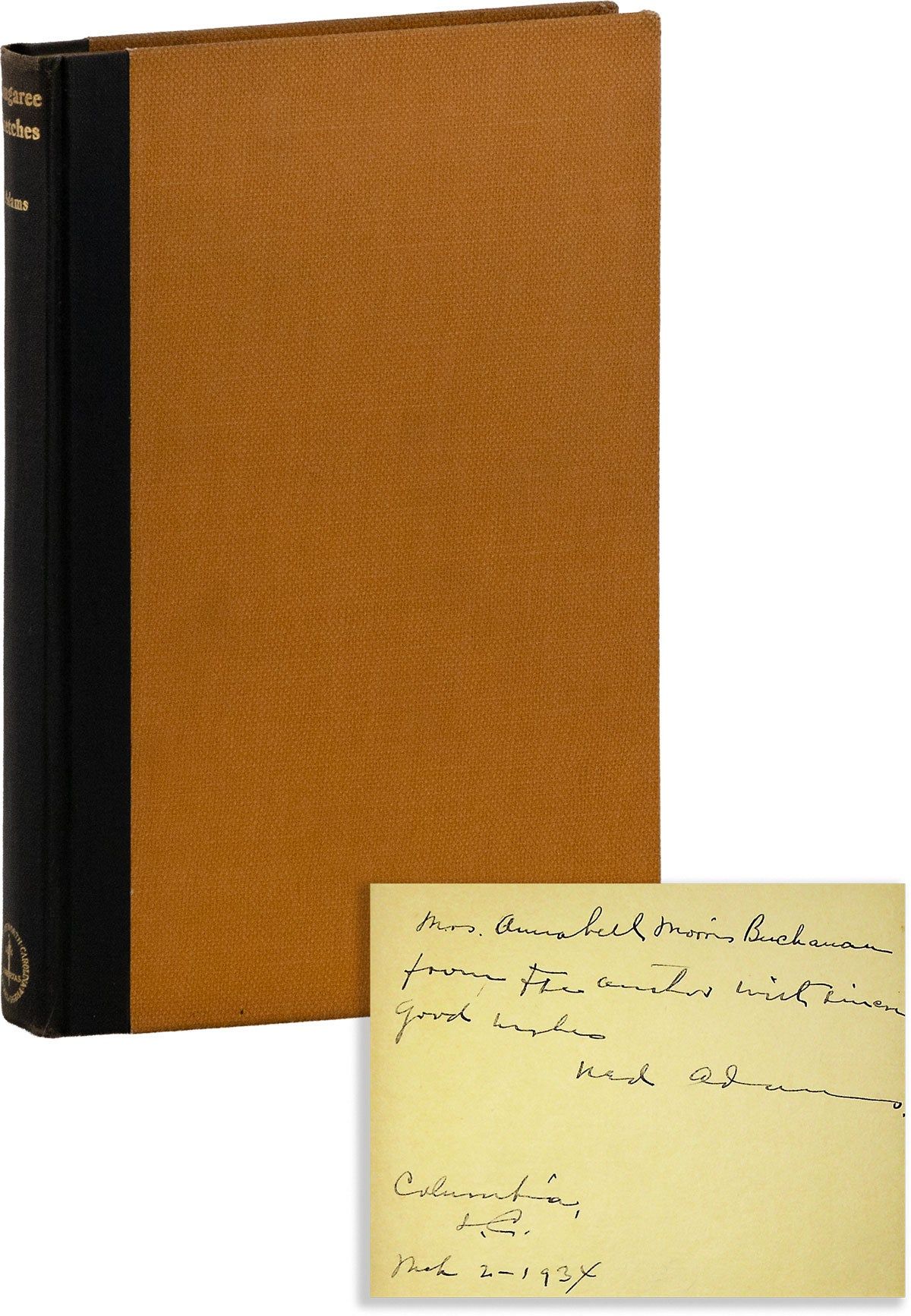
Chapel Hill: University of North Carolina Press, 1927. First Edition. First printing. Inscribed on front endpaper: "Mrs. Annabel Morris Buchanan from the author with sincere good wishes," signed "Ned Adams," datemarked Columbia, SC, 1934. Small octavo (20cm). Black cloth spine over orange-tan cloth-covered boards (hardcover); dustjacket (in pieces) laid-in; xvii,117pp. A tight, clean copy, tightly bound and textually unmarked; Very Good or better. The jacket, completely disarticulated but substantially complete, is laid-in in four pieces.
Adams' well-received first book, a collection of dialect stories set among the African-American residents of the Congaree River region of South Carolina. Like pretty much all work in this mode, best intentions aside, Adams's stories are deeply problematic: his use of dialect is cringeworthy to a sensitive modern reader, but in his time and place Adams was an oddity – a well-to-do white physician from an old South Carolina family who was genuinely sympathetic to the plight of southern Blacks, and was heralded by Americans of both European and African descent as a champion of Southern folk culture and civil rights.
This copy with an interesting association: presented by the author to Virginia folklorist Annabel Morris Buchanan, founder of the seminal White Top Music Festival in Southwest Virginia which, though it spanned only a decade (1931-1939) was a memorable and important early attempt to recognize and preserve southern Appalachian folk culture. The association – between two "advanced" thinkers whose approaches to cultural preservation (in two separate but oddly interlinked realms), though inarguably well-meaning, might now be looked upon as anachronistic – strikes us as a fruitful starting point for inquiry.
Adams' well-received first book, a collection of dialect stories set among the African-American residents of the Congaree River region of South Carolina. Like pretty much all work in this mode, best intentions aside, Adams's stories are deeply problematic: his use of dialect is cringeworthy to a sensitive modern reader, but in his time and place Adams was an oddity – a well-to-do white physician from an old South Carolina family who was genuinely sympathetic to the plight of southern Blacks, and was heralded by Americans of both European and African descent as a champion of Southern folk culture and civil rights.
This copy with an interesting association: presented by the author to Virginia folklorist Annabel Morris Buchanan, founder of the seminal White Top Music Festival in Southwest Virginia which, though it spanned only a decade (1931-1939) was a memorable and important early attempt to recognize and preserve southern Appalachian folk culture. The association – between two "advanced" thinkers whose approaches to cultural preservation (in two separate but oddly interlinked realms), though inarguably well-meaning, might now be looked upon as anachronistic – strikes us as a fruitful starting point for inquiry.