

Archive of Lifelong Progressive and Democratic Party Organizer Carl Vonder Lancken, with Much on the Campaigns of Henry Wallace and Estes Kefauver




- Two scrapbooks (fourteen and 132 pages); Campaign Handbook of the Progressive Party (1948); ten loose flyers and press releases
- United States and Brazil , 1970
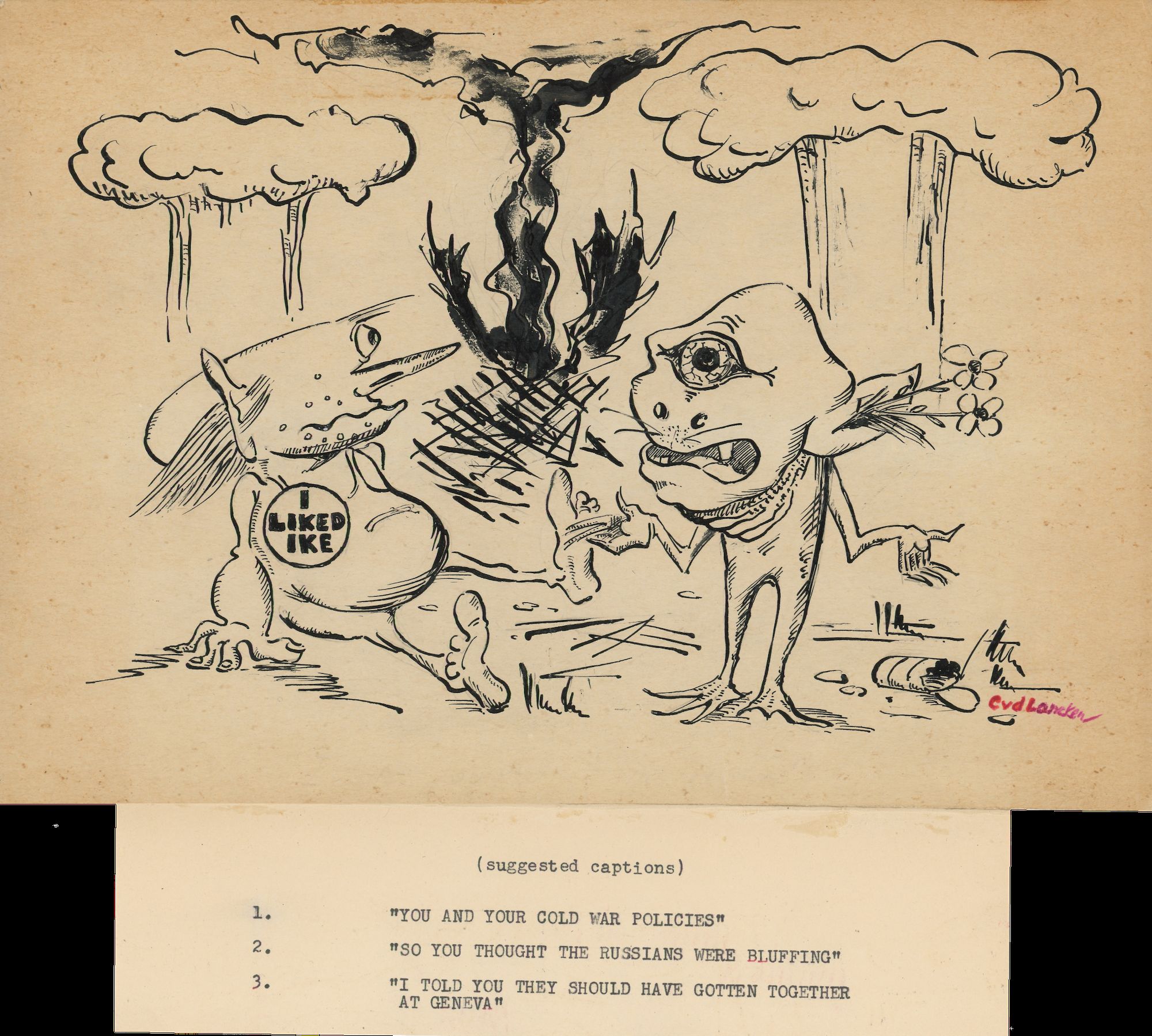
United States and Brazil, 1970. Two scrapbooks (fourteen and 132 pages); Campaign Handbook of the Progressive Party (1948); ten loose flyers and press releases (not including duplicates); twenty-six loose newspaper clippings; one hand-drawn cartoon; and forty-eight pieces of loose correspondence (twenty-four incoming and the same outgoing) dated between 1955 and 1957. Overall Near Fine.. A large archive of material belonging to professor and organizer Carl Vonder Lancken (1910–1993), mainly documenting his political activities, which included campaigning for Henry Wallace in 1948 and Estes Kefauver in 1956. Most of the material is contained in Lancken’s dense and meticulously kept 132 page scrapbook, which documents his activities between 1941 and 1971.
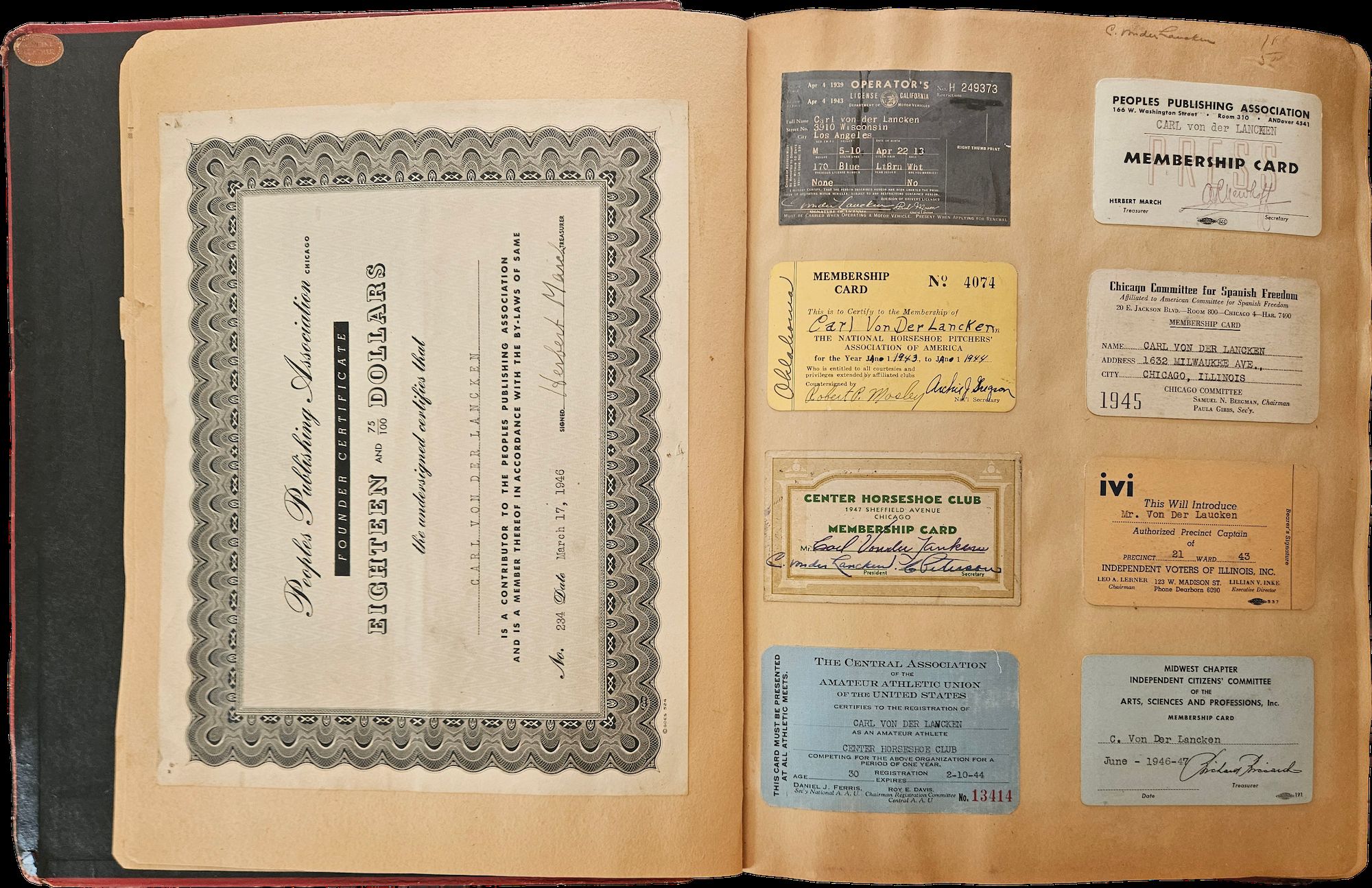
Prior to Wallace’s campaign Lancken was involved with organized labor, and was a member of the United Shoe Workers of America CIO in Chicago, for which he was the educational director and provided legal counsel (membership cards in the scrapbook show that he was a longtime member of the Tennessee Bar). Items from this time include clippings from The CIO News, Shoe Worker’s Edition and The Shoe Horn, the official publication of the Chicago Joint Council No. 25, USWA; a syllabus for a “Brief Course in Trade Unionism for Shop Stewards and Committee Members”, for which Lancken taught a unit on International Affairs Since 1933; and Lancken’s due books, Chicago Industrial Union Council membership card, and honorable withdrawal certificate and card from the USWA.
At the time Lancken was also executive director of the Chicago Council of American-Soviet Friendship. The archive includes flyers for Council events, such as a lecture on “Soviet Women and Family Life in Russia” by Rose Maurer; and a number of letters from artists and politicians expressing support for the cause but turning down Lancken’s invitations to an unspecified event: Eddie Cantor, Rockwell Kent, Jo Davidson, Archibald MacLeish, Henry Wallace, Henry Morgenthau, and Raymond Robins all write to him. Robins explains that he is paralyzed and “shall not walk again this side of the ‘Great Divide’”, but sends Lancken a check in support. Lancken received an invitation from Soviet ambassador Nikolai Novikov to an event “In Celebration of the Twenty-ninth Anniversary of the Great October Revolution”; Novikov also sent a telegram declining one of Lancken’s invitations.
Lancken was also busily writing to congresspeople urging them to abolish the House Un-American Activities Committee (HUAC), about which he received mixed replies; many are supportive and many more noncommittal, but Rep. Alexander Resa of Illinois is downright blistering:
“Your telegram [...] shows that you grossly misunderstand the meaning of the vote on the Barsky matter and that you are unforgivably unfair to many fine liberals in the House of Representatives. [...] When representatives of the joint anti-Fascist Refugee Committee called upon me some time ago I told them very frankly that I thought the course they were bent upon pursuing would destroy every chance of abolishing the Committee on un-American Activities in this Congress. Prior to the Barsky incident there was a considerable volume of opinion in the House of Representatives that the Committee ought to be abolished. That opinion is not so generally held since the Barsky incident. [...] You say that my pledge to abolish the Rankin Committee is meaningless. I do not permit anybody, no matter who he is, to make such a charge against me and to go unscathed. I demand of you a complete and immediate retraction of this charge of bad faith. In the absence of my receiving it promptly I want you to know that there is a[n] ugly four-letter word which I apply to you with all the vigor at my command.” (April 13, 1946)
The “Barsky incident” concerns Edward K. Barsky, head of the Joint Anti-Fascist Refugee Committee, an organization that aided refugees of the Spanish Civil War (a cause that Lancken shared, as a member of the Chicago Committee for Spanish Freedom). Barsky was charged with contempt of Congress for refusing to give the HUAC his organization’s financial records.
Lancken’s next activity, as executive secretary of the Progressive Party in Oklahoma, was working to get Henry A. Wallace on the ballot. This part of the scrapbook mainly consists of newspaper clippings, including from the African American Black Dispatch newspaper. Lancken and his Party co-organizer M. A. Shadid were at pains to demonstrate that neither they nor the Progressive Party were Communist-affiliated; however, a 1945 letter from Lancken to the Communist Party USA regarding some comments in the New Masses and critiquing Browderism—and closing with the line “Lets unite and smash reaction”—suggests that this is not the whole story, at least on Lancken’s part. Later, Lancken and Wallace would have a correspondence in which Lancken chastises Wallace for his stance on the Korean War; Wallace defends himself and tells Lancken that “If you wish to pass on comments to others just say that if the PP leadership continues its present trend it will wreck itself and the PP”. Lancken also corresponds on the topic with Wallace campaign manager “Beanie” Baldwin, who is somewhat more sympathetic. Also from this period is the 1948 Campaign Handbook of the Progressive Party.
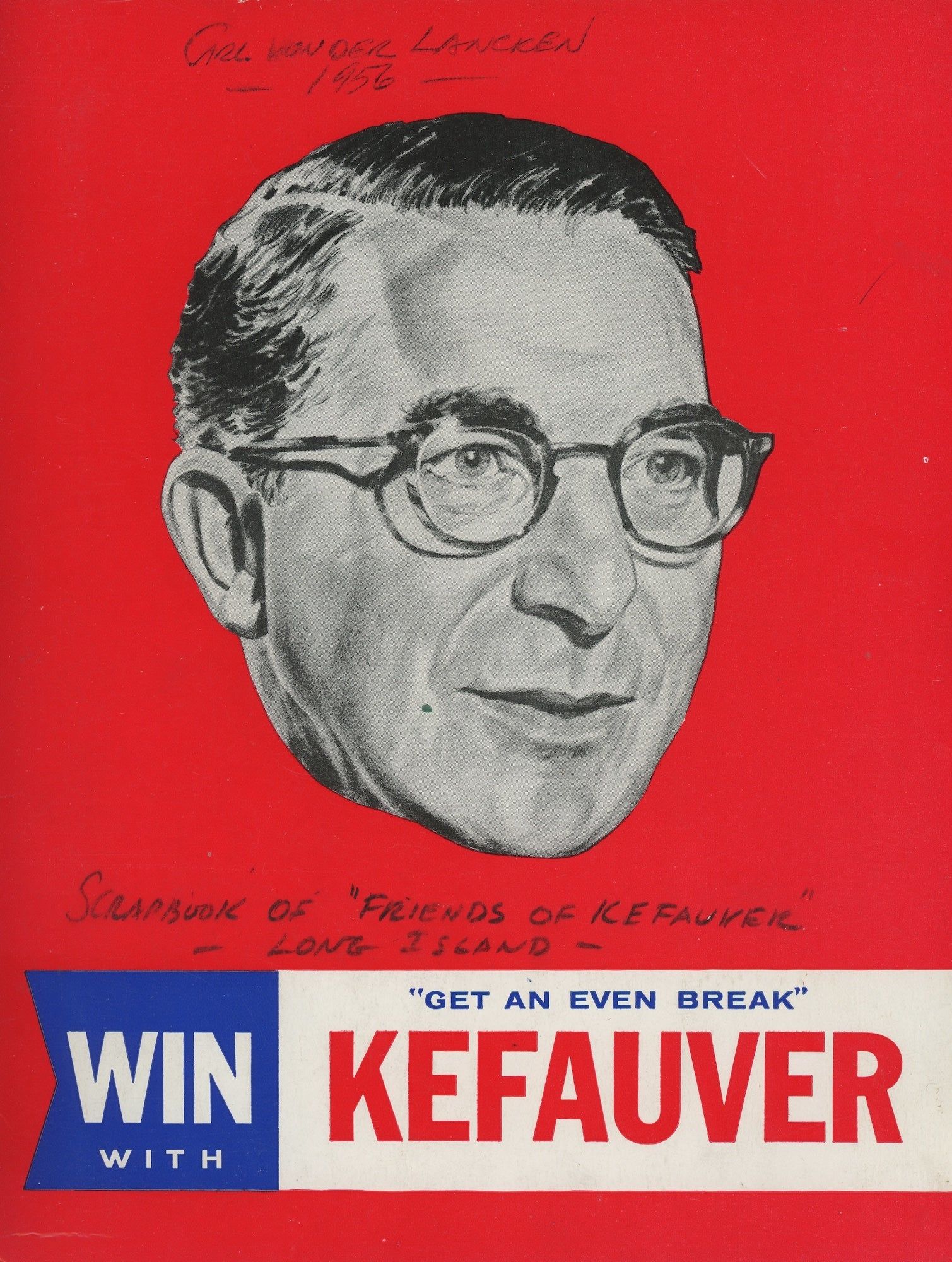
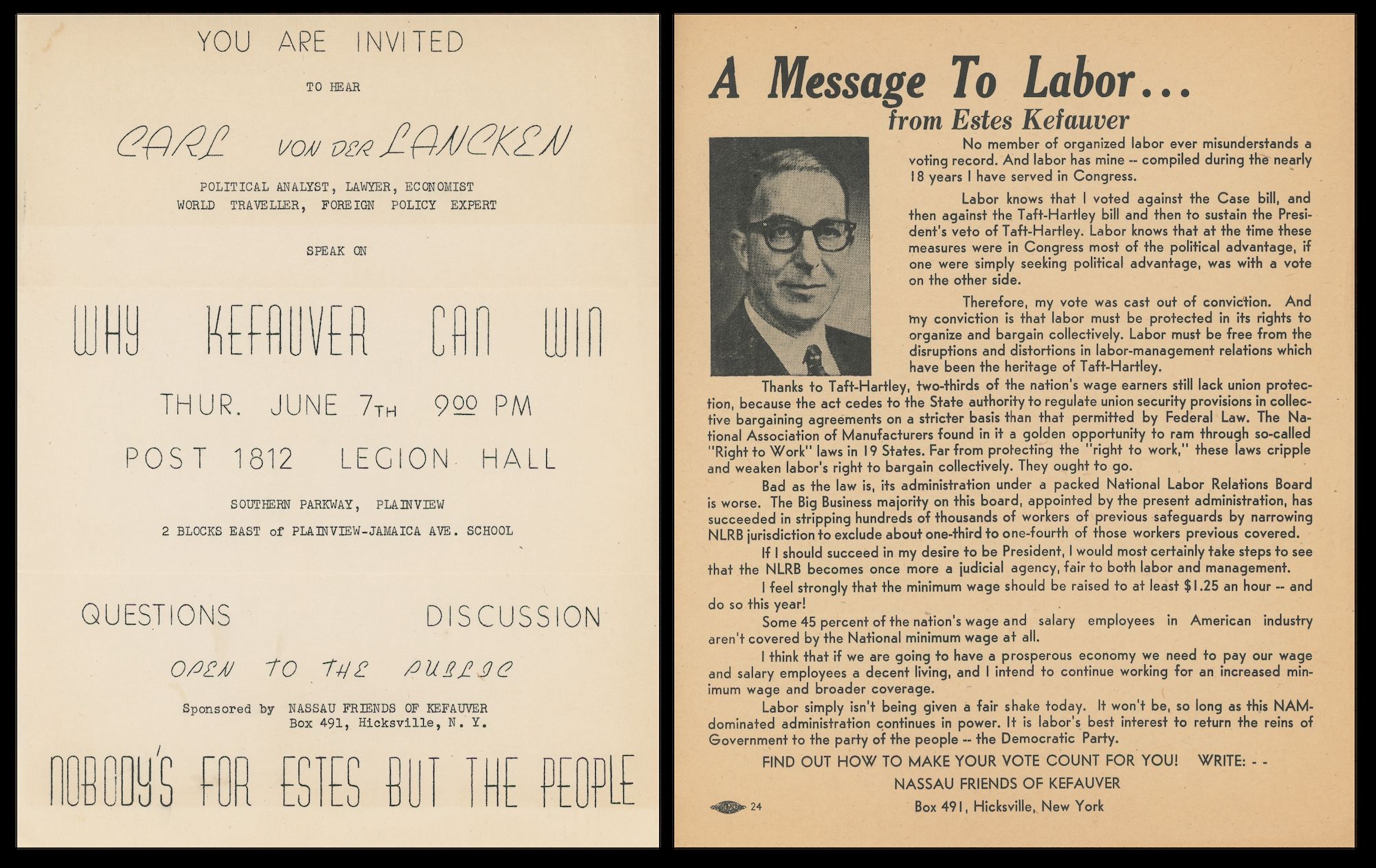
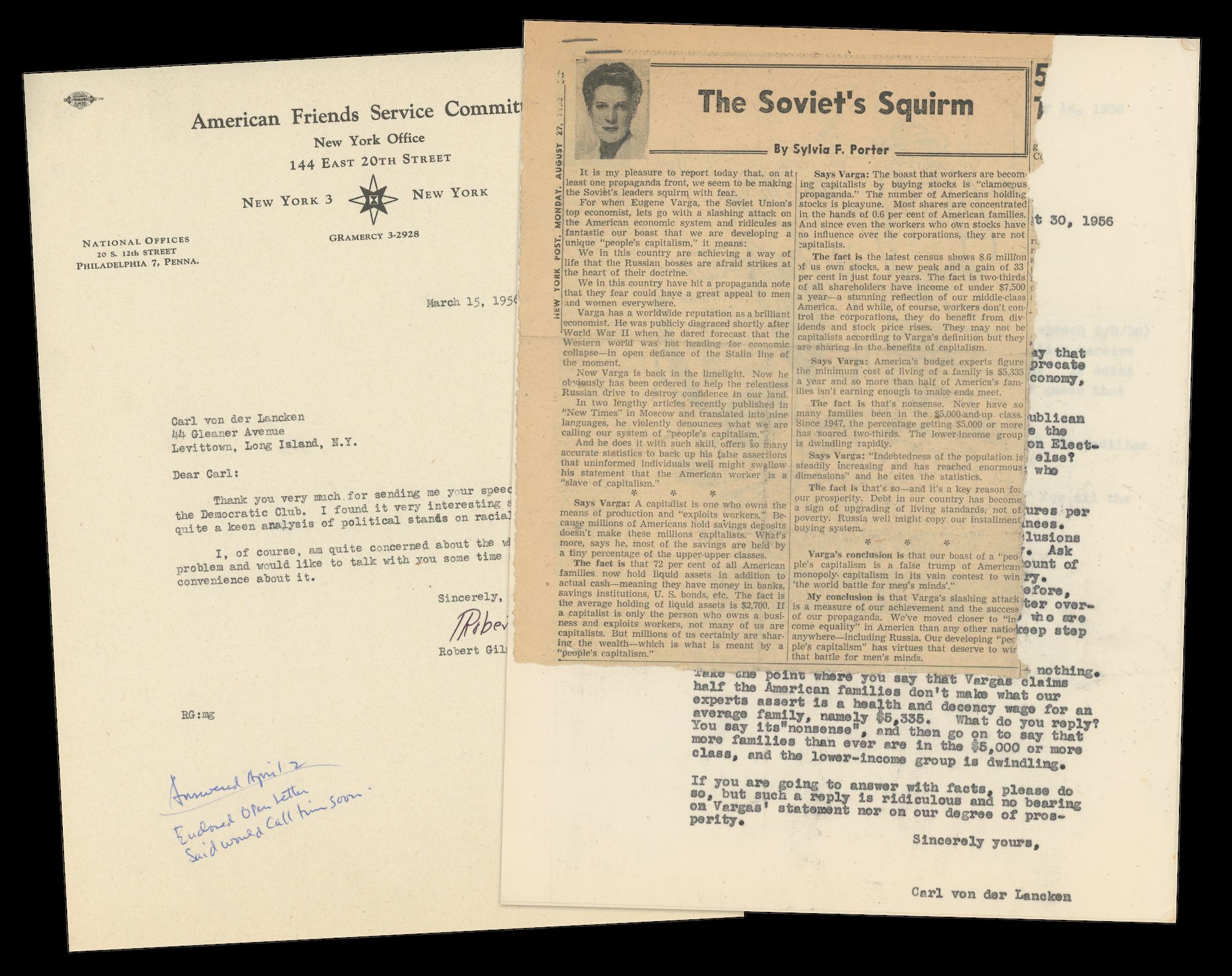
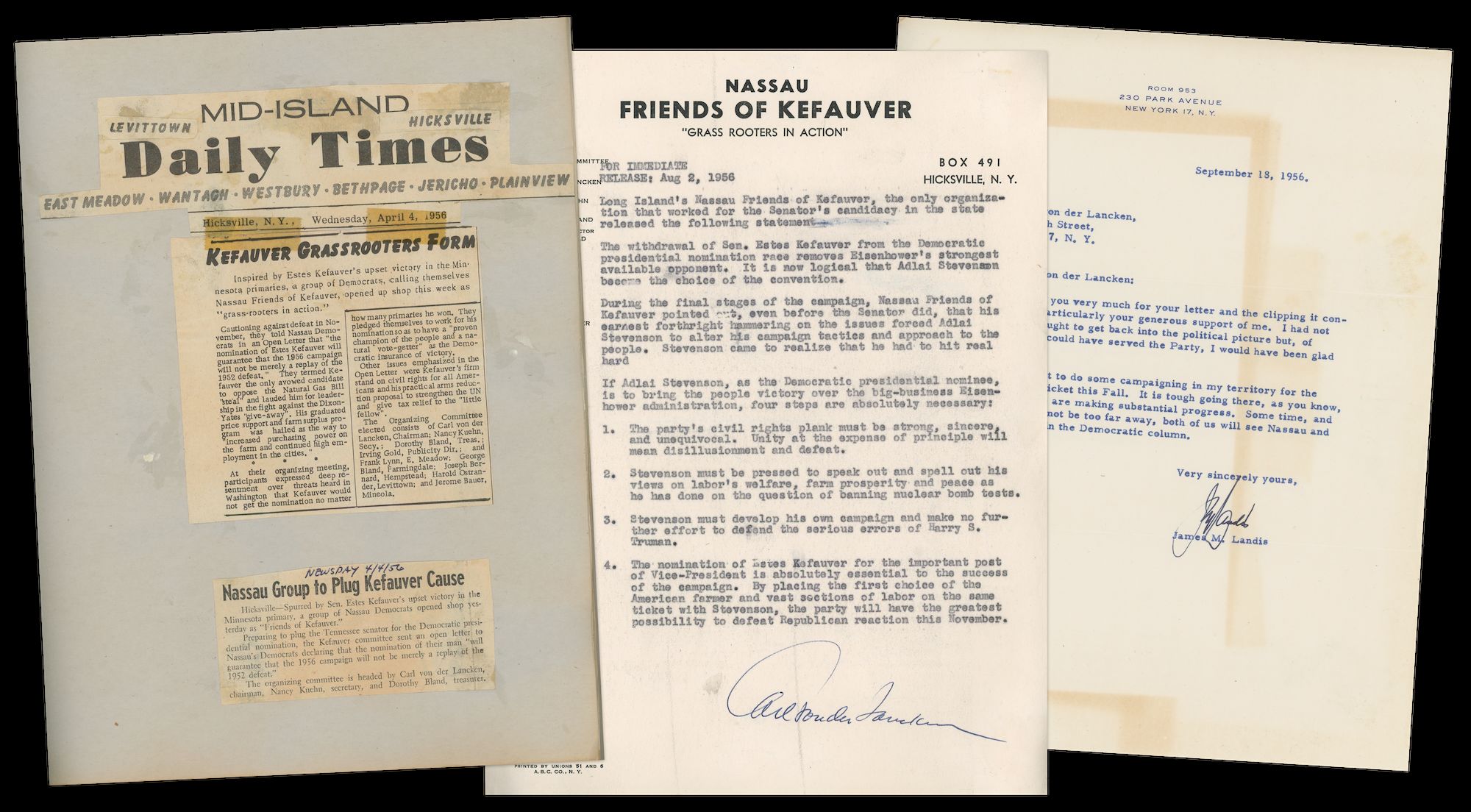
Lancken’s time organizing for Estes Kefauver is documented in the larger scrapbook but also in the loose pages and the smaller “Win With Kefauver” scrapbook. Lancken, who founded the Nassau Friends of Kefauver, gave Kefauver policy and strategy suggestions; according to Lancken’s obituary, he was also a Kefauver speechwriter. Kefauver thanks him and encourages him to “keep in touch” and “continue to give me the benefit of your ideas and suggestions”. Other Kefauver materials include party mailers and flyers (especially Kefauver’s anti-Taft-Hartley “Message to Labor”), and Lancken’s form letters to fellow Long Islanders asking them to contact him with any thoughts or questions about Kefauver. In the one reply to this form letter in the archive, Mr. and Mrs. Earl Schow of Levittown castigate Lancken for choosing a candidate with “no personality [and] no speaking ability.” Following Kefauver’s primary loss to Adlai Stevenson, Lancken also corresponded with the Stevenson-Kefauver campaign, though less enthusiastically and often.
His other activities later in life include involvement with the humanist Ethical Culture Society, the Long Island Committee for a Sane Nuclear Policy, and the White Plains-Greenburgh NAACP. Throughout his life, Lancken was also an avid horseshoe pitcher and a frequent writer of letters to the editor, especially on the topic of racism both in progressive politics and in the local news—one letter to the Mid-Island Daily Times expresses his disappointment about the publication of a large photo of a minstrel show, and explains why minstrelsy is racist and not amusing.
Overall, the archive provides meticulous documentation of Lancken’s political life as a self-described “grass-rooter in action”; of interest to historians of midcentury progressive politics.
Prior to Wallace’s campaign Lancken was involved with organized labor, and was a member of the United Shoe Workers of America CIO in Chicago, for which he was the educational director and provided legal counsel (membership cards in the scrapbook show that he was a longtime member of the Tennessee Bar). Items from this time include clippings from The CIO News, Shoe Worker’s Edition and The Shoe Horn, the official publication of the Chicago Joint Council No. 25, USWA; a syllabus for a “Brief Course in Trade Unionism for Shop Stewards and Committee Members”, for which Lancken taught a unit on International Affairs Since 1933; and Lancken’s due books, Chicago Industrial Union Council membership card, and honorable withdrawal certificate and card from the USWA.
At the time Lancken was also executive director of the Chicago Council of American-Soviet Friendship. The archive includes flyers for Council events, such as a lecture on “Soviet Women and Family Life in Russia” by Rose Maurer; and a number of letters from artists and politicians expressing support for the cause but turning down Lancken’s invitations to an unspecified event: Eddie Cantor, Rockwell Kent, Jo Davidson, Archibald MacLeish, Henry Wallace, Henry Morgenthau, and Raymond Robins all write to him. Robins explains that he is paralyzed and “shall not walk again this side of the ‘Great Divide’”, but sends Lancken a check in support. Lancken received an invitation from Soviet ambassador Nikolai Novikov to an event “In Celebration of the Twenty-ninth Anniversary of the Great October Revolution”; Novikov also sent a telegram declining one of Lancken’s invitations.
Lancken was also busily writing to congresspeople urging them to abolish the House Un-American Activities Committee (HUAC), about which he received mixed replies; many are supportive and many more noncommittal, but Rep. Alexander Resa of Illinois is downright blistering:
“Your telegram [...] shows that you grossly misunderstand the meaning of the vote on the Barsky matter and that you are unforgivably unfair to many fine liberals in the House of Representatives. [...] When representatives of the joint anti-Fascist Refugee Committee called upon me some time ago I told them very frankly that I thought the course they were bent upon pursuing would destroy every chance of abolishing the Committee on un-American Activities in this Congress. Prior to the Barsky incident there was a considerable volume of opinion in the House of Representatives that the Committee ought to be abolished. That opinion is not so generally held since the Barsky incident. [...] You say that my pledge to abolish the Rankin Committee is meaningless. I do not permit anybody, no matter who he is, to make such a charge against me and to go unscathed. I demand of you a complete and immediate retraction of this charge of bad faith. In the absence of my receiving it promptly I want you to know that there is a[n] ugly four-letter word which I apply to you with all the vigor at my command.” (April 13, 1946)
The “Barsky incident” concerns Edward K. Barsky, head of the Joint Anti-Fascist Refugee Committee, an organization that aided refugees of the Spanish Civil War (a cause that Lancken shared, as a member of the Chicago Committee for Spanish Freedom). Barsky was charged with contempt of Congress for refusing to give the HUAC his organization’s financial records.
Lancken’s next activity, as executive secretary of the Progressive Party in Oklahoma, was working to get Henry A. Wallace on the ballot. This part of the scrapbook mainly consists of newspaper clippings, including from the African American Black Dispatch newspaper. Lancken and his Party co-organizer M. A. Shadid were at pains to demonstrate that neither they nor the Progressive Party were Communist-affiliated; however, a 1945 letter from Lancken to the Communist Party USA regarding some comments in the New Masses and critiquing Browderism—and closing with the line “Lets unite and smash reaction”—suggests that this is not the whole story, at least on Lancken’s part. Later, Lancken and Wallace would have a correspondence in which Lancken chastises Wallace for his stance on the Korean War; Wallace defends himself and tells Lancken that “If you wish to pass on comments to others just say that if the PP leadership continues its present trend it will wreck itself and the PP”. Lancken also corresponds on the topic with Wallace campaign manager “Beanie” Baldwin, who is somewhat more sympathetic. Also from this period is the 1948 Campaign Handbook of the Progressive Party.
Lancken’s time organizing for Estes Kefauver is documented in the larger scrapbook but also in the loose pages and the smaller “Win With Kefauver” scrapbook. Lancken, who founded the Nassau Friends of Kefauver, gave Kefauver policy and strategy suggestions; according to Lancken’s obituary, he was also a Kefauver speechwriter. Kefauver thanks him and encourages him to “keep in touch” and “continue to give me the benefit of your ideas and suggestions”. Other Kefauver materials include party mailers and flyers (especially Kefauver’s anti-Taft-Hartley “Message to Labor”), and Lancken’s form letters to fellow Long Islanders asking them to contact him with any thoughts or questions about Kefauver. In the one reply to this form letter in the archive, Mr. and Mrs. Earl Schow of Levittown castigate Lancken for choosing a candidate with “no personality [and] no speaking ability.” Following Kefauver’s primary loss to Adlai Stevenson, Lancken also corresponded with the Stevenson-Kefauver campaign, though less enthusiastically and often.
His other activities later in life include involvement with the humanist Ethical Culture Society, the Long Island Committee for a Sane Nuclear Policy, and the White Plains-Greenburgh NAACP. Throughout his life, Lancken was also an avid horseshoe pitcher and a frequent writer of letters to the editor, especially on the topic of racism both in progressive politics and in the local news—one letter to the Mid-Island Daily Times expresses his disappointment about the publication of a large photo of a minstrel show, and explains why minstrelsy is racist and not amusing.
Overall, the archive provides meticulous documentation of Lancken’s political life as a self-described “grass-rooter in action”; of interest to historians of midcentury progressive politics.