

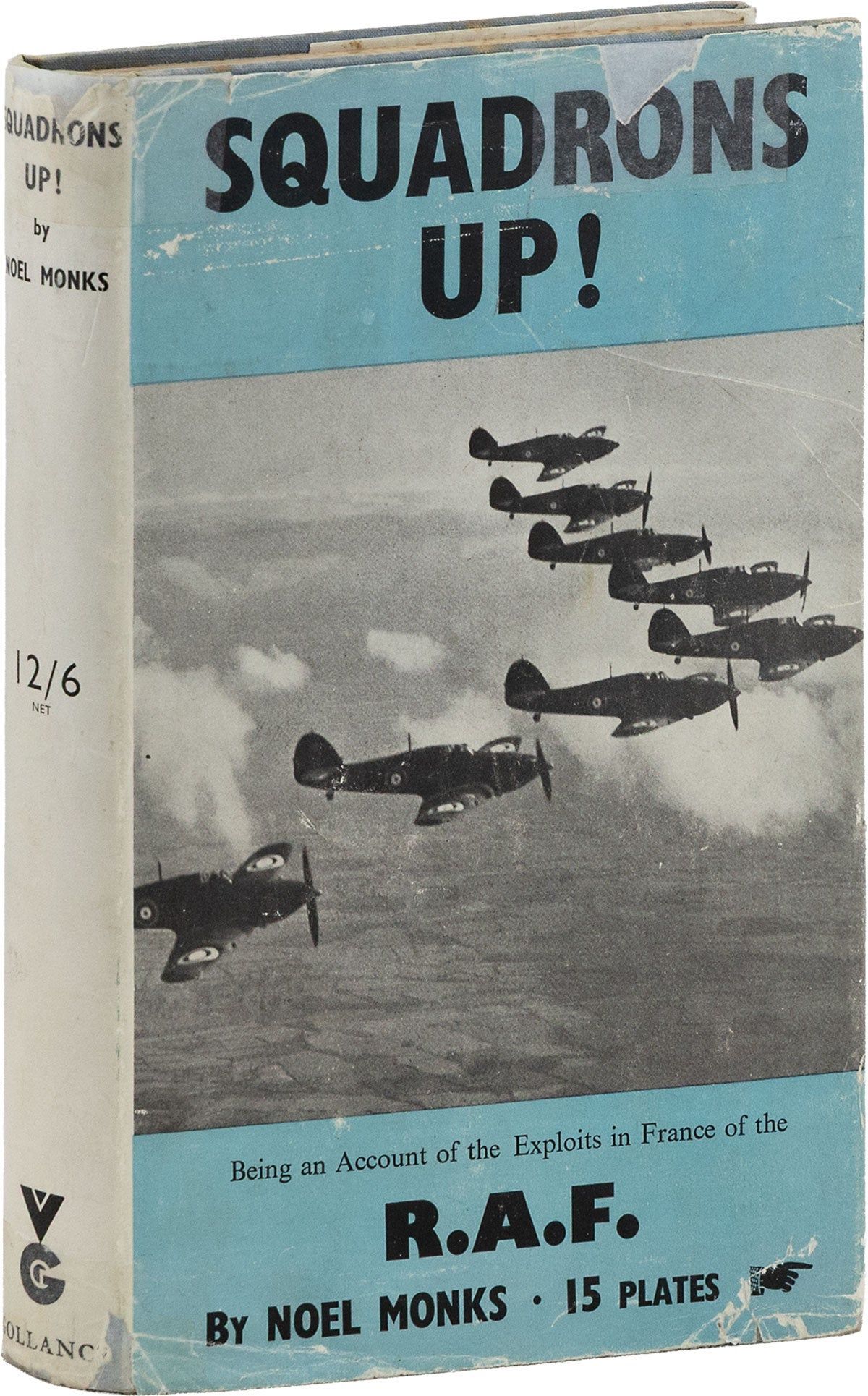
Squadrons Up! Being an Account of the Exploits in France of the R.A.F.
- London: Victor Gollancz Ltd, 1940
London: Victor Gollancz Ltd, 1940. Third Impression. Ocatvo. 22cm. Publisher's light blue cloth titled in gilt to spine. Dustjacket. 253pp. Bumped to spine ends, scuffing and wear to extremities, slight dulling of the cheap gilt, strong and solid; internally clean and fresh, illustrated throughout, light spotting to page edges; in a clean, bright dustjacket with shallow loss and chipping to the spine ends and corners, reinforced to verso with tape. A good solid copy that has seen some use.
Monks was a Daily Mail journalist embedded in France with the RAF in the early days prceding the Battle of Britain, and was close friends with a number of the men who fought the seemingly inexhaustible waves of Luftwaffe seeking to subjugate Europe under fascism. His admiration is clear, and there is the necessary degree of bluff, military propaganda, but his technical understanding of air fighting came straight from the mouths of the men who were up there developing it. His central point is one that is often overlooked in stirring accounts of Spitfires and Hurricanes scrambling across the skies of Europe; no man had, previous to the early days of WW2, fought another man at 30,000 feet in an "orange crate" made out of aluminium and canvas, screaming across the sky at 350mph, firing 9600 rounds per minute. Everything we now know about being a fighter pilot had to be developed from the ground up by these men; additionally it had to be conceived by men whose average age was 22, and upon whose barely-of-age shoulders rested the security and future of their society and way of life.
Monks was a Daily Mail journalist embedded in France with the RAF in the early days prceding the Battle of Britain, and was close friends with a number of the men who fought the seemingly inexhaustible waves of Luftwaffe seeking to subjugate Europe under fascism. His admiration is clear, and there is the necessary degree of bluff, military propaganda, but his technical understanding of air fighting came straight from the mouths of the men who were up there developing it. His central point is one that is often overlooked in stirring accounts of Spitfires and Hurricanes scrambling across the skies of Europe; no man had, previous to the early days of WW2, fought another man at 30,000 feet in an "orange crate" made out of aluminium and canvas, screaming across the sky at 350mph, firing 9600 rounds per minute. Everything we now know about being a fighter pilot had to be developed from the ground up by these men; additionally it had to be conceived by men whose average age was 22, and upon whose barely-of-age shoulders rested the security and future of their society and way of life.