

The Last Journals of David Livingstone, in Central Africa, from 1865 to His Death
- London: John Murray, 1874
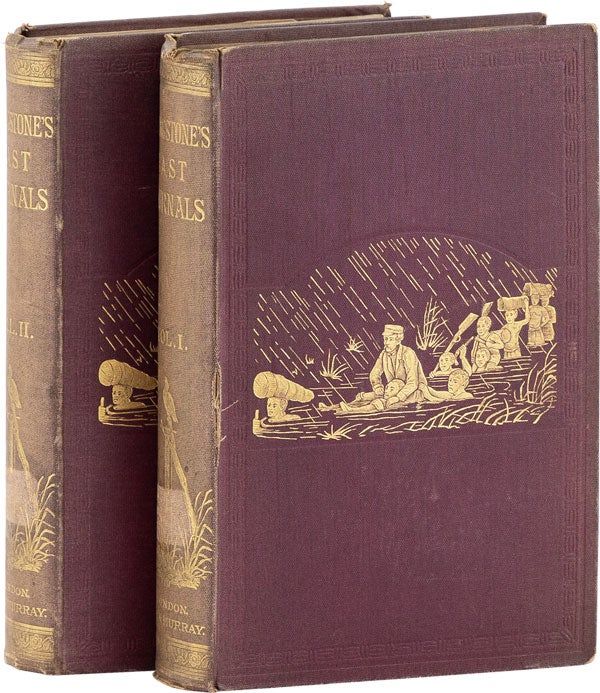
London: John Murray, 1874. First Edition. First printing. Octavo (23cm). Two volumes in purple cloth, stamped in gilt on front and spine; brown coated endpapers; xvi,360,6pp;[viii],346,20pp; 6pp publisher's catalogue at rear of vol. I, 20pp catalogue in vol. II; frontispieces, 3 lithographic facsimiles of leaves from Livingstone's journal, 17 full-page wood-engraved plates, 24 in-text wood engravings, color folding map in vol. II, large color folding map in pocket at rear of vol. I. Ex-library, with marks of spine labels, circulation slips to rear endpapers, and perforated stamps to title pages. Lightly rubbed, spines sunned but boards bright, vol. I hinges cracked, one leaf of ads in vol. II detached: Good or better.
Famed explorer David Livingstone (1813-1873) embarked on his final African expedition in 1866, in an attempt to suppress the local slave trade and trace the source of the White Nile. During this journey he lost contact with Britain for six years, leading to Henry Stanley's mission to locate him, and their famous encounter at Lake Tanganyika in 1871. Livingstone died of malaria and dysentry at Chitambo, in modern Zambia, in 1873. After his death, his popularity in Britain surged. HOWGEGO L36. MENDELSSOHN I, p.912-3.
Famed explorer David Livingstone (1813-1873) embarked on his final African expedition in 1866, in an attempt to suppress the local slave trade and trace the source of the White Nile. During this journey he lost contact with Britain for six years, leading to Henry Stanley's mission to locate him, and their famous encounter at Lake Tanganyika in 1871. Livingstone died of malaria and dysentry at Chitambo, in modern Zambia, in 1873. After his death, his popularity in Britain surged. HOWGEGO L36. MENDELSSOHN I, p.912-3.