

36 Fugen für das Piano Forte Verfasst nach einem neuen System ... Eigenthum des verlegers ... No. 49. Preis f. 6 C.M. B. 4
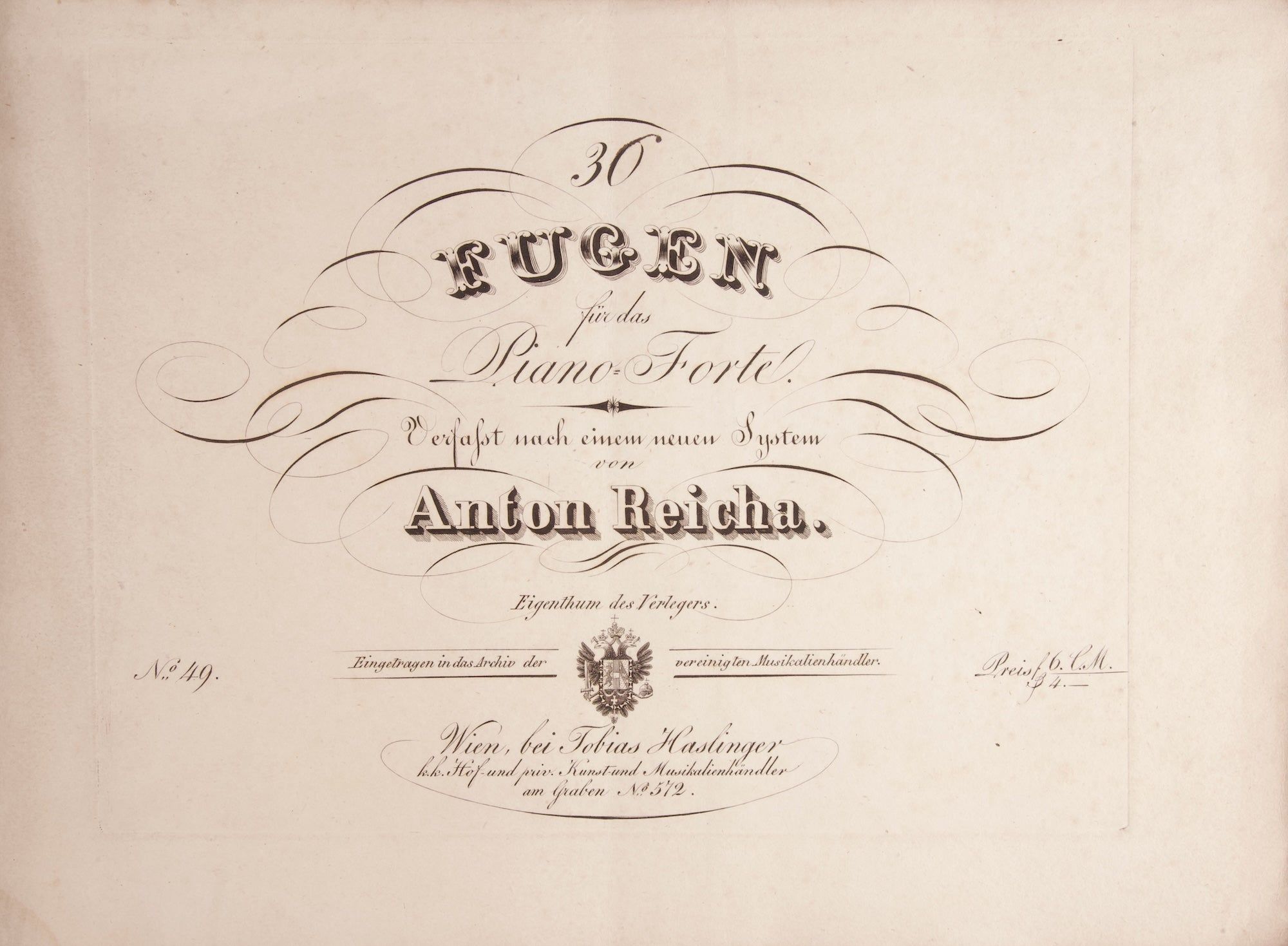
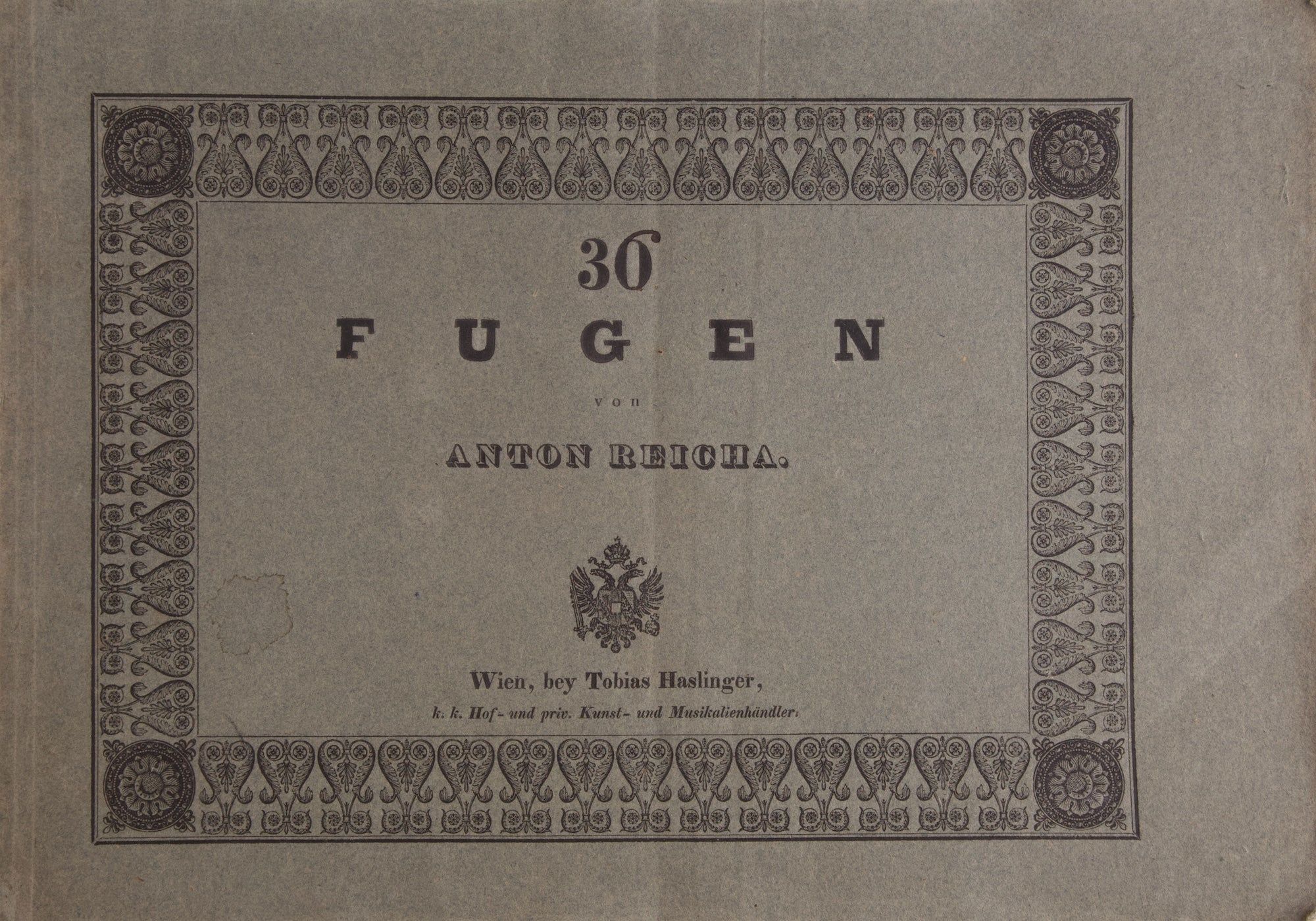
- Wien: Tobias Haslinger k.k. Hof- und priv. Kunst-und Musikalienhändler am Graben No. 572, 1828
Wien: Tobias Haslinger k.k. Hof- und priv. Kunst-und Musikalienhändler am Graben No. 572, 1828. Oblong folio. Original dark green publisher's printed wrappers with titling within decorative border. 1f. (recto title, verso blank), 127, [iv] (remarks on selected fugues) pp. Title engraved, music lithographed, remarks typeset.
Wrappers very slightly worn and creased. Occasional minor wear and foxing; binders' holes to blank inner margin of several leaves.
In very good condition overall. Second edition. Šotolová: Antoní Reicha: A Biography and Thematic Catalogue, pp. 242-248.
Reicha borrows themes from several composers including Haydn (No. 3), Bach (No. 5), Mozart (No. 7), Domenico Scarlatti (No. 9), and Frescobaldi (No. 14). He also experiments with harmony, as in No 8 (a "Cercle harmonique") and No. 25 where, instead of the traditional tonic-dominant-tonic pattern for the fugal entrances, the fugal entrances proceed in major keys at a distance of a major third from one another (D major to B-flat major to F-sharp major). In the 25th fugue, perhaps even more arresting than the harmonic patterns themselves is the contrast between the extreme quality of those patterns and the nursery-rhyme-like nature of the fugue's theme.
Reicha was a Czech composer active in France and Austria. "Though a prolific composer, he was of particular importance as a theorist and teacher in early 19th-century Paris. ... In Reicha’s output some individual works defy classification as purely musical, theoretical or didactic; this resulted, no doubt, from his Hamburg meditations. Like L’art de varier and Bach’s didactic works, the 36 Fugues (1803, dedicated to Haydn) subsume pedagogical examples within artistic conceptions. No.13 offers modal principles in which cadences are possible on all but the 7th degree of the scale without further alteration; nos.20, 24 and 28 contribute ‘combined metre’ (e.g. 6/8 + 2/8), while no.30 displays polymetre. Beethoven owned a copy of these fugues; though he wrote of them that ‘the fugue is no longer a fugue’, changes in his style (e.g. Variations op.35) may derive from Reicha’s ideas on variation and fugue. The exchange of ideas between them was probably reciprocal." Peter Eliot Stone in Grove Music Online.
Wrappers very slightly worn and creased. Occasional minor wear and foxing; binders' holes to blank inner margin of several leaves.
In very good condition overall. Second edition. Šotolová: Antoní Reicha: A Biography and Thematic Catalogue, pp. 242-248.
Reicha borrows themes from several composers including Haydn (No. 3), Bach (No. 5), Mozart (No. 7), Domenico Scarlatti (No. 9), and Frescobaldi (No. 14). He also experiments with harmony, as in No 8 (a "Cercle harmonique") and No. 25 where, instead of the traditional tonic-dominant-tonic pattern for the fugal entrances, the fugal entrances proceed in major keys at a distance of a major third from one another (D major to B-flat major to F-sharp major). In the 25th fugue, perhaps even more arresting than the harmonic patterns themselves is the contrast between the extreme quality of those patterns and the nursery-rhyme-like nature of the fugue's theme.
Reicha was a Czech composer active in France and Austria. "Though a prolific composer, he was of particular importance as a theorist and teacher in early 19th-century Paris. ... In Reicha’s output some individual works defy classification as purely musical, theoretical or didactic; this resulted, no doubt, from his Hamburg meditations. Like L’art de varier and Bach’s didactic works, the 36 Fugues (1803, dedicated to Haydn) subsume pedagogical examples within artistic conceptions. No.13 offers modal principles in which cadences are possible on all but the 7th degree of the scale without further alteration; nos.20, 24 and 28 contribute ‘combined metre’ (e.g. 6/8 + 2/8), while no.30 displays polymetre. Beethoven owned a copy of these fugues; though he wrote of them that ‘the fugue is no longer a fugue’, changes in his style (e.g. Variations op.35) may derive from Reicha’s ideas on variation and fugue. The exchange of ideas between them was probably reciprocal." Peter Eliot Stone in Grove Music Online.