

Three Sonatas for the Piano Forte or Harpsichord With Accompaniments for a Violin and Violoncello. Dedicated by Permission to His Royal Highness the Prince of Wales ... Opera VI. Price 7s: 6. Set [1st - 2d]. [Score]
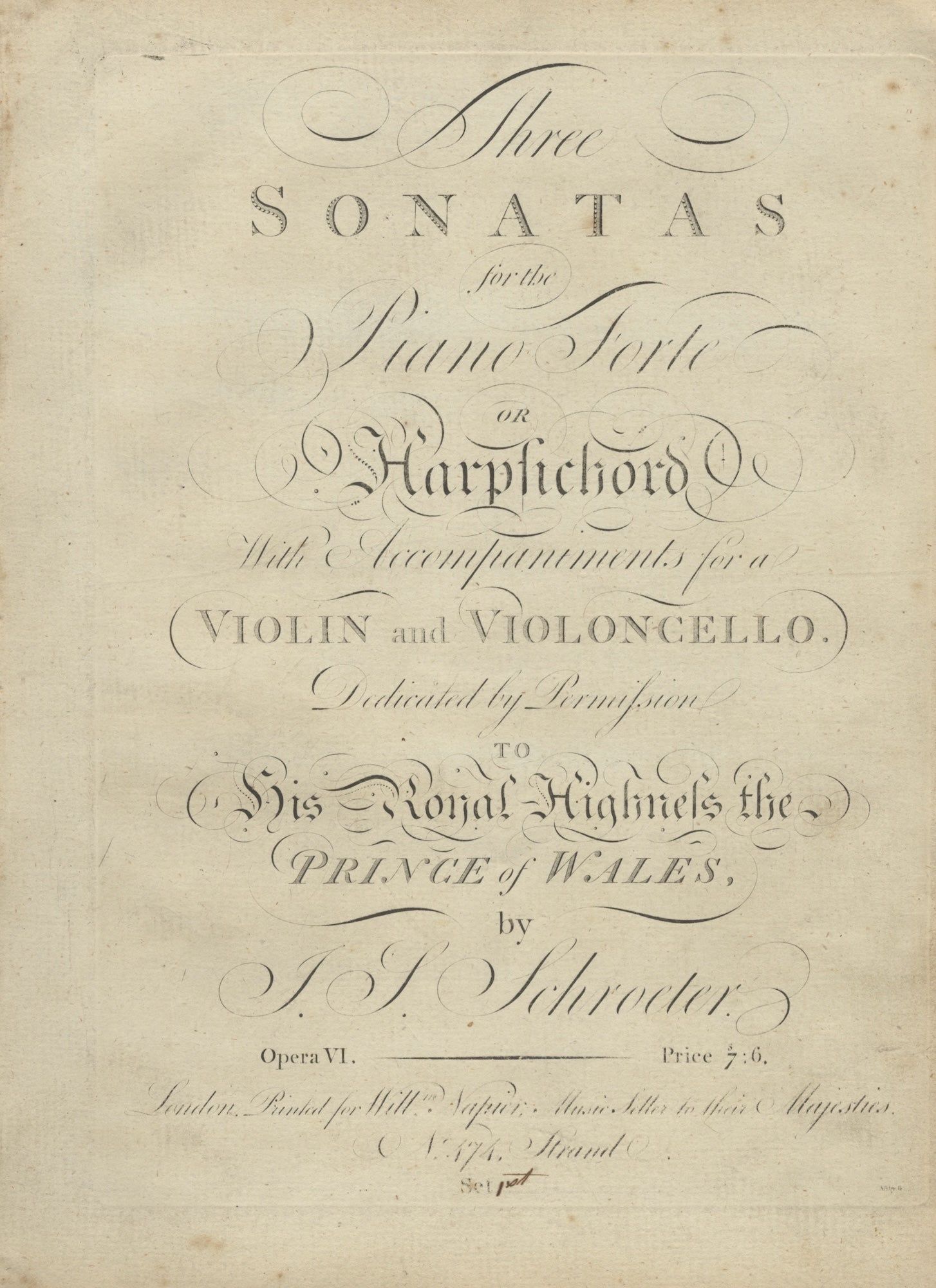
- London: Willm. Napier, Music Seller to their Majesties, No. 474, Strand [PN 157], 1785
London: Willm. Napier, Music Seller to their Majesties, No. 474, Strand [PN 157], 1785. 2 volumes bound together. Folio. Disbound. Engraved.
First set: 1f. (recto title, verso blank), [i] (blank), 2-29 pp.
Second set: 1f. (recto title, verso blank), [i] (blank), 30-53 pp.
Each set contains three sonatas for a total of six sonatas.
Occasional fingerings in pencil.
Very slightly worn and foxed; occasional small tears and creases. This edition not in JISC or BUC, and may pre-date the edition listed there.
OCLC 497706513 (both sets, at the British Library, and the Collecties Nederlands Muziek Instituut). BUC p. 933 (the 1785 set of six sonatas together). RISM S2196 (1 copy only of the second set, at the Bayerische Staatsbibliothek).
Schroeter, a German pianist and composer, "received his earliest musical instruction from his father, and studied with J.A. Hiller in Leipzig from about 1763. Early chroniclers suggested he studied with C.P.E. Bach, but there is no evidence to support this. ... Through the intervention of J.C. Bach, Schroeter gained the protection and interest of the English court, where he made a great impression. On Bach’s death in 1782 he was promptly named music master to Queen Charlotte. His public career was cut short, however, when he eloped to Scotland with one of his students. Her wealthy family, apparently distraught by the marriage, settled a yearly allowance of £500 on Schroeter with the proviso that he abandon his career as a public performer. Nevertheless, he subsequently held an appointment with the Prince of Wales (later George IV), regularly performing in his semi-private concerts, as well as in occasional benefits or concerts of the nobility. Schroeter’s health, apparently never robust, deteriorated rapidly so that he lost his voice altogether and died of a lung disease while still young. His widow, Rebecca Schroeter, later became a student and admirer of Haydn during his first London visit. Her affectionate letters were carefully kept by the composer, who dedicated to her his piano trios hXV:24–6.
Schroeter’s importance lies, Burney wrote, in his being ‘the first who brought into England the true art of treating [the piano]’ (Rees’s Cyclopaedia). His playing was not without bravura, and he astounded audiences by the graceful ease with which he performed rapid passage-work. Indeed the impression he made owed much to the delivery: ‘His touch was extremely light and graceful so that just to watch him play became a pleasure in itself’ (Musikalisches Wochenblatt)." Ronald R. Kidd in Grove Music Online.
First set: 1f. (recto title, verso blank), [i] (blank), 2-29 pp.
Second set: 1f. (recto title, verso blank), [i] (blank), 30-53 pp.
Each set contains three sonatas for a total of six sonatas.
Occasional fingerings in pencil.
Very slightly worn and foxed; occasional small tears and creases. This edition not in JISC or BUC, and may pre-date the edition listed there.
OCLC 497706513 (both sets, at the British Library, and the Collecties Nederlands Muziek Instituut). BUC p. 933 (the 1785 set of six sonatas together). RISM S2196 (1 copy only of the second set, at the Bayerische Staatsbibliothek).
Schroeter, a German pianist and composer, "received his earliest musical instruction from his father, and studied with J.A. Hiller in Leipzig from about 1763. Early chroniclers suggested he studied with C.P.E. Bach, but there is no evidence to support this. ... Through the intervention of J.C. Bach, Schroeter gained the protection and interest of the English court, where he made a great impression. On Bach’s death in 1782 he was promptly named music master to Queen Charlotte. His public career was cut short, however, when he eloped to Scotland with one of his students. Her wealthy family, apparently distraught by the marriage, settled a yearly allowance of £500 on Schroeter with the proviso that he abandon his career as a public performer. Nevertheless, he subsequently held an appointment with the Prince of Wales (later George IV), regularly performing in his semi-private concerts, as well as in occasional benefits or concerts of the nobility. Schroeter’s health, apparently never robust, deteriorated rapidly so that he lost his voice altogether and died of a lung disease while still young. His widow, Rebecca Schroeter, later became a student and admirer of Haydn during his first London visit. Her affectionate letters were carefully kept by the composer, who dedicated to her his piano trios hXV:24–6.
Schroeter’s importance lies, Burney wrote, in his being ‘the first who brought into England the true art of treating [the piano]’ (Rees’s Cyclopaedia). His playing was not without bravura, and he astounded audiences by the graceful ease with which he performed rapid passage-work. Indeed the impression he made owed much to the delivery: ‘His touch was extremely light and graceful so that just to watch him play became a pleasure in itself’ (Musikalisches Wochenblatt)." Ronald R. Kidd in Grove Music Online.