

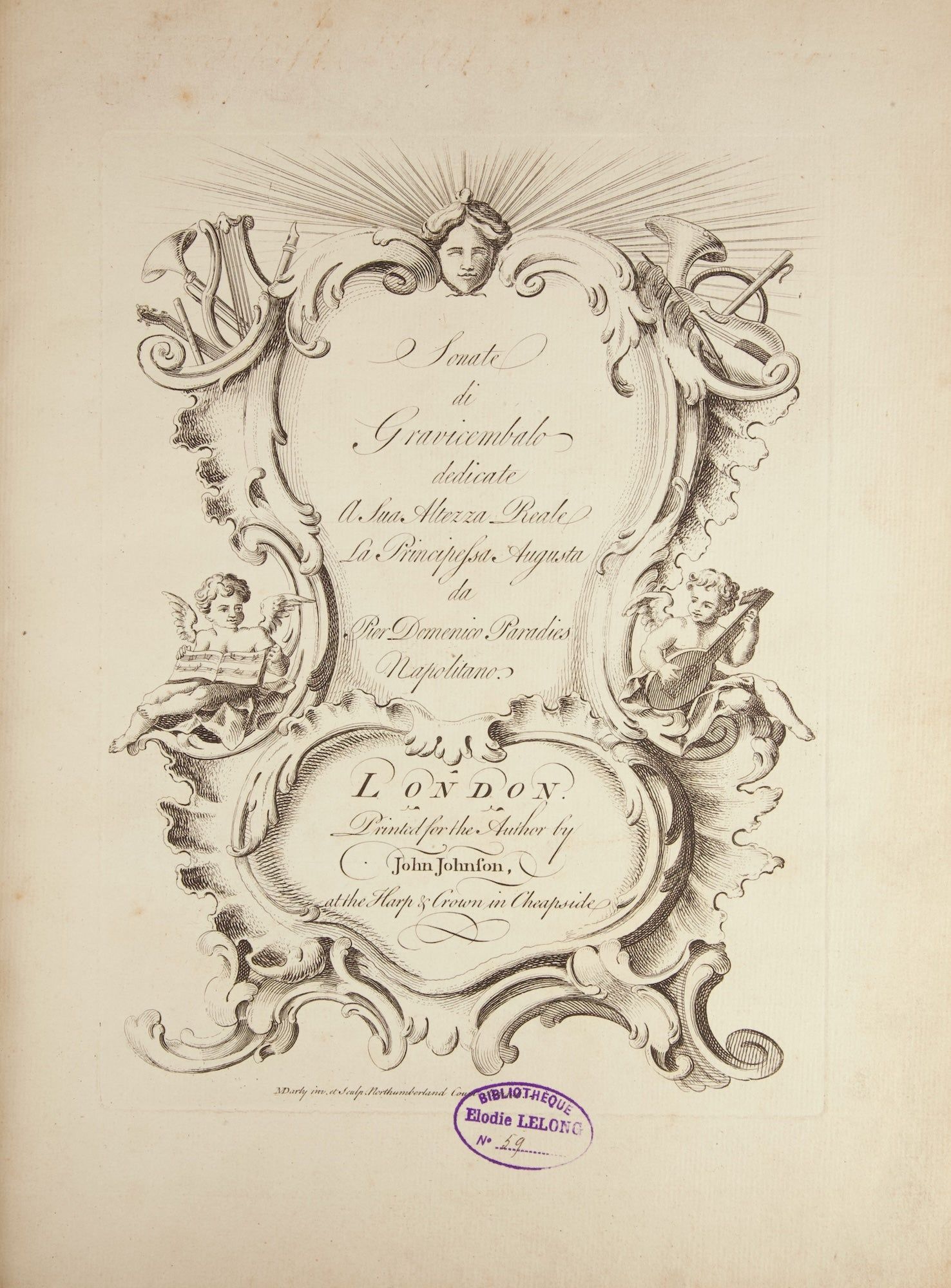
Sonate di Gravicembalo dedicate A Sua Altezza Reale la Principessa Augusta da Pier Domenico Paradies Napolitano ... M. Darly inv. et Sculp. Northumberland Court. [Harpsichord sonatas]
- London: Printed for the Author by John Johnson at the Harp & Crown in Cheapside, 1754
London: Printed for the Author by John Johnson at the Harp & Crown in Cheapside, 1754. Folio. Contemporary mid-tan leather-backed marbled boards with decorative dark red title label gilt to upper., raised bands on spine. 1f. (recto elaborately engraved title within decorative border incorporating a violin, horn, trumpet, bassoon, violin, lyre, putti holding an open book of music and a lute, with a face emanating rays of light, verso blank). 1f. (recto dedication, verso blank), 1f. (recto privilege, verso blank), 47 pp.
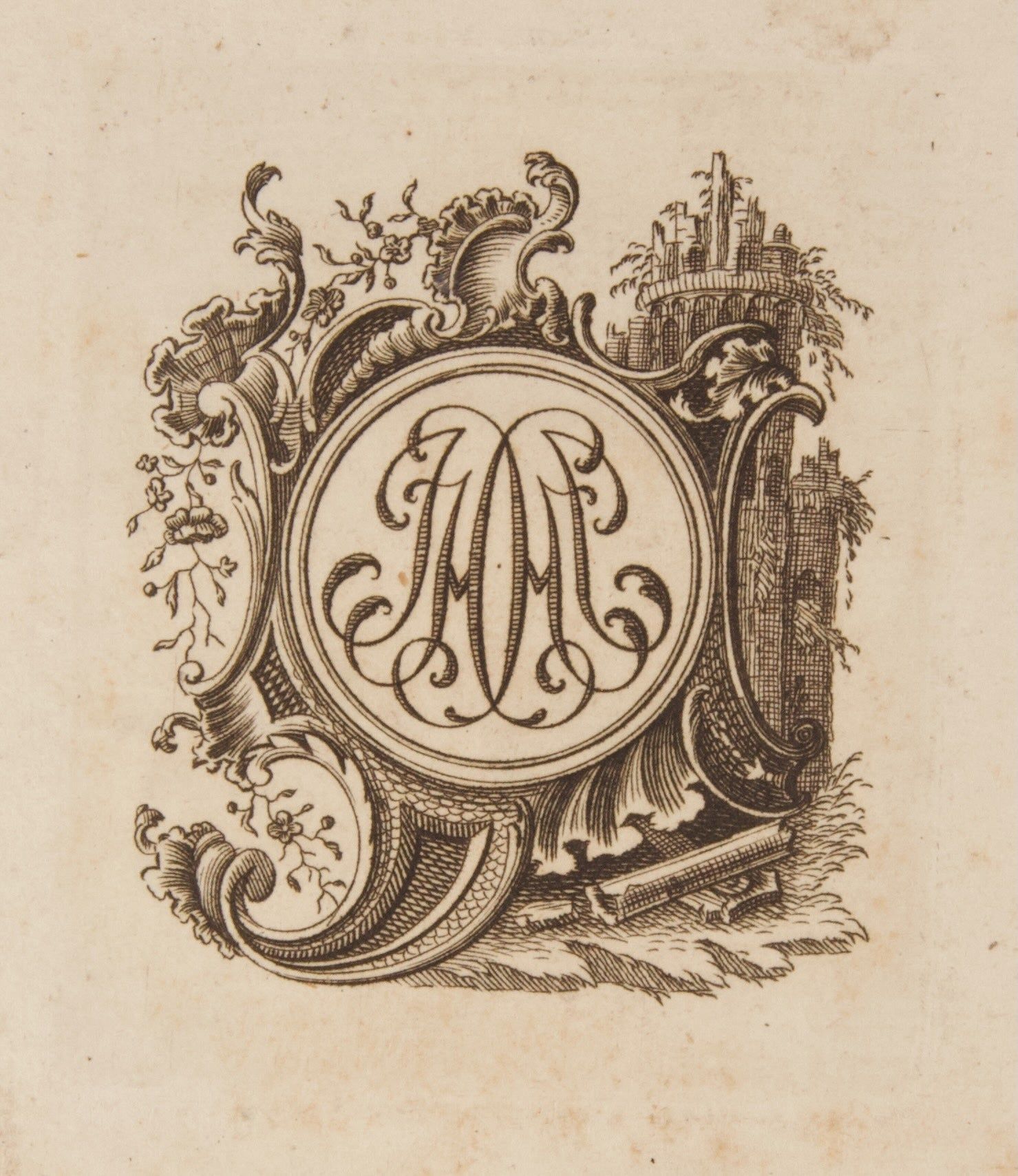
Engraved bookplate with floral and architectural motifs and monogram to front pastedown; small oval handstamps in purple ink of musician Elodie Lelong (1869-1926), "Bibliotheque Elodie Lelong No. [59]," to upper board, free front endpaper, title, and dedication.
Binding worn, rubbed, and bumped; upper detached; outer portions reinforced with early vellum. Slightly soiled, mainly to blank lower outer margins; minor losses to blank lower outer corners of title and a number of additional leaves; small tears to several blank lower margins. First Edition. BUC p. 761. RISM P893 and PP893 (4 copies in the U.S., at Columbia, Harvard, the University of California, Berkeley and the Library of Congress).
Paradies was an "Italian composer, harpsichordist, and teacher. He is believed to have studied with Nicola Porpora in Naples, but little is known about his early life. The first documented performance of his music was of the opera Alessandro in Persia (Lucca, 1738), on a libretto of the Florentine Francesco Vanneschi. ... Paradies emigrated to London in 1746, having already changed the spelling of his name from the Italian ‘Paradisi’. He was one of numerous Italian composers, including Galuppi, who worked there during the mid-18th century. ...
Although Paradies published a concerto for organ or harpsichord and orchestra and composed numerous other instrumental works, his most enduring fame rests on his 12 Sonate di gravicembalo. This collection, published by John Johnson under the protection of a royal privilege in 1754, was reprinted several times in England during the composer’s life, as well as by Le Clerc and Imbault in Paris and Roger in Amsterdam. These sonatas quickly achieved widespread popularity in England and on the continent. The letters of Leopold Mozart indicate that they were studied and performed in his household. Although Burney attributed Paradies’s failure as an opera composer to inexperience, the sonatas consistently display refined craftsmanship. Several of them appeared in 19th- and 20th-century collections of keyboard music, and the entire set exists in two modern editions. The second movement of the sixth sonata, often published separately, entitled ‘Toccata’, has remained popular among harpsichordists and pianists.
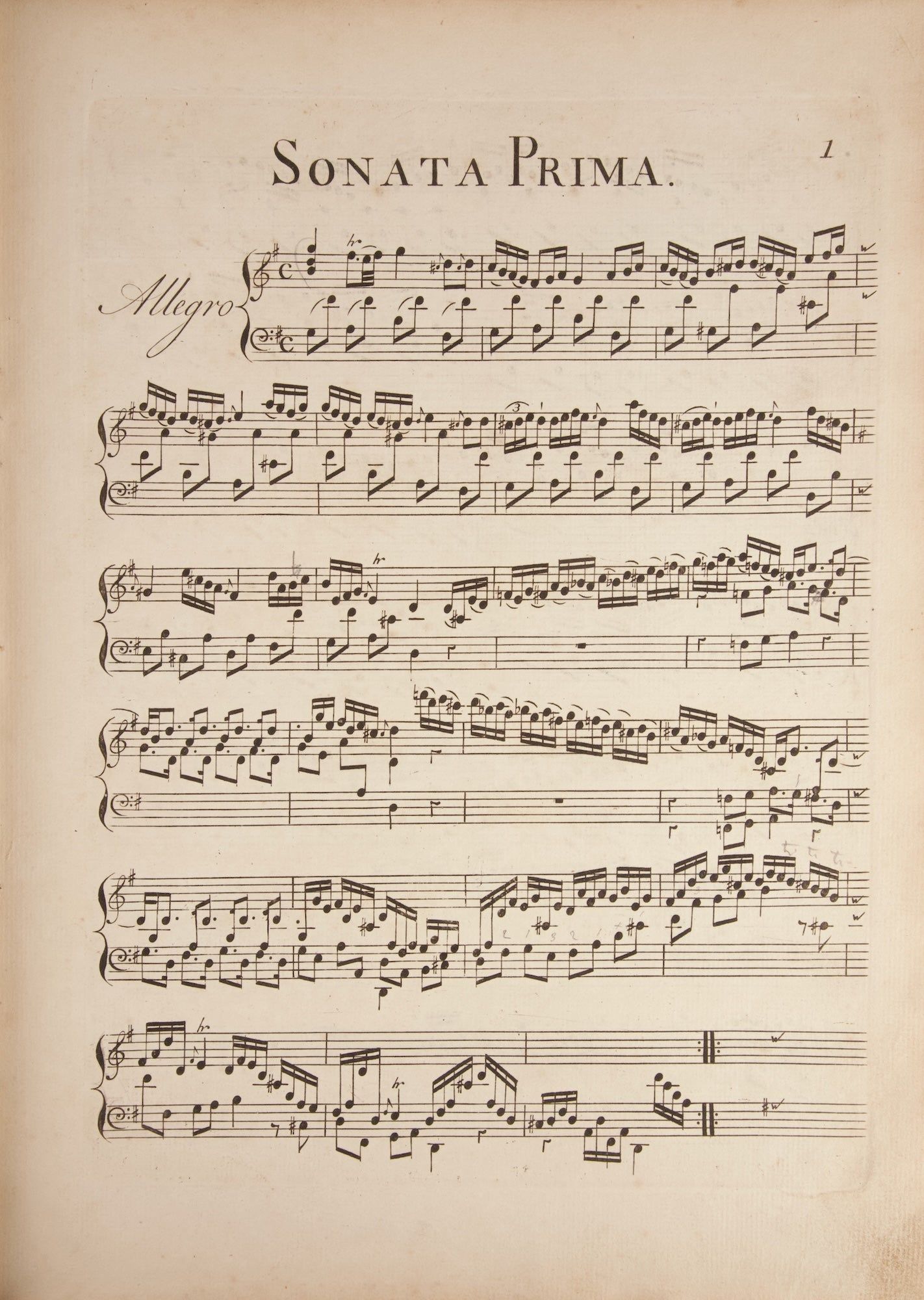
The 12 sonatas are all in two movements. They display some of the more progressive features of the time along with many that are still firmly rooted in Baroque style. Their most modern attribute is the appearance of Classical formal procedure within many individual movements. The opening movements of the sonatas are the most complex and innovative, with 11 of the 12 recognizable as various versions of sonata form. Five of the closing movements are lively, quasi-contrapuntal studies, characterized by rhythmic regularity and broken-chord figuration. Their binary structures sometimes approximate sonata forms except for the lack of rhythmic differentiation (e.g. the ‘Toccata’ from Sonata no.6). Three are gigas and one is a minuet, all in binary form. The remaining three finales are lyrical rondos in slow or moderate tempos. Although many passages approach the cantabile style of Classical pianoforte music, this music was obviously conceived for harpsichord. Dynamic markings are non-existent. The textures exemplify the transitional state of keyboard composition of the mid-century. Much of the writing, especially in the finales, is in two parts in a style that resembles counterpoint, but in which one voice is normally more harmonic than melodic. Some movements begin with brief canonic passages, but quickly abandon imitative style. The first movements tend to be dominated by the melody in the right hand with various patterns outlining the harmony in the left. The true Alberti bass is used only occasionally. Many passages show the influence of the graceful keyboard idiom of Paradies’s Neapolitan predecessor Domenico Scarlatti. In his manipulation of form, Paradies is inconsistent. Of the 11 first movements that resemble sonata form, seven omit all or part of the principal thematic area in the recapitulation in the manner of Scarlatti. Four, however, contain convincing thematic differentiation in the expositions and full recapitulations. Similarly, some of the sections after the central double bar are perfunctory transpositions of opening material, while others contain relatively sophisticated thematic development." Donald C. Sanders in Grove Music Online.
Engraved bookplate with floral and architectural motifs and monogram to front pastedown; small oval handstamps in purple ink of musician Elodie Lelong (1869-1926), "Bibliotheque Elodie Lelong No. [59]," to upper board, free front endpaper, title, and dedication.
Binding worn, rubbed, and bumped; upper detached; outer portions reinforced with early vellum. Slightly soiled, mainly to blank lower outer margins; minor losses to blank lower outer corners of title and a number of additional leaves; small tears to several blank lower margins. First Edition. BUC p. 761. RISM P893 and PP893 (4 copies in the U.S., at Columbia, Harvard, the University of California, Berkeley and the Library of Congress).
Paradies was an "Italian composer, harpsichordist, and teacher. He is believed to have studied with Nicola Porpora in Naples, but little is known about his early life. The first documented performance of his music was of the opera Alessandro in Persia (Lucca, 1738), on a libretto of the Florentine Francesco Vanneschi. ... Paradies emigrated to London in 1746, having already changed the spelling of his name from the Italian ‘Paradisi’. He was one of numerous Italian composers, including Galuppi, who worked there during the mid-18th century. ...
Although Paradies published a concerto for organ or harpsichord and orchestra and composed numerous other instrumental works, his most enduring fame rests on his 12 Sonate di gravicembalo. This collection, published by John Johnson under the protection of a royal privilege in 1754, was reprinted several times in England during the composer’s life, as well as by Le Clerc and Imbault in Paris and Roger in Amsterdam. These sonatas quickly achieved widespread popularity in England and on the continent. The letters of Leopold Mozart indicate that they were studied and performed in his household. Although Burney attributed Paradies’s failure as an opera composer to inexperience, the sonatas consistently display refined craftsmanship. Several of them appeared in 19th- and 20th-century collections of keyboard music, and the entire set exists in two modern editions. The second movement of the sixth sonata, often published separately, entitled ‘Toccata’, has remained popular among harpsichordists and pianists.
The 12 sonatas are all in two movements. They display some of the more progressive features of the time along with many that are still firmly rooted in Baroque style. Their most modern attribute is the appearance of Classical formal procedure within many individual movements. The opening movements of the sonatas are the most complex and innovative, with 11 of the 12 recognizable as various versions of sonata form. Five of the closing movements are lively, quasi-contrapuntal studies, characterized by rhythmic regularity and broken-chord figuration. Their binary structures sometimes approximate sonata forms except for the lack of rhythmic differentiation (e.g. the ‘Toccata’ from Sonata no.6). Three are gigas and one is a minuet, all in binary form. The remaining three finales are lyrical rondos in slow or moderate tempos. Although many passages approach the cantabile style of Classical pianoforte music, this music was obviously conceived for harpsichord. Dynamic markings are non-existent. The textures exemplify the transitional state of keyboard composition of the mid-century. Much of the writing, especially in the finales, is in two parts in a style that resembles counterpoint, but in which one voice is normally more harmonic than melodic. Some movements begin with brief canonic passages, but quickly abandon imitative style. The first movements tend to be dominated by the melody in the right hand with various patterns outlining the harmony in the left. The true Alberti bass is used only occasionally. Many passages show the influence of the graceful keyboard idiom of Paradies’s Neapolitan predecessor Domenico Scarlatti. In his manipulation of form, Paradies is inconsistent. Of the 11 first movements that resemble sonata form, seven omit all or part of the principal thematic area in the recapitulation in the manner of Scarlatti. Four, however, contain convincing thematic differentiation in the expositions and full recapitulations. Similarly, some of the sections after the central double bar are perfunctory transpositions of opening material, while others contain relatively sophisticated thematic development." Donald C. Sanders in Grove Music Online.