

Cav. Pietro Raimondi Romano Maestro Compositore di Musica. All' Insigne Pontificia Congre. re ed Academia di S. Cecilia di Roma
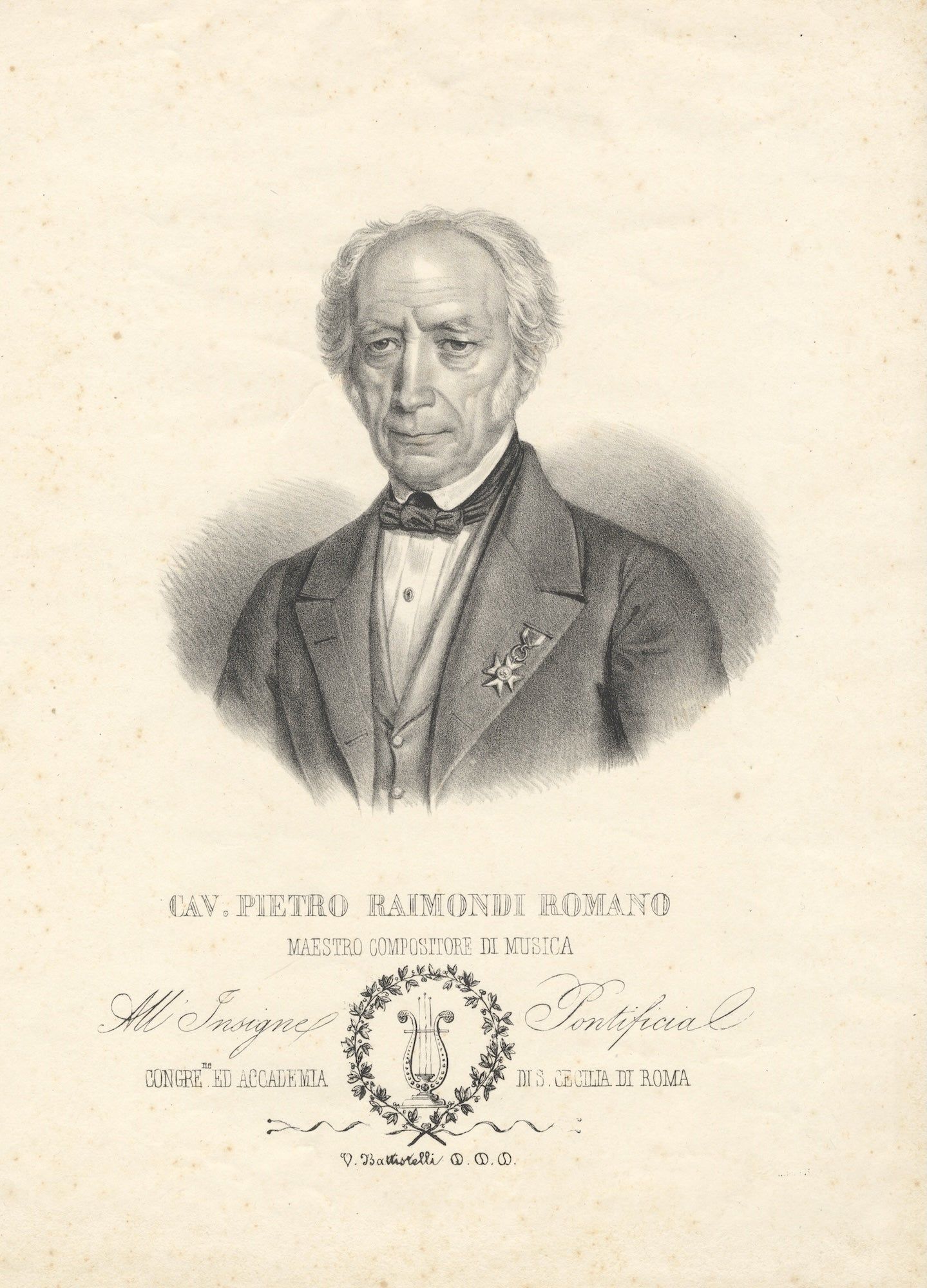
- [?]Rome: V. Battistelli, 1852
[?]Rome: V. Battistelli, 1852. Head-and-shoulders portrait lithograph.
Image size 315 x 190 mm; sheet size 400 x 284 mm. On wove paper.
Minor foxing; narrow strip of dark gray paper to upper margin of verso. Scarce. Arrigoni and Bertarelli 3615.
"After completing studies with Tritto at the Conservatorio di S Maria della Pietà in Naples, [Raimondi] embarked on a series of operas, mostly comic, for Genoa, Florence, Naples and Rome. In 1815 he took his first post as maestro di cappella in Acireale, Sicily, and apart from reviving two earlier operas for Messina and Catania, he was occupied mainly with cantatas and sacred music during this period. He resumed operatic composition after settling in Naples in 1820, reaffirming the gift for light farcical works, partly in Neapolitan dialect and with spoken dialogue, that was largely to sustain his theatrical career. His skill in treating comic dialect parts is shown in the first-act duet of Il finto feudatario (1826), in which the disguised Baron Folpo affects a lofty Italian while attempting to trick Albina into marrying him, reverting to dialect in an explosion of patter-singing as he sees his plan fail. The performance of such works was naturally restricted to Naples, though La donna colonello (1822), profiting by its association with Rubini, who had created the lead tenor role, was revived in Dresden in an all-Italian version. Rubini also included arias written for him in La caccia di Enrico IV (1822) and Argia (1823) on concert tours, and inserted them into other operas, helping to spread Raimondi’s fame. ... Around 1836 his first didactic text Bassi imitati e fugati was published, and the same year a messa di gloria for double chorus and double orchestra was performed in Palermo. This was the first in a series of experiments in musical simultaneity which culminated in his ‘triple oratorio’ Putifar-Giuseppe-Giacobbe (1847–8), a set of three oratorios to be performed first separately and then simultaneously. The great success of this work led to Raimondi’s appointment in 1852 as maestro di cappella at S Pietro, Rome." Jesse Rosenberg in Grove Music Online.
Image size 315 x 190 mm; sheet size 400 x 284 mm. On wove paper.
Minor foxing; narrow strip of dark gray paper to upper margin of verso. Scarce. Arrigoni and Bertarelli 3615.
"After completing studies with Tritto at the Conservatorio di S Maria della Pietà in Naples, [Raimondi] embarked on a series of operas, mostly comic, for Genoa, Florence, Naples and Rome. In 1815 he took his first post as maestro di cappella in Acireale, Sicily, and apart from reviving two earlier operas for Messina and Catania, he was occupied mainly with cantatas and sacred music during this period. He resumed operatic composition after settling in Naples in 1820, reaffirming the gift for light farcical works, partly in Neapolitan dialect and with spoken dialogue, that was largely to sustain his theatrical career. His skill in treating comic dialect parts is shown in the first-act duet of Il finto feudatario (1826), in which the disguised Baron Folpo affects a lofty Italian while attempting to trick Albina into marrying him, reverting to dialect in an explosion of patter-singing as he sees his plan fail. The performance of such works was naturally restricted to Naples, though La donna colonello (1822), profiting by its association with Rubini, who had created the lead tenor role, was revived in Dresden in an all-Italian version. Rubini also included arias written for him in La caccia di Enrico IV (1822) and Argia (1823) on concert tours, and inserted them into other operas, helping to spread Raimondi’s fame. ... Around 1836 his first didactic text Bassi imitati e fugati was published, and the same year a messa di gloria for double chorus and double orchestra was performed in Palermo. This was the first in a series of experiments in musical simultaneity which culminated in his ‘triple oratorio’ Putifar-Giuseppe-Giacobbe (1847–8), a set of three oratorios to be performed first separately and then simultaneously. The great success of this work led to Raimondi’s appointment in 1852 as maestro di cappella at S Pietro, Rome." Jesse Rosenberg in Grove Music Online.