

L'Euridice d'Ottavio Rinuccini, Rappresentata nello sponsalitio della Christianiss. Regina di Francia, e di Navarra. [Libretto]
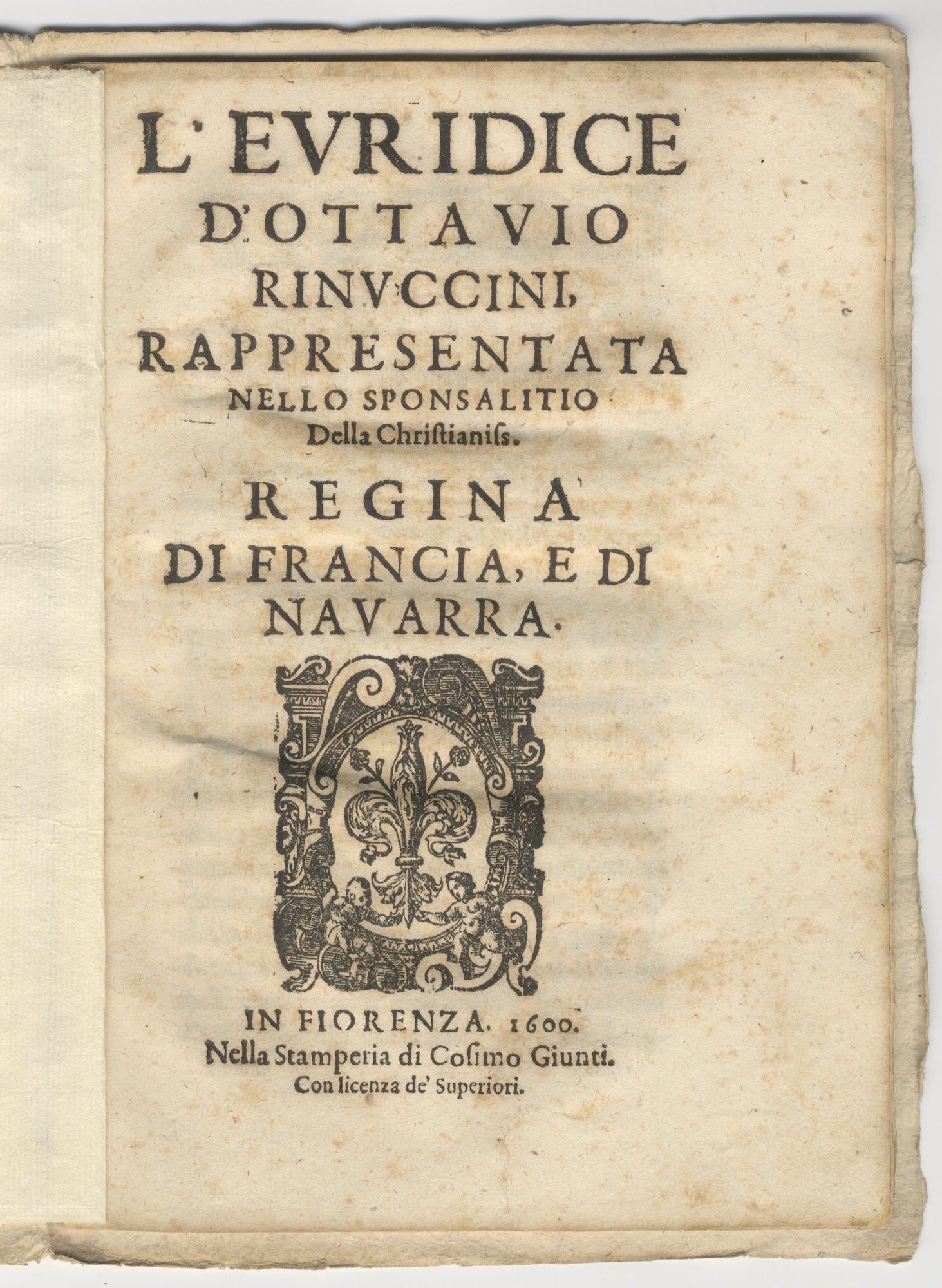
- Fiorenza: Nella Stamperia di Cosimo Giunti. Con licenza de' Superiori, 1600
Fiorenza: Nella Stamperia di Cosimo Giunti. Con licenza de' Superiori, 1600. Small quarto. Contemporary carta rustica. 1f. (recto title with woodcut Medici coat of arms, verso blank), [iii] (dedication "Alla Christianissima Maria Medici" dated "Di Firenze il dì [blank] Ottobre 1600"), [i] (blank), 1f. (recto cast list, verso blank) + 16ff., with large woodcut Medici coat of arms to final page. Typeset.
With decorative woodcut headpiece and initial to first page of text.
With correction in early manuscript to leaf 5.
Slightly worn; edges browned; occasional minor stains and foxing; some irregular and incorrect printed foliation (e.g. "7" printed twice); first letters of names of cast members only partially inked. First Edition, second variant (with comma after Rinuccini to title). Allacci col. 317. Fuld p. 95 (not assigning precedence). Gaspari V, p. 393. Hirsch IV, 1391. Sartori II, 9398. Sonneck I, pp. 460-461. Watanabe O'Kelly and Simon 1229. Wotquenne p. 66.
Euridice, an opera in 5 scenes with music mainly by Peri with additions by Giulio Romolo Caccini (1551-1618) to a libretto by Ottavio Rinuccini (1562-1621) after Ovid's Metamorphoses (Book 10) with borrowings from Virgil's fourth Georgic and Poliziano's Orfeo, was first performed in Florence at the Palazzo Pitti on 6 October 1600 as part of the celebrations of the wedding of Maria de’ Medici and Henri IV, King of France; Peri himself played the part of Orpheus.
"In Euridice, Peri goes further than he had in his Dafne (1597/8) in the devising of ways of writing a drama with continuous music. There are choruses to end each of the five scenes, and several set pieces - Orpheus’s invocation of nature, Tirsi’s strophic song of celebration, and the messenger’s moving description of Eurydice’s death, all in the second scene, Orpheus’s lament before the gates of hell in the fourth and his strophic song of celebration and joy in the fifth. Euridice gives a clear impression of Peri’s theatrical style and the nature of his contribution to the development of opera, of his special gift for expressive recitative and his imaginative use of dissonance and striking harmonies." Howard Mayer Brown, revised by Barbara Russano Hanning in Grove Music Online
Rinuccini, an "Italian, courtier and author of lyric and dramatic poetry, is considered to be the first librettist and his libretto to the present work, in itself, a very important document relating to early opera. In his dedication to the Queen, Rinuccini states that it "has been the opinion of many" that Ancient tragedy was sung in its entirety, that he had longed believed it impossible to recreate this because of the weakness of modern music, but that Peri had overcome these doubts with his beautiful settings, first of Dafne and now even more so by his even greater setting of Euridice." Barbara R. Hanning in Grove Music Online
"Although Caccini’s name is inextricably linked with that of Peri in the creation of the first Florentine operas and although his setting of Euridice was the first such opera ever to be published, Caccini should primarily be viewed as a composer of songs." H. Wiley Hitchcock in Grove Music Online. His contributions to Euridice include Euridice’s arias, some of the shepherd’s and the nymph’s, and the choruses ending scenes 1, 2, and 4 (Al canto, al ballo, Poi che gli eterni imperi and Sospirate, aure celesti).
Peri was an Italian composer, singer and instrumentalist. "His most significant contribution was his development of the dramatic recitative for musical theatre. His most characteristic examples of this style are found in Euridice (1600), the earliest opera for which complete music has survived. ... Euridice received high praise, particularly from Marco da Gagliano, who was impressed not only by the work but also by Peri’s own expressive singing. .... Peri and Rinuccini’s second collaboration, Euridice, is a significant advance on the experimental Dafne. The longer libretto has a more intricate design, and the music a wider range of expressive techniques." William V. Porter and Tim Carter in Grove Music Online
An attractive copy of the libretto for the earliest opera for which complete music has survived.
With decorative woodcut headpiece and initial to first page of text.
With correction in early manuscript to leaf 5.
Slightly worn; edges browned; occasional minor stains and foxing; some irregular and incorrect printed foliation (e.g. "7" printed twice); first letters of names of cast members only partially inked. First Edition, second variant (with comma after Rinuccini to title). Allacci col. 317. Fuld p. 95 (not assigning precedence). Gaspari V, p. 393. Hirsch IV, 1391. Sartori II, 9398. Sonneck I, pp. 460-461. Watanabe O'Kelly and Simon 1229. Wotquenne p. 66.
Euridice, an opera in 5 scenes with music mainly by Peri with additions by Giulio Romolo Caccini (1551-1618) to a libretto by Ottavio Rinuccini (1562-1621) after Ovid's Metamorphoses (Book 10) with borrowings from Virgil's fourth Georgic and Poliziano's Orfeo, was first performed in Florence at the Palazzo Pitti on 6 October 1600 as part of the celebrations of the wedding of Maria de’ Medici and Henri IV, King of France; Peri himself played the part of Orpheus.
"In Euridice, Peri goes further than he had in his Dafne (1597/8) in the devising of ways of writing a drama with continuous music. There are choruses to end each of the five scenes, and several set pieces - Orpheus’s invocation of nature, Tirsi’s strophic song of celebration, and the messenger’s moving description of Eurydice’s death, all in the second scene, Orpheus’s lament before the gates of hell in the fourth and his strophic song of celebration and joy in the fifth. Euridice gives a clear impression of Peri’s theatrical style and the nature of his contribution to the development of opera, of his special gift for expressive recitative and his imaginative use of dissonance and striking harmonies." Howard Mayer Brown, revised by Barbara Russano Hanning in Grove Music Online
Rinuccini, an "Italian, courtier and author of lyric and dramatic poetry, is considered to be the first librettist and his libretto to the present work, in itself, a very important document relating to early opera. In his dedication to the Queen, Rinuccini states that it "has been the opinion of many" that Ancient tragedy was sung in its entirety, that he had longed believed it impossible to recreate this because of the weakness of modern music, but that Peri had overcome these doubts with his beautiful settings, first of Dafne and now even more so by his even greater setting of Euridice." Barbara R. Hanning in Grove Music Online
"Although Caccini’s name is inextricably linked with that of Peri in the creation of the first Florentine operas and although his setting of Euridice was the first such opera ever to be published, Caccini should primarily be viewed as a composer of songs." H. Wiley Hitchcock in Grove Music Online. His contributions to Euridice include Euridice’s arias, some of the shepherd’s and the nymph’s, and the choruses ending scenes 1, 2, and 4 (Al canto, al ballo, Poi che gli eterni imperi and Sospirate, aure celesti).
Peri was an Italian composer, singer and instrumentalist. "His most significant contribution was his development of the dramatic recitative for musical theatre. His most characteristic examples of this style are found in Euridice (1600), the earliest opera for which complete music has survived. ... Euridice received high praise, particularly from Marco da Gagliano, who was impressed not only by the work but also by Peri’s own expressive singing. .... Peri and Rinuccini’s second collaboration, Euridice, is a significant advance on the experimental Dafne. The longer libretto has a more intricate design, and the music a wider range of expressive techniques." William V. Porter and Tim Carter in Grove Music Online
An attractive copy of the libretto for the earliest opera for which complete music has survived.