

Der traurige Jäger, Op. 75, no. 8. Autograph musical manuscript full score of the complete partsong. Unsigned and undated, but Dresden, 1849
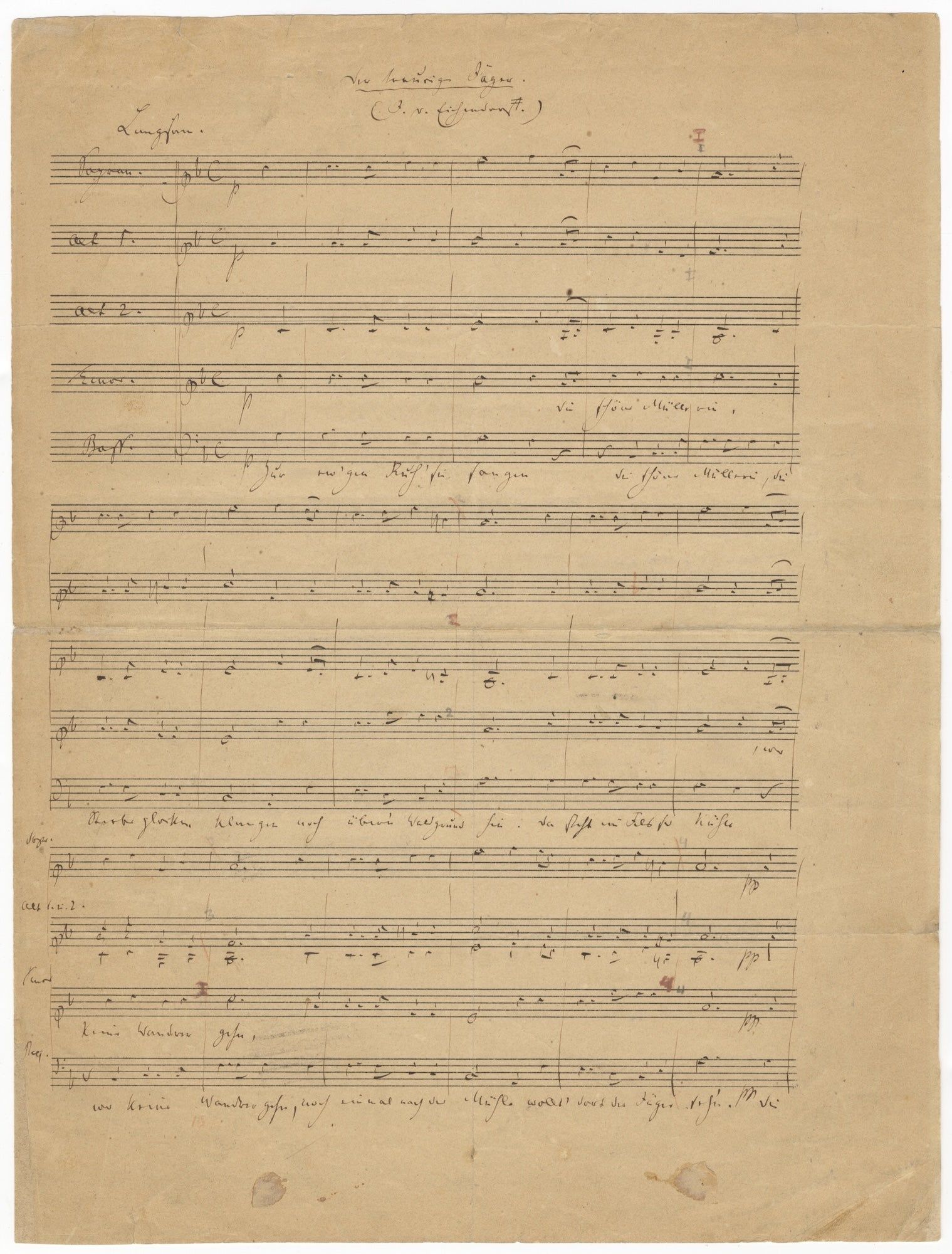
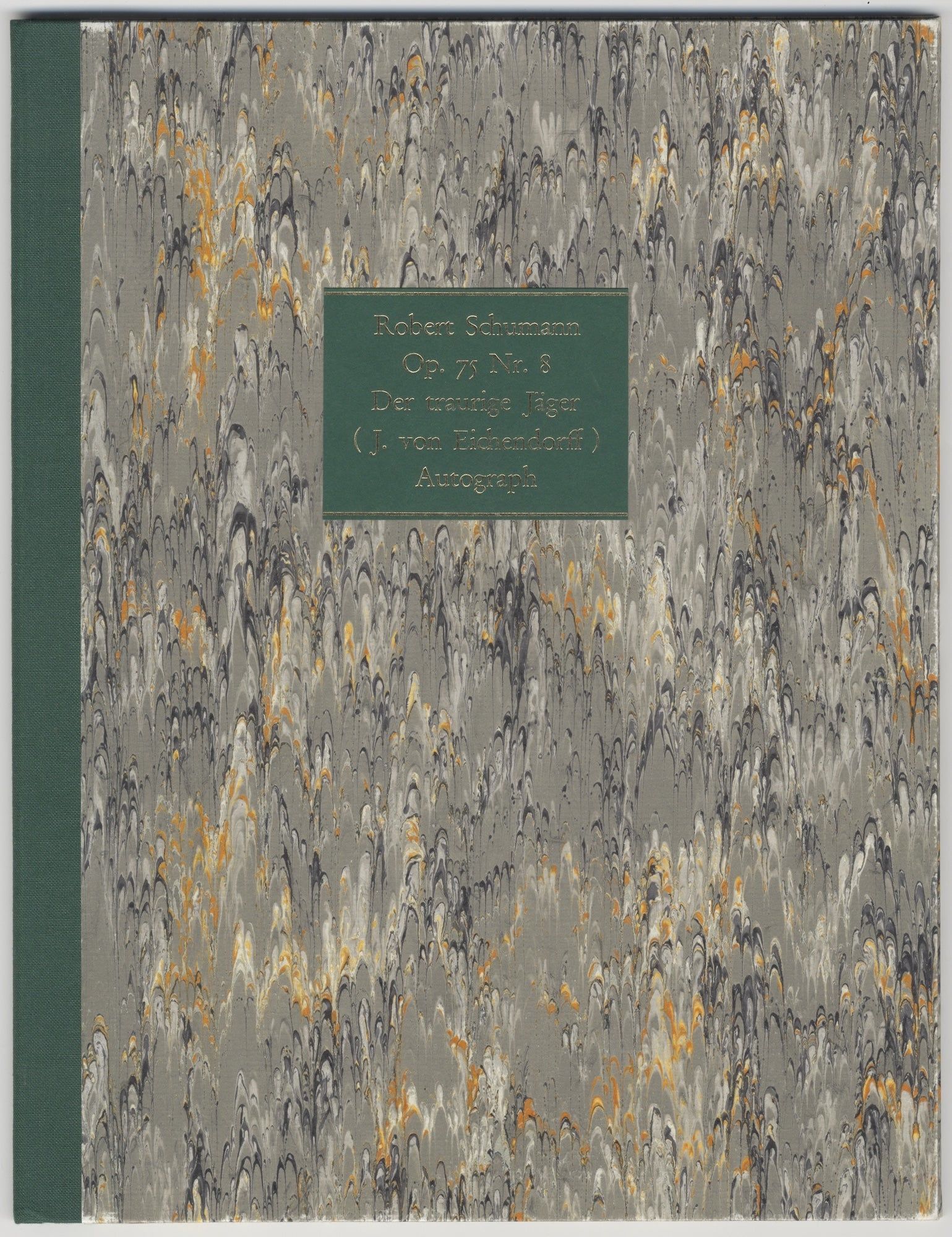
2 pp. Folio (303 x 230 mm). Notated for soprano, two altos, tenor, and bass on on 14-stave paper with three systems of four-five staves per page. Housed in a modern dark green cloth-backed marbled board portfolio with dark green title label gilt to upper.
The Stichvorlage, with occasional markings by the printer in lead and red pencil.
With text in German by Joseph Freiherr von Eichendorff commencing "Zur ew’gen Ruh’ sie sangen die schöne Müllerin."
Slightly worn; uniformly browned; minor soiling; creased at folds; professional repairs including to central horizontal fold where upper and lower portion of leaf have been rejoined. Overall very good. McCorkle: Robert Schumann. Thematisch-Bibliographisches Werkverzeichnis, pp. 325-329, records the full score of the present song as well as song number 9 as being lost. The first edition of Der traurige Jäger was published in 1850 by Whistling in Schumann's Romanzen und Balladen, Book 2.
"While best remembered for his piano music and songs, and some of his symphonic and chamber works, Schumann made significant contributions to all the musical genres of his day and cultivated a number of new ones as well. His dual interest in music and literature led him to develop a historically informed music criticism and a compositional style deeply indebted to literary models. A leading exponent of musical Romanticism, he had a powerful impact on succeeding generations of European composers. ...
In 1849, Schumann’s most productive year, he focussed alternately on Hausmusik (character-pieces for instrumental ensemble, choral partsongs, lieder) – from which he could expect handsome financial returns – and on more imposing forms involving vocal and instrumental soloists, chorus and orchestra. Just as significant as the individuality of the genres is their interdependence in Schumann’s hands. Like his poetic cycles for keyboard, his song cycles may be viewed as constellations of lyric fragments. ...
In a letter to Hiller (10 April 1849), Schumann juxtaposed the surge in his productivity with the upheavals wrought by the mid-century revolutions: ‘For some time now I’ve been very busy – it’s been my most fruitful year – it seemed as if the outer storms compelled people to turn inward’. Indeed, in 1849 alone Schumann completed nearly 40 works, many of them sizable. Nor was this creative outburst without its financial rewards; Schumann’s annual income from composing increased from 314 thalers in 1848 to 1275 thalers in 1849. He further supplemented his earnings, beginning in November 1848, by giving private instruction to Heinrich Richter. The productive phase reaching into the early part of 1850 also proved to be a period of physical and psychological well-being." John Daverio and Eric Sams in Grove Music Online
"Prominent among Schumann's works for unaccompanied mixed voices are the four volumes of Romanzen und Balladen, Opp. 67 and 75 (1849), 145 and 146 (1849-51). As their title would suggest, and like the similarly named collections of solo songs, these are short, simple settings, in German folksong style, of narrative verses." Halsey in Walker, ed.: Robert Schumann. The Man & His Music, p. 359.
"In Der traurige Jäger (The Mourning Hunter), we are moved by the ostinato passage, representing the sad hunter playing his horn calls 'while his heart is breaking.' " Fischer-Dieskau: Robert Schumann. Words and Music. The Vocal Compositions, p. 152.
Eichendorff (1788-1857) was a noted German poet. "Although his first published work was a novel, Eichendorff may be considered the German Romantic lyricist par excellence. Music plays an important part in many of his works, especially his best-known prose tale, Aus dem Leben eines Taugenichts (1826). Despite the rather limited vocabulary of his poetry and the seemingly untroubled note of calm confidence emanating from most of his best-known works, Eichendorff is anything but the simple, predictable, pious optimist he is sometimes held to be. Among the many composers who have set his lyrics are Brahms (6 lieder, choral works), Franz (13 lieder), Mendelssohn (5 lieder, 10 partsongs, a duet), Schumann (16 lieder, 6 partsongs) and Wolf (26 lieder and 6 choruses). Even in the 20th century the calm and occasionally melancholy beauty of his verses has drawn composers as disparate as Burkhard (a choral piece), Medtner (5 lieder), Paumgartner (an opera, Aus dem Leben eines Taugenichts), Reger (2 lieder, a chorus, a duet), Schoeck (more than 40 songs, choral works and an opera, Das Schloss Dürande), Ethel Smyth (4 lieder) and Richard Strauss (a lied and a choral piece). Pfitzner’s cantata Von deutscher Seele and his 19 song settings deserve particular mention." Peter Branscombe in Grove Music Online
An exceptionally emotive song, recounting a hunter's lament at the death of a beautiful miller's wife.
Autograph musical manuscripts of complete works by Schumann are rare to the market.
The Stichvorlage, with occasional markings by the printer in lead and red pencil.
With text in German by Joseph Freiherr von Eichendorff commencing "Zur ew’gen Ruh’ sie sangen die schöne Müllerin."
Slightly worn; uniformly browned; minor soiling; creased at folds; professional repairs including to central horizontal fold where upper and lower portion of leaf have been rejoined. Overall very good. McCorkle: Robert Schumann. Thematisch-Bibliographisches Werkverzeichnis, pp. 325-329, records the full score of the present song as well as song number 9 as being lost. The first edition of Der traurige Jäger was published in 1850 by Whistling in Schumann's Romanzen und Balladen, Book 2.
"While best remembered for his piano music and songs, and some of his symphonic and chamber works, Schumann made significant contributions to all the musical genres of his day and cultivated a number of new ones as well. His dual interest in music and literature led him to develop a historically informed music criticism and a compositional style deeply indebted to literary models. A leading exponent of musical Romanticism, he had a powerful impact on succeeding generations of European composers. ...
In 1849, Schumann’s most productive year, he focussed alternately on Hausmusik (character-pieces for instrumental ensemble, choral partsongs, lieder) – from which he could expect handsome financial returns – and on more imposing forms involving vocal and instrumental soloists, chorus and orchestra. Just as significant as the individuality of the genres is their interdependence in Schumann’s hands. Like his poetic cycles for keyboard, his song cycles may be viewed as constellations of lyric fragments. ...
In a letter to Hiller (10 April 1849), Schumann juxtaposed the surge in his productivity with the upheavals wrought by the mid-century revolutions: ‘For some time now I’ve been very busy – it’s been my most fruitful year – it seemed as if the outer storms compelled people to turn inward’. Indeed, in 1849 alone Schumann completed nearly 40 works, many of them sizable. Nor was this creative outburst without its financial rewards; Schumann’s annual income from composing increased from 314 thalers in 1848 to 1275 thalers in 1849. He further supplemented his earnings, beginning in November 1848, by giving private instruction to Heinrich Richter. The productive phase reaching into the early part of 1850 also proved to be a period of physical and psychological well-being." John Daverio and Eric Sams in Grove Music Online
"Prominent among Schumann's works for unaccompanied mixed voices are the four volumes of Romanzen und Balladen, Opp. 67 and 75 (1849), 145 and 146 (1849-51). As their title would suggest, and like the similarly named collections of solo songs, these are short, simple settings, in German folksong style, of narrative verses." Halsey in Walker, ed.: Robert Schumann. The Man & His Music, p. 359.
"In Der traurige Jäger (The Mourning Hunter), we are moved by the ostinato passage, representing the sad hunter playing his horn calls 'while his heart is breaking.' " Fischer-Dieskau: Robert Schumann. Words and Music. The Vocal Compositions, p. 152.
Eichendorff (1788-1857) was a noted German poet. "Although his first published work was a novel, Eichendorff may be considered the German Romantic lyricist par excellence. Music plays an important part in many of his works, especially his best-known prose tale, Aus dem Leben eines Taugenichts (1826). Despite the rather limited vocabulary of his poetry and the seemingly untroubled note of calm confidence emanating from most of his best-known works, Eichendorff is anything but the simple, predictable, pious optimist he is sometimes held to be. Among the many composers who have set his lyrics are Brahms (6 lieder, choral works), Franz (13 lieder), Mendelssohn (5 lieder, 10 partsongs, a duet), Schumann (16 lieder, 6 partsongs) and Wolf (26 lieder and 6 choruses). Even in the 20th century the calm and occasionally melancholy beauty of his verses has drawn composers as disparate as Burkhard (a choral piece), Medtner (5 lieder), Paumgartner (an opera, Aus dem Leben eines Taugenichts), Reger (2 lieder, a chorus, a duet), Schoeck (more than 40 songs, choral works and an opera, Das Schloss Dürande), Ethel Smyth (4 lieder) and Richard Strauss (a lied and a choral piece). Pfitzner’s cantata Von deutscher Seele and his 19 song settings deserve particular mention." Peter Branscombe in Grove Music Online
An exceptionally emotive song, recounting a hunter's lament at the death of a beautiful miller's wife.
Autograph musical manuscripts of complete works by Schumann are rare to the market.