

Three Letters from Frederick MacMonnies to Thomas Dewing Concerning Sculpting the Players’ Club’s Edwin Booth Monument

- Three letters totaling twenty-two pages, 5 x 8 inches and smaller. Folded; some with large tears at folds though entirely legibl
- France , 1910
France, 1910. Three letters totaling twenty-two pages, 5 x 8 inches and smaller. Folded; some with large tears at folds though entirely legible. Overall excellent.. Frederick MacMonnies (1863–1937) was an American expatriate sculptor and painter, known in the US for works including Nathan Hale and Bacchante and Infant Faun. In 1907, New York City’s Player’s Club commissioned MacMonnies to design and produce a monument to the club’s founder, Edwin Booth.
Offered here are three letters from MacMonnies to Players Club member and fellow visual artist Thomas W. Dewing (1850–1938) following the commission. MacMonnies seemed to have been under extraordinary emotional stress, writing that he was returning to France as “New York had played on my nerves” (N.d.) and, later, that:
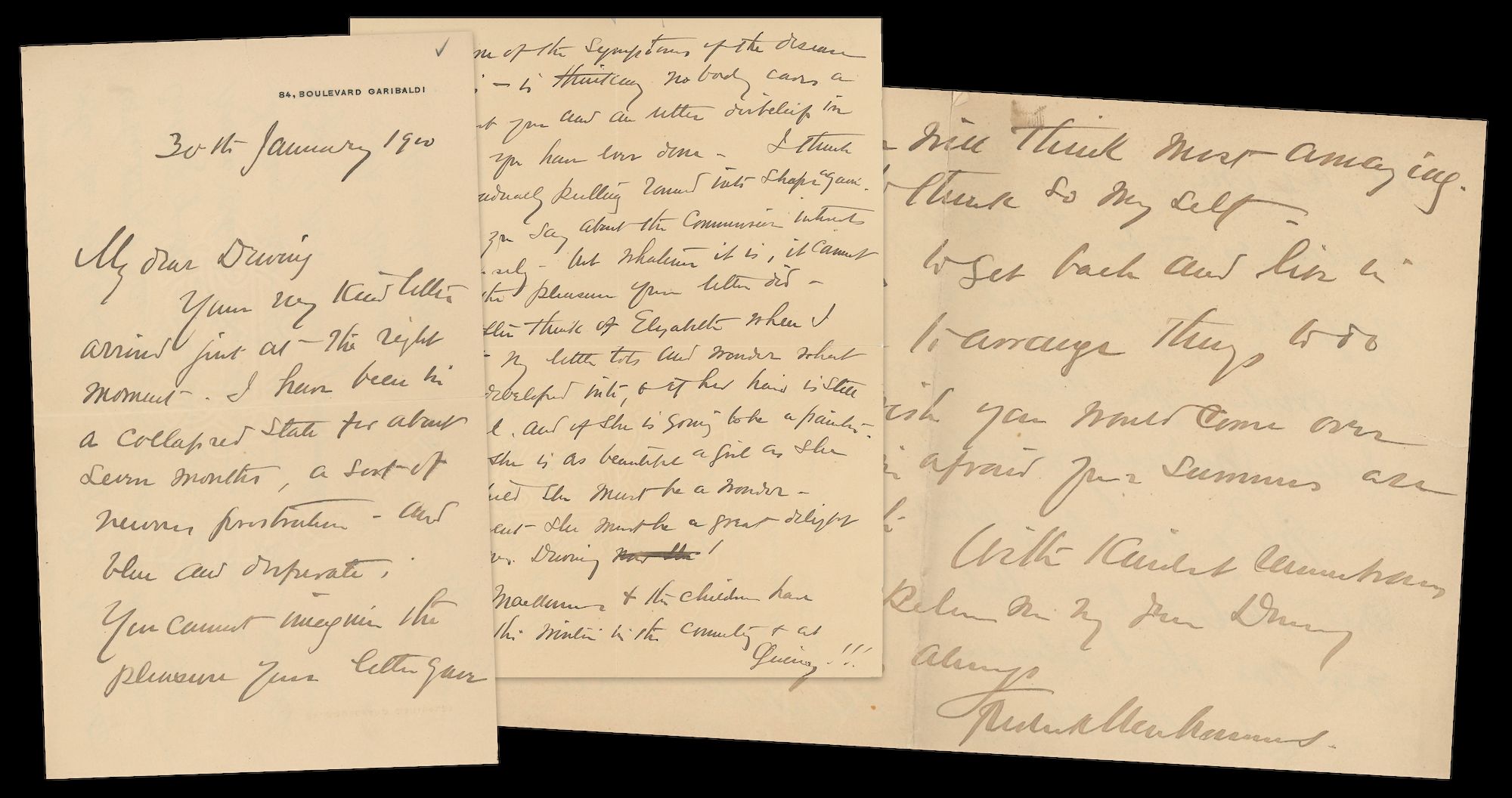
“I have been in a collapsed state for about seven months, a sort of nervous prostration, and blue and desperate. You cannot imagine the pleasure your letter gave me, as one of the symptoms of the disease I have is in thinking nobody cares a [?] about you and an utter disbelief in any work you have ever done.” (January 30, 1910)
Later news from Dewing would not be so soothing to MacMonnies, as it reached the sculptor that the Players Club had some reservations about his design for the Booth memorial. MacMonnies’ May letter is worth quoting at length, as he justifies his design choices and critiques trends in statuary:
“I was sorry & very much surprised to hear you did not like my design for the Booth Memorial, for I have & always have had such implicit confidence & admiration for your taste that I thought there must be something wrong with me & a screw loose somewhere.
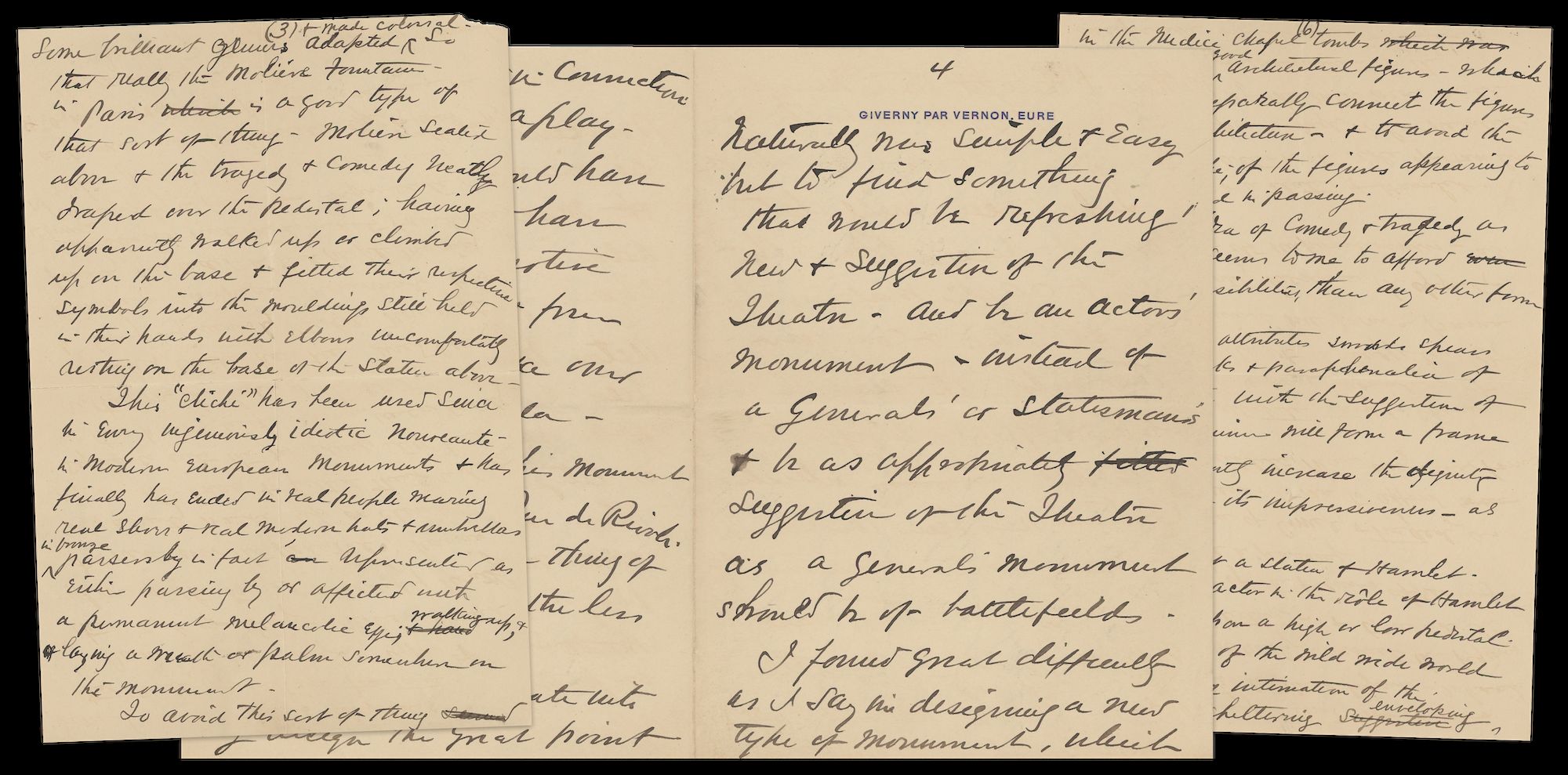
“I had been highly elated over the design from the first – after making about 75 sketches & going over thoroughly the usual statue & pendant figure on pedestal ‘cliches’, which I think has been the cause of many rotten monuments all over the world [...] really the Moliere Fountain in Paris is a good type of that sort of thing – Moliere seated above & the tragedy & comedy neatly draped over the pedestal; having apparently walked or climbed up on the base & fitted their respective symbols into the mouldings still held in their hands with elbows uncomfortably resting on the base of the statue above. This ‘cliche’ has been used since in every ingeniously idiotic nouveaute in modern European monuments [...]
“To avoid this sort of thing naturally was simple & easy, but to find something that would be refeshing, new & suggestive of the Theatre, and be an actors’ monument, instead of a General’s or Statesman’s & be as appropriately suggestive of the Theatre as a General’s monument should be of the battlefield.
“I found great difficulty as I say in designing a new type of monument which would only be used in connection with an actor or playwright. [...] I tried to incorporate into my design the great point in the Medici Chapel tombs & of all good architectural figures, which is to inseparably connect the figures with the architecture, & to avoid the clock cliche, of figures appearing to have stopped in passing. [...]
“No one knows more about this my dear Dewing than yourself – your work has always had richness & simplicity, dignity, & all the rest, but they are never barren or bald [...] What might naturally appear overloaded or over enriched or complicated in a preliminary sketch in sculpture may in the finished production, appear clear & simple & yet be even more complex than the sketch [...]
“The design I have made is in my friends’ opinions here the best thing I have done (several distinguished architects & sculptors to whom I showed it warmly approved), & I am desperately sickened at the thought of having it fall into the list of things not done. I am hoping that in the hurly burly of New York life & your many interests you have not had the time to give the design much attention, and that my long explanation of what I have tried to do & hope to do with it may induce you to look into the matter again.” (May 28, 1910)
In 1913, MacMonnies would resign the commission, unable to come to an agreement with the Club over the design.[1]
[1] “MacMonnies Quits Booth Memorial; Tells Friends He Has Had Too Much Trouble with the Committee”, The New York Times, July 8, 1913, 6.
Offered here are three letters from MacMonnies to Players Club member and fellow visual artist Thomas W. Dewing (1850–1938) following the commission. MacMonnies seemed to have been under extraordinary emotional stress, writing that he was returning to France as “New York had played on my nerves” (N.d.) and, later, that:
“I have been in a collapsed state for about seven months, a sort of nervous prostration, and blue and desperate. You cannot imagine the pleasure your letter gave me, as one of the symptoms of the disease I have is in thinking nobody cares a [?] about you and an utter disbelief in any work you have ever done.” (January 30, 1910)
Later news from Dewing would not be so soothing to MacMonnies, as it reached the sculptor that the Players Club had some reservations about his design for the Booth memorial. MacMonnies’ May letter is worth quoting at length, as he justifies his design choices and critiques trends in statuary:
“I was sorry & very much surprised to hear you did not like my design for the Booth Memorial, for I have & always have had such implicit confidence & admiration for your taste that I thought there must be something wrong with me & a screw loose somewhere.
“I had been highly elated over the design from the first – after making about 75 sketches & going over thoroughly the usual statue & pendant figure on pedestal ‘cliches’, which I think has been the cause of many rotten monuments all over the world [...] really the Moliere Fountain in Paris is a good type of that sort of thing – Moliere seated above & the tragedy & comedy neatly draped over the pedestal; having apparently walked or climbed up on the base & fitted their respective symbols into the mouldings still held in their hands with elbows uncomfortably resting on the base of the statue above. This ‘cliche’ has been used since in every ingeniously idiotic nouveaute in modern European monuments [...]
“To avoid this sort of thing naturally was simple & easy, but to find something that would be refeshing, new & suggestive of the Theatre, and be an actors’ monument, instead of a General’s or Statesman’s & be as appropriately suggestive of the Theatre as a General’s monument should be of the battlefield.
“I found great difficulty as I say in designing a new type of monument which would only be used in connection with an actor or playwright. [...] I tried to incorporate into my design the great point in the Medici Chapel tombs & of all good architectural figures, which is to inseparably connect the figures with the architecture, & to avoid the clock cliche, of figures appearing to have stopped in passing. [...]
“No one knows more about this my dear Dewing than yourself – your work has always had richness & simplicity, dignity, & all the rest, but they are never barren or bald [...] What might naturally appear overloaded or over enriched or complicated in a preliminary sketch in sculpture may in the finished production, appear clear & simple & yet be even more complex than the sketch [...]
“The design I have made is in my friends’ opinions here the best thing I have done (several distinguished architects & sculptors to whom I showed it warmly approved), & I am desperately sickened at the thought of having it fall into the list of things not done. I am hoping that in the hurly burly of New York life & your many interests you have not had the time to give the design much attention, and that my long explanation of what I have tried to do & hope to do with it may induce you to look into the matter again.” (May 28, 1910)
In 1913, MacMonnies would resign the commission, unable to come to an agreement with the Club over the design.[1]
[1] “MacMonnies Quits Booth Memorial; Tells Friends He Has Had Too Much Trouble with the Committee”, The New York Times, July 8, 1913, 6.