

Life History of Ulysses Sordet DeMoulin and History of Demoulin Family
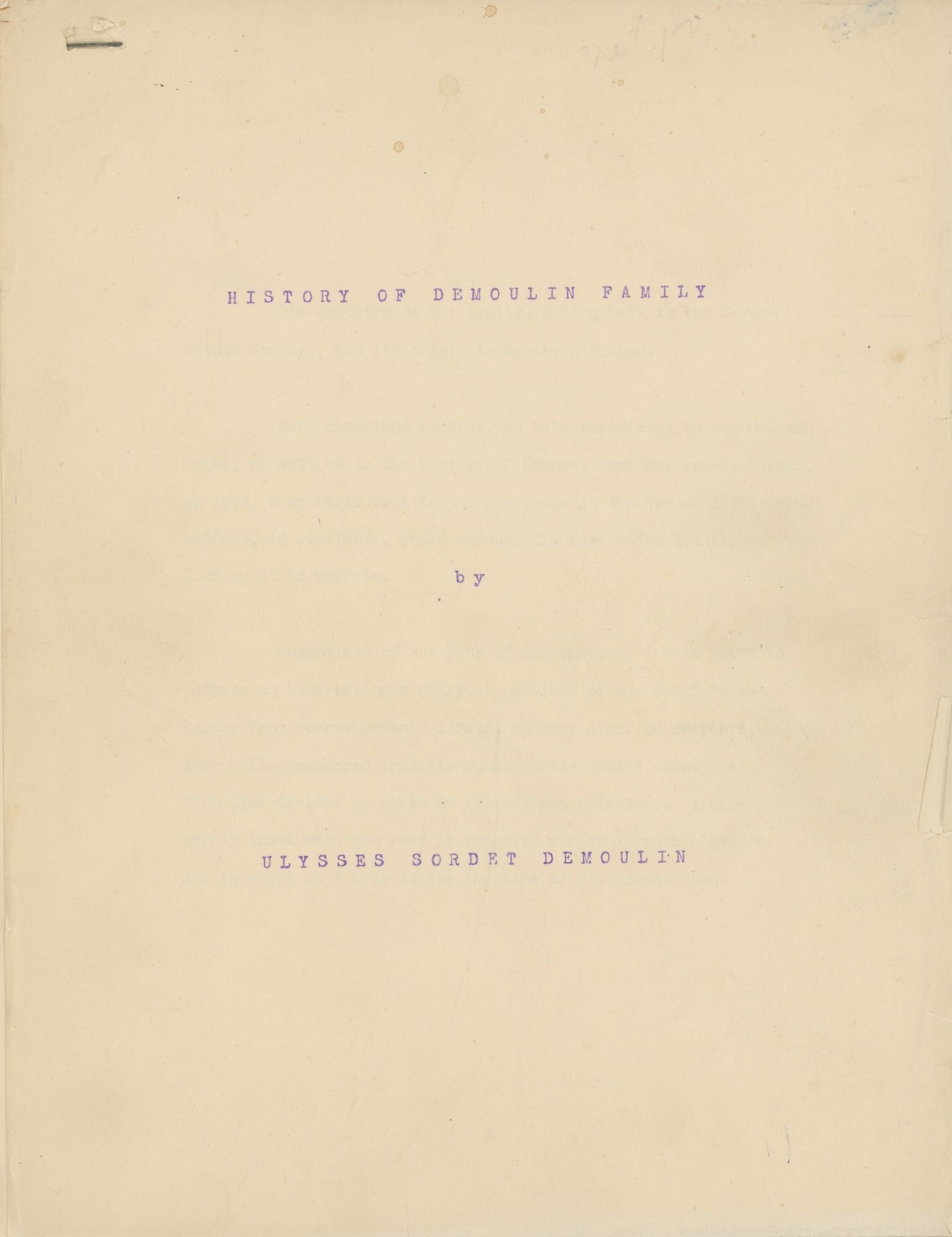
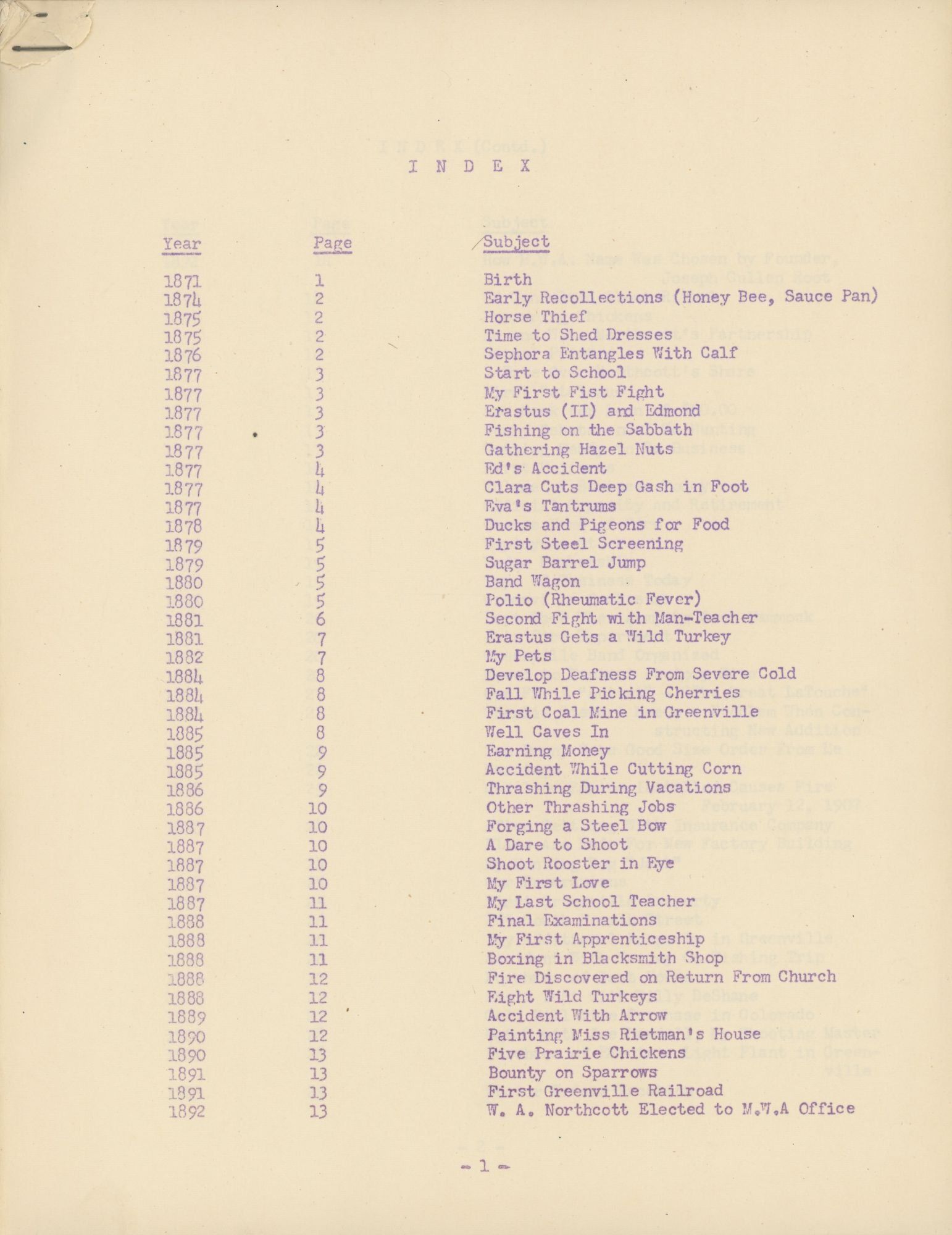
- Two stapled packets of mimeographed typed pages (eighty-seven and twenty-eight pages), with one signed
- Greenville, Illinois , 1954
Greenville, Illinois, 1954. Two stapled packets of mimeographed typed pages (eighty-seven and twenty-eight pages), with one signed. Excellent to Near Fine.. An autobiography and genealogy written by Ulysses S. DeMoulin (1871–1955), founder of DeMoulin Bros., a uniform manufacturing company which now mainly supplies marching band attire. The genealogy incorrectly traces the family’s history back to French Revolutionary figure Camille Desmoulins, though it appears accurate otherwise. It includes a description of early Sebastopol (Highland) Illinois, with a simple map. In the autobiography, which is told in a large number of short anecdotes, DeMoulin discusses his childhood and early life in Jamestown and Sebastopol, and goes into detail about the early years of his company, beginning with the formation of the Modern Woodmen of America fraternal organization, for which the company supplied uniforms and items used in ‘rituals’. DeMoulin used the profits from this enterprise to invest in a number of others, including a mine near Gold Hill, Colorado, and oil drilling land in Illinois. However, the most interesting portions of the autobiography concern DeMoulin’s role in the development of agriculture in California’s Imperial Valley.
DeMoulin first travels to southern California in 1903, happening to meet several engineers involved with the Imperial Irrigation System, who take him to see the new town of Brawley:
“Here, by lantern light, we sat around on the ground in the evening, discussing many kinds of farm lands, and if soft, hard or sandy. We slept in ‘remadas,’ made by setting posts to protrude about twelve feet above the ground, which were then braced and divided into small box-like stalls. The remada was then covered with tree branches, and a huge heavy taupalin [sic] curtain hung over the sides and front at night, to keep out the dust, of which you might find two or three inches at your door in the morning. A pitcher of water, and a bowl, were your only means of bathing. There were no streets in Brawley at this time, only trails, as the town had not yet been surveyed, having only been founded in October, 1902. People were living in tents while waiting for completion of hotel accommodations and other living quarters under construction.”
DeMoulin begins buying land in the Brawley area to rent to farmers and traveling to the area regularly. He describes the building of the Laguna Dam, spending a week at the workers’ camp, “at which time I slept in the workmen’s crudely-built bunks, and ate with them at the long, rough pine tables”; and befriends author Harold Bell Wright. He also witnesses several conflicts with the IWW:
“In 1908 there moved into Brawley about 200 International Workmen of the World, or more familiarly known as ‘I.W.W.’s,’ (I won’t Work,) and in command was a Captain Stanley. However, as most unwelcome guests, they proceeded to join a strike in the cantaloupe sheds, and inserting razor blades into apples, the strikers threw them at workers. ‘Goons’ also tried to interfere with the trucking operations from the fields to the packing sheds. I recall of one driver telling a goon that if he even attempted to place a foot in his truck, he would shoot him. And defying the driver, the goon was instantly killed. Naturally, this would cause a riot and they sent to El Centro for a tank, such as it was in those days - a cannon and several machine guns. But soon after the Mayor had issued orders to shoot anyone getting out of hand, an agreement was easily reached.”
University of Washington’s IWW History Project documents two IWW actions in Brawley between 1905 and 1920, neither of which match DeMoulin’s description; nor does the event appear in newspapers. However, “Captain” William Stanley was in the area, serving as the secretary of the I.W.W.’s chapter in the Imperial Valley. In 1911, Stanley was killed in an early battle of the Mexican Revolution, assisting Mexican Liberal Party fighters in occupying Mexicali. DeMoulin claims to have traveled with several others to watch the fighting that would end the occupation:
“It was suddenly discovered one morning that Captain Stanley and his I.W.W.’s had disappeared during the night, and word had gotten around they had settled in Mexicalo [sic], a Mexican border town, and were so strong in number they overpowered the police, pillaged the shops and stores, defying the Mexican Government by taking over complete possession of Mexicalo. However, after putting up with this condition for several months, the Mexican Government sent in about 500 Infantrymen, with orders to get rid of them immediately, under any condition. [...] Stanley’s men had made a large opening in the river bank to a depth of about five feet, which led through to the bank facing south. From this vantage point, his men could fire their muskets when the Mexicans advanced towards them, and soon took to their heels when Stanley’s men began firing. [...] Several of us had driven down to [sic] Brawley to witness the fighting, and bullets had been spattered everywhere. Many of the people never thinking of danger, stood out in the open so as not to miss what was going on, but I was glad to stay in the back of the adobes, at least where one was protected from stray bullets. And having heard rumors of their retreating possibly the next day, which was Sunday, we drove down again, but all was quiet and we met with no resistance. Many of the men were swimming, and others were entertaining their wives and families in one way or another. We didn’t stay too long on that trip as one never knew what might happen. But it wasn’t long before they disappeared from Mexicalo entirely, for which everyone was most grateful and happy.”
DeMoulin is none too fond of Mexican workers either, describing how the 1928 construction of a primitive border wall “didn’t stop the wetbacks [...] from swimming across”, and complaining that “regardless of having no sense, nor education, many were hired, and the employers would hide them in groves, because if they were arrested, it would cost $160.00, including court and attorney fees, to have each one returned to Mexico.” (DeMoulin’s other targets for racial abuse include “a couple of crooked ‘Jewish Kikes’” who were “certainly professionals when it came to putting the money in their pockets”, and several Black men who he claims steal from him.)
DeMoulin credits himself with bringing grapefruit production to the Imperial Valley, and describes a scam by the area’s real estate agents to unload inferior farmland onto unsuspecting investors. He recounts his company making leather “‘Red Men’s’ costumes” for a “Chief Gray Eagle” in Oklahoma, whose “squaws wouldn’t work for him any more.”
Of interest to historians of the Imperial Valley’s development, and especially of labor relations in the agriculture industry.
DeMoulin first travels to southern California in 1903, happening to meet several engineers involved with the Imperial Irrigation System, who take him to see the new town of Brawley:
“Here, by lantern light, we sat around on the ground in the evening, discussing many kinds of farm lands, and if soft, hard or sandy. We slept in ‘remadas,’ made by setting posts to protrude about twelve feet above the ground, which were then braced and divided into small box-like stalls. The remada was then covered with tree branches, and a huge heavy taupalin [sic] curtain hung over the sides and front at night, to keep out the dust, of which you might find two or three inches at your door in the morning. A pitcher of water, and a bowl, were your only means of bathing. There were no streets in Brawley at this time, only trails, as the town had not yet been surveyed, having only been founded in October, 1902. People were living in tents while waiting for completion of hotel accommodations and other living quarters under construction.”
DeMoulin begins buying land in the Brawley area to rent to farmers and traveling to the area regularly. He describes the building of the Laguna Dam, spending a week at the workers’ camp, “at which time I slept in the workmen’s crudely-built bunks, and ate with them at the long, rough pine tables”; and befriends author Harold Bell Wright. He also witnesses several conflicts with the IWW:
“In 1908 there moved into Brawley about 200 International Workmen of the World, or more familiarly known as ‘I.W.W.’s,’ (I won’t Work,) and in command was a Captain Stanley. However, as most unwelcome guests, they proceeded to join a strike in the cantaloupe sheds, and inserting razor blades into apples, the strikers threw them at workers. ‘Goons’ also tried to interfere with the trucking operations from the fields to the packing sheds. I recall of one driver telling a goon that if he even attempted to place a foot in his truck, he would shoot him. And defying the driver, the goon was instantly killed. Naturally, this would cause a riot and they sent to El Centro for a tank, such as it was in those days - a cannon and several machine guns. But soon after the Mayor had issued orders to shoot anyone getting out of hand, an agreement was easily reached.”
University of Washington’s IWW History Project documents two IWW actions in Brawley between 1905 and 1920, neither of which match DeMoulin’s description; nor does the event appear in newspapers. However, “Captain” William Stanley was in the area, serving as the secretary of the I.W.W.’s chapter in the Imperial Valley. In 1911, Stanley was killed in an early battle of the Mexican Revolution, assisting Mexican Liberal Party fighters in occupying Mexicali. DeMoulin claims to have traveled with several others to watch the fighting that would end the occupation:
“It was suddenly discovered one morning that Captain Stanley and his I.W.W.’s had disappeared during the night, and word had gotten around they had settled in Mexicalo [sic], a Mexican border town, and were so strong in number they overpowered the police, pillaged the shops and stores, defying the Mexican Government by taking over complete possession of Mexicalo. However, after putting up with this condition for several months, the Mexican Government sent in about 500 Infantrymen, with orders to get rid of them immediately, under any condition. [...] Stanley’s men had made a large opening in the river bank to a depth of about five feet, which led through to the bank facing south. From this vantage point, his men could fire their muskets when the Mexicans advanced towards them, and soon took to their heels when Stanley’s men began firing. [...] Several of us had driven down to [sic] Brawley to witness the fighting, and bullets had been spattered everywhere. Many of the people never thinking of danger, stood out in the open so as not to miss what was going on, but I was glad to stay in the back of the adobes, at least where one was protected from stray bullets. And having heard rumors of their retreating possibly the next day, which was Sunday, we drove down again, but all was quiet and we met with no resistance. Many of the men were swimming, and others were entertaining their wives and families in one way or another. We didn’t stay too long on that trip as one never knew what might happen. But it wasn’t long before they disappeared from Mexicalo entirely, for which everyone was most grateful and happy.”
DeMoulin is none too fond of Mexican workers either, describing how the 1928 construction of a primitive border wall “didn’t stop the wetbacks [...] from swimming across”, and complaining that “regardless of having no sense, nor education, many were hired, and the employers would hide them in groves, because if they were arrested, it would cost $160.00, including court and attorney fees, to have each one returned to Mexico.” (DeMoulin’s other targets for racial abuse include “a couple of crooked ‘Jewish Kikes’” who were “certainly professionals when it came to putting the money in their pockets”, and several Black men who he claims steal from him.)
DeMoulin credits himself with bringing grapefruit production to the Imperial Valley, and describes a scam by the area’s real estate agents to unload inferior farmland onto unsuspecting investors. He recounts his company making leather “‘Red Men’s’ costumes” for a “Chief Gray Eagle” in Oklahoma, whose “squaws wouldn’t work for him any more.”
Of interest to historians of the Imperial Valley’s development, and especially of labor relations in the agriculture industry.