

Portrait of Nishkû'ntu or “John Wilson The Revealer of Peyote.”
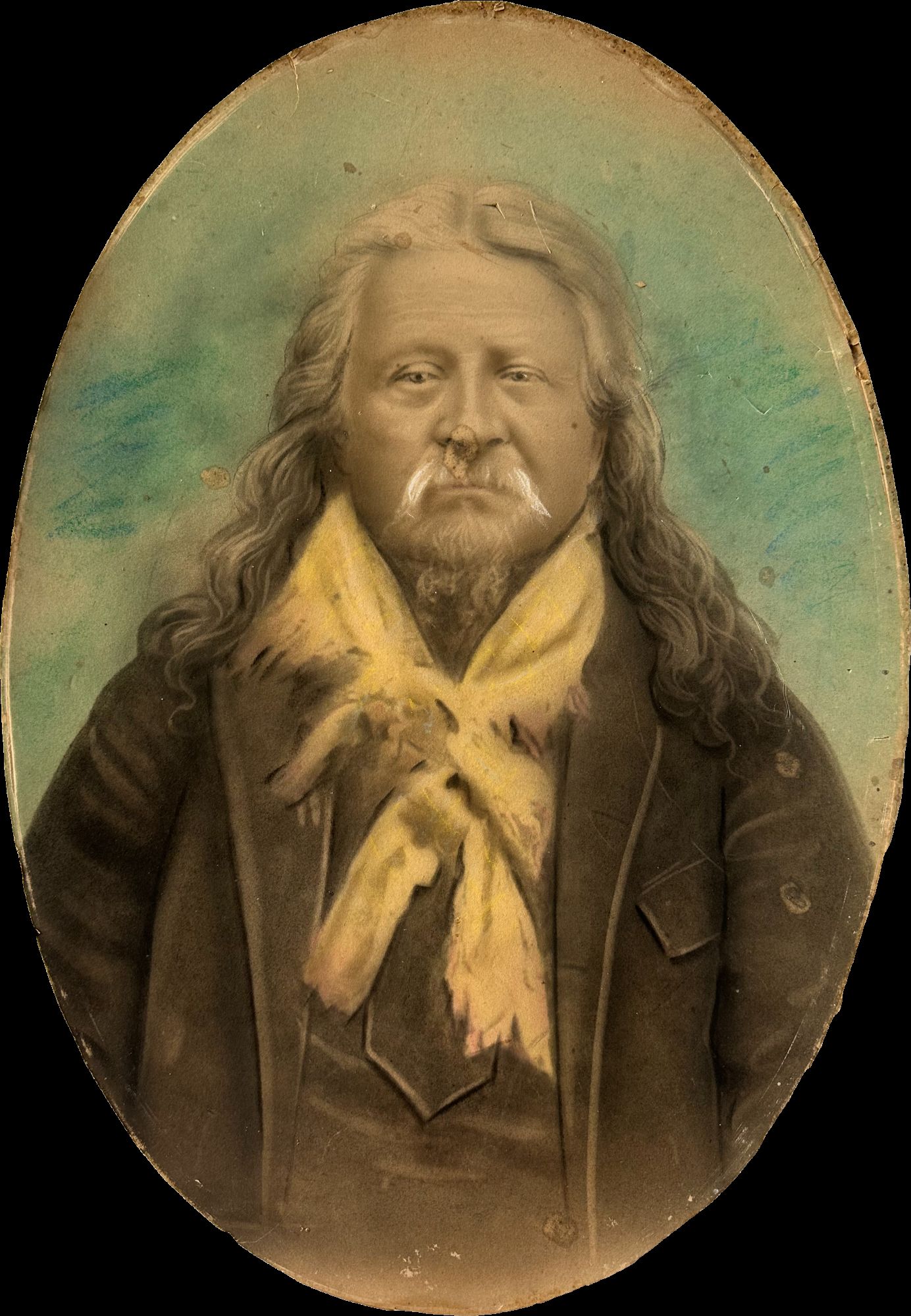
- Solar enlargement measuring approximately 23 x 17 inches in a period gilt edge frame with domed glass
- N.p.: N.p., 1900
N.p.: N.p., 1900. Solar enlargement measuring approximately 23 x 17 inches in a period gilt edge frame with domed glass. Very good with some marks and discoloration, frame missing one piece.. A large and impressive portrait of Nishkû'ntu, or John Wilson “the Revealer of Peyote,” created circa 1900. The image is a hand-colored enlargement after a photograph by G.W. Parsons, which was taken on the Osage Reservation in Indian Territory (present-day Oklahoma).
Nishkû'ntu (c. 1845–1901), a Caddo medicine man and religious leader, was born in Texas shortly before the Caddo were driven to Indian Territory (now Oklahoma). He popularized the use of the psychoactive peyote plant in the Native American Church, particularly in the Big Moon peyote ceremony, and frequently led Ghost Dance ceremonies. He was killed in 1901 in a train accident. From the Smithsonian:
“John Wilson, or Moonhead, a Caddo member, was a very early adherent to the [Peyote] ceremony, which was newly popular in Oklahoma in the late 1800s. Borrowed over many generations from Indian peoples on the Mexican border, the ceremony came to Wilson via the Comanche peyote leader Quanah Parker. Wilson redefined the church through an appropriation of the Europeans’ Jesus as a key figure in what was nevertheless conceived of as a traditional Indian ritual. The ceremony was, thus, not yet Christian; rather, Wilson’s use of Jesus was an attempt to appropriate the spiritual power of the colonizer.”
References
Daniel Swan, Peyote Religious Art: Symbols of Faith and Belief (University Press of Mississippi, 1999), 30.
Omer Stewart, Peyote Religion: A History (University of Oklahoma Press, 1987), 86.
Nishkû'ntu (c. 1845–1901), a Caddo medicine man and religious leader, was born in Texas shortly before the Caddo were driven to Indian Territory (now Oklahoma). He popularized the use of the psychoactive peyote plant in the Native American Church, particularly in the Big Moon peyote ceremony, and frequently led Ghost Dance ceremonies. He was killed in 1901 in a train accident. From the Smithsonian:
“John Wilson, or Moonhead, a Caddo member, was a very early adherent to the [Peyote] ceremony, which was newly popular in Oklahoma in the late 1800s. Borrowed over many generations from Indian peoples on the Mexican border, the ceremony came to Wilson via the Comanche peyote leader Quanah Parker. Wilson redefined the church through an appropriation of the Europeans’ Jesus as a key figure in what was nevertheless conceived of as a traditional Indian ritual. The ceremony was, thus, not yet Christian; rather, Wilson’s use of Jesus was an attempt to appropriate the spiritual power of the colonizer.”
References
Daniel Swan, Peyote Religious Art: Symbols of Faith and Belief (University Press of Mississippi, 1999), 30.
Omer Stewart, Peyote Religion: A History (University of Oklahoma Press, 1987), 86.