

Letters and Documents from the Development of Western Railroad Lines, Late 1800s to Early 1900s


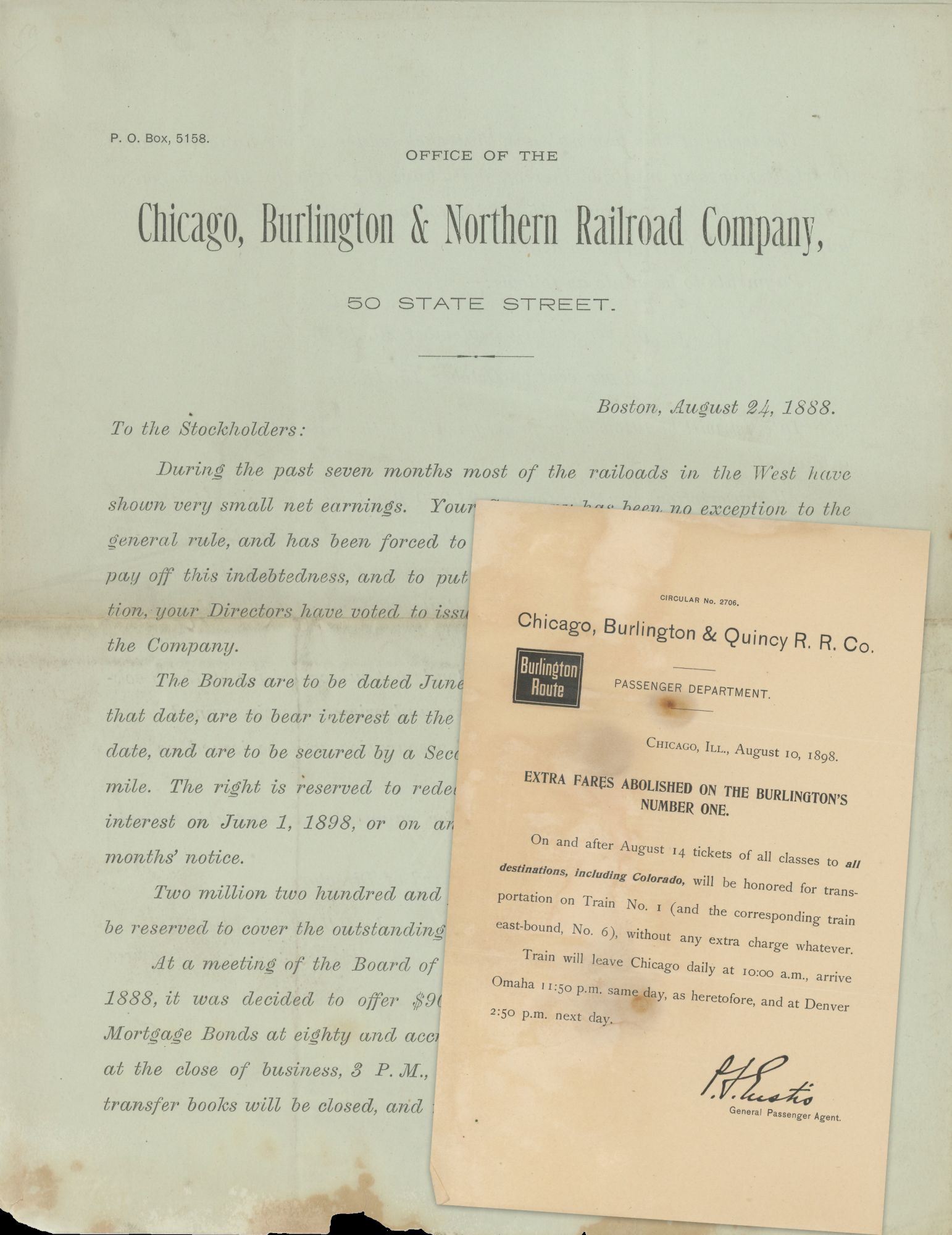
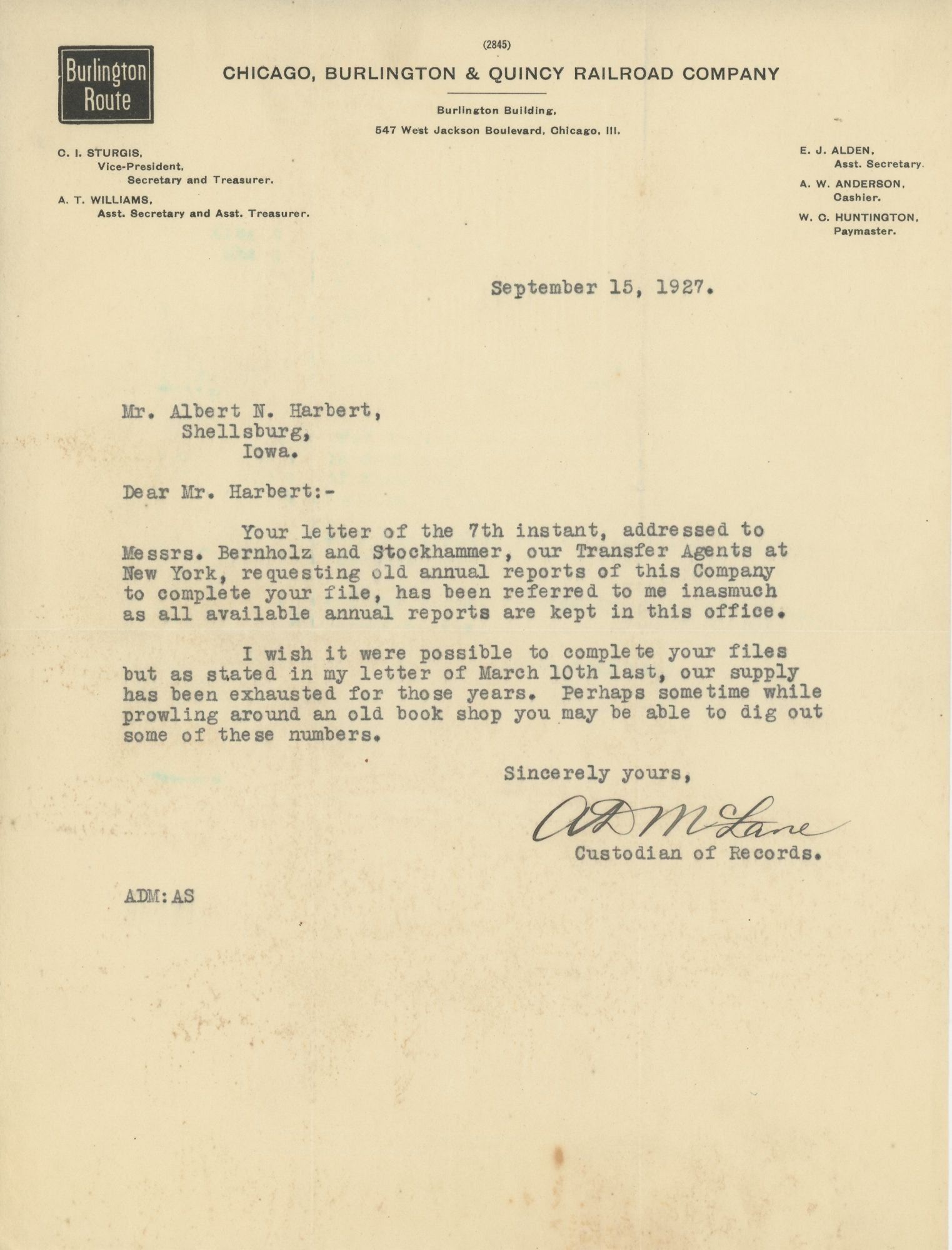
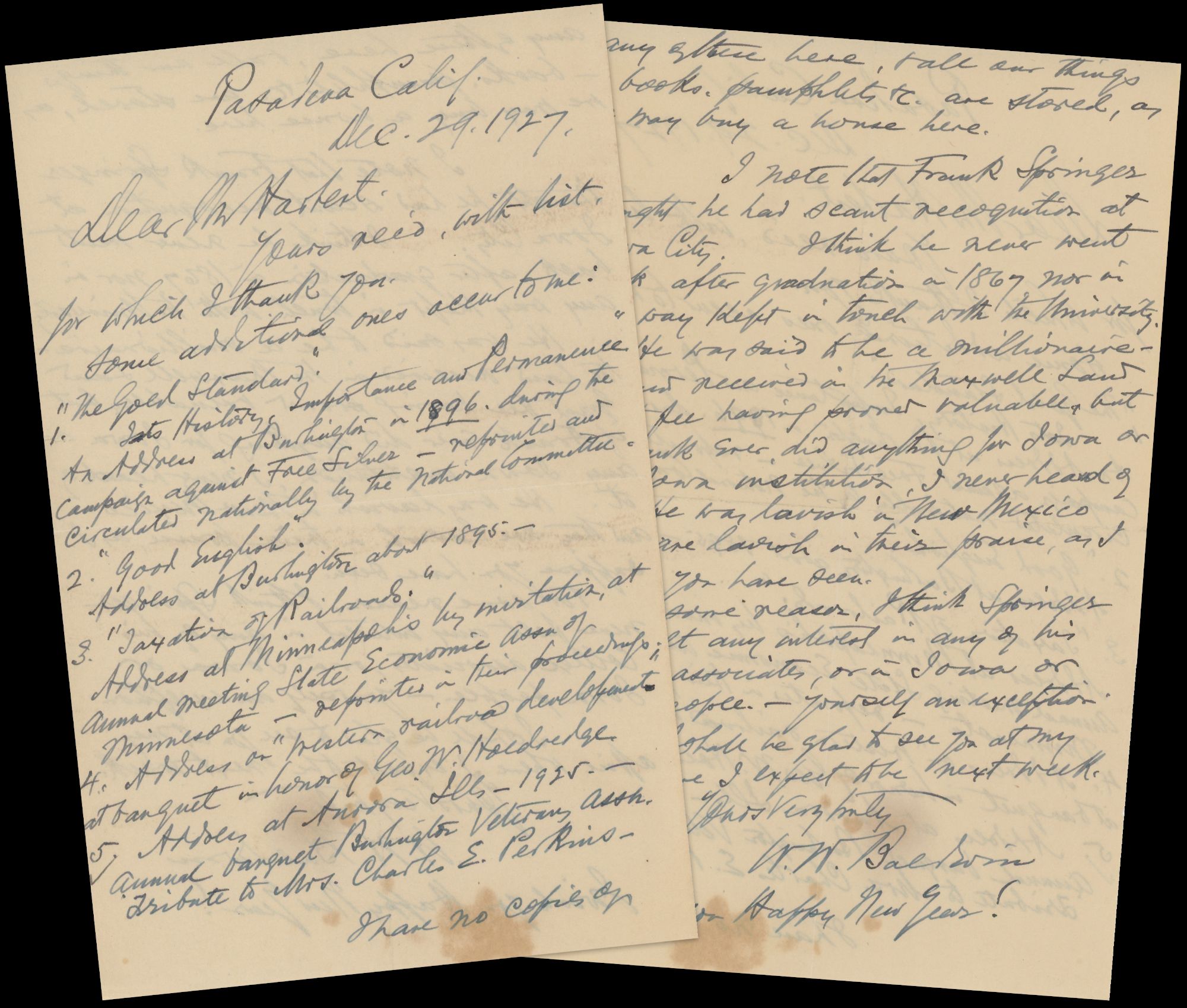
- Forty-two letters with several miscellaneous documents (circulars, stock offerings, etc.)
- United States , 1936
United States, 1936. Forty-two letters with several miscellaneous documents (circulars, stock offerings, etc.). Conditions vary with some items worn and quite fragile; most excellent.. The Chicago, Burlington, and Quincy Railroad (CB&Q) was formed in 1855 by a consolidation of several other western railroad companies. The company and its subsidiaries, known for their sleek diesel Zephyr trains, operated extensively throughout the midwest, west, and Texas throughout the nineteenth and twentieth centuries. Today, its former passenger operation has been assumed by Amtrak, and its freight operation continues as the BNSF Railway. The Burlington, Cedar Rapids and Northern Railway (BCR&N) operated between 1876 and 1903 and was succeeded by the Rock Island Line.
Offered here is a small collection of letters and documents pertaining to the relatively early days of the CB&Q and BCR&N, alongside later correspondence from an Iowan who was writing a history of Iowa railroads.
Earlier letters include discussions of plans for the extension of the CB&Q lines; for instance, railroad official O.W. Palmer writes:
“The other day at the meeting I gave Mr. McClure some changes to Leavenworth – Since that time I have gone into the question a little more thoroughly and find that to be consistent we would have to reduce a great many points in Western Iowa where there is no competition whatever + no need of a reduction – I have therefore concluded not to make any changes except where we have to meet some other fellows rate.” (August 7, 1894)
On the reverse of this letter and one other is an attractive map of the many CB&Q lines between Chicago and Denver/Cheyenne.
Also from around this time are several letters from William W. Baldwin discussing railroad business in both an official and unofficial capacity with BCR&N President Charles J. Ives. In 1895, Baldwin tells Ives about a scalping scheme on the BCR&N for which several conductors are fired (April 20), and in 1896 about a silver-backing newspaperman:
“A fellow named Hyskel has persuade[d] certain silver idiots here to loan him $200 or $300 with which he has started a morning daily calle[d] the “Burlington Democrat”. It is a violent vindictive anarchistic silver sheet, and Hyskel himself a thorough crook of the bigoted sort, although personally decent and mild enough. Has your company given them transportation? They will be after it hot foot. Our folks here have refused him, – saying he will have to get it under a regular advertising contract. These are to be made January 1st. If you can put him off until then, I think the paper will die before January. They own no press, nor any property – are simply trying to bull it through past the election. It is easy enough to put them off + there are plenty of good reasons why it ought to be done. There is not a meaner silver organ in the state. It was started as a silver venture purely. I suppose Tracy will get them B.CR. + N. transportation if he can. He is the same variety. It is such examples that make the situation so full of menace + danger to all business.” (October 19)
“Tracy” is Samuel K. Tracy, then Solicitor general for the BCR&N, the son of Judge Joshua Tracy, who was president of the line until his death in 1884.
Later correspondence is mainly between Baldwin and Albert N. Harbert of Iowa; Harbert was writing a history of Iowa railroads and Baldwin had apparently written a number of pieces on the topic (the collection includes a mimeographed bibliography of his works). Harbert had a particular interest in the china dinnerware used on the lines.
Of interest to historians of western railroads around the turn of the century.
Offered here is a small collection of letters and documents pertaining to the relatively early days of the CB&Q and BCR&N, alongside later correspondence from an Iowan who was writing a history of Iowa railroads.
Earlier letters include discussions of plans for the extension of the CB&Q lines; for instance, railroad official O.W. Palmer writes:
“The other day at the meeting I gave Mr. McClure some changes to Leavenworth – Since that time I have gone into the question a little more thoroughly and find that to be consistent we would have to reduce a great many points in Western Iowa where there is no competition whatever + no need of a reduction – I have therefore concluded not to make any changes except where we have to meet some other fellows rate.” (August 7, 1894)
On the reverse of this letter and one other is an attractive map of the many CB&Q lines between Chicago and Denver/Cheyenne.
Also from around this time are several letters from William W. Baldwin discussing railroad business in both an official and unofficial capacity with BCR&N President Charles J. Ives. In 1895, Baldwin tells Ives about a scalping scheme on the BCR&N for which several conductors are fired (April 20), and in 1896 about a silver-backing newspaperman:
“A fellow named Hyskel has persuade[d] certain silver idiots here to loan him $200 or $300 with which he has started a morning daily calle[d] the “Burlington Democrat”. It is a violent vindictive anarchistic silver sheet, and Hyskel himself a thorough crook of the bigoted sort, although personally decent and mild enough. Has your company given them transportation? They will be after it hot foot. Our folks here have refused him, – saying he will have to get it under a regular advertising contract. These are to be made January 1st. If you can put him off until then, I think the paper will die before January. They own no press, nor any property – are simply trying to bull it through past the election. It is easy enough to put them off + there are plenty of good reasons why it ought to be done. There is not a meaner silver organ in the state. It was started as a silver venture purely. I suppose Tracy will get them B.CR. + N. transportation if he can. He is the same variety. It is such examples that make the situation so full of menace + danger to all business.” (October 19)
“Tracy” is Samuel K. Tracy, then Solicitor general for the BCR&N, the son of Judge Joshua Tracy, who was president of the line until his death in 1884.
Later correspondence is mainly between Baldwin and Albert N. Harbert of Iowa; Harbert was writing a history of Iowa railroads and Baldwin had apparently written a number of pieces on the topic (the collection includes a mimeographed bibliography of his works). Harbert had a particular interest in the china dinnerware used on the lines.
Of interest to historians of western railroads around the turn of the century.