

Oaths of Office and Surety Bond Documents for Five Texan Public Officials, 1864–1866


- Three double-sided sheets measuring approximately 12 x 7 ½ inches
- Orange County, Texas , 1866
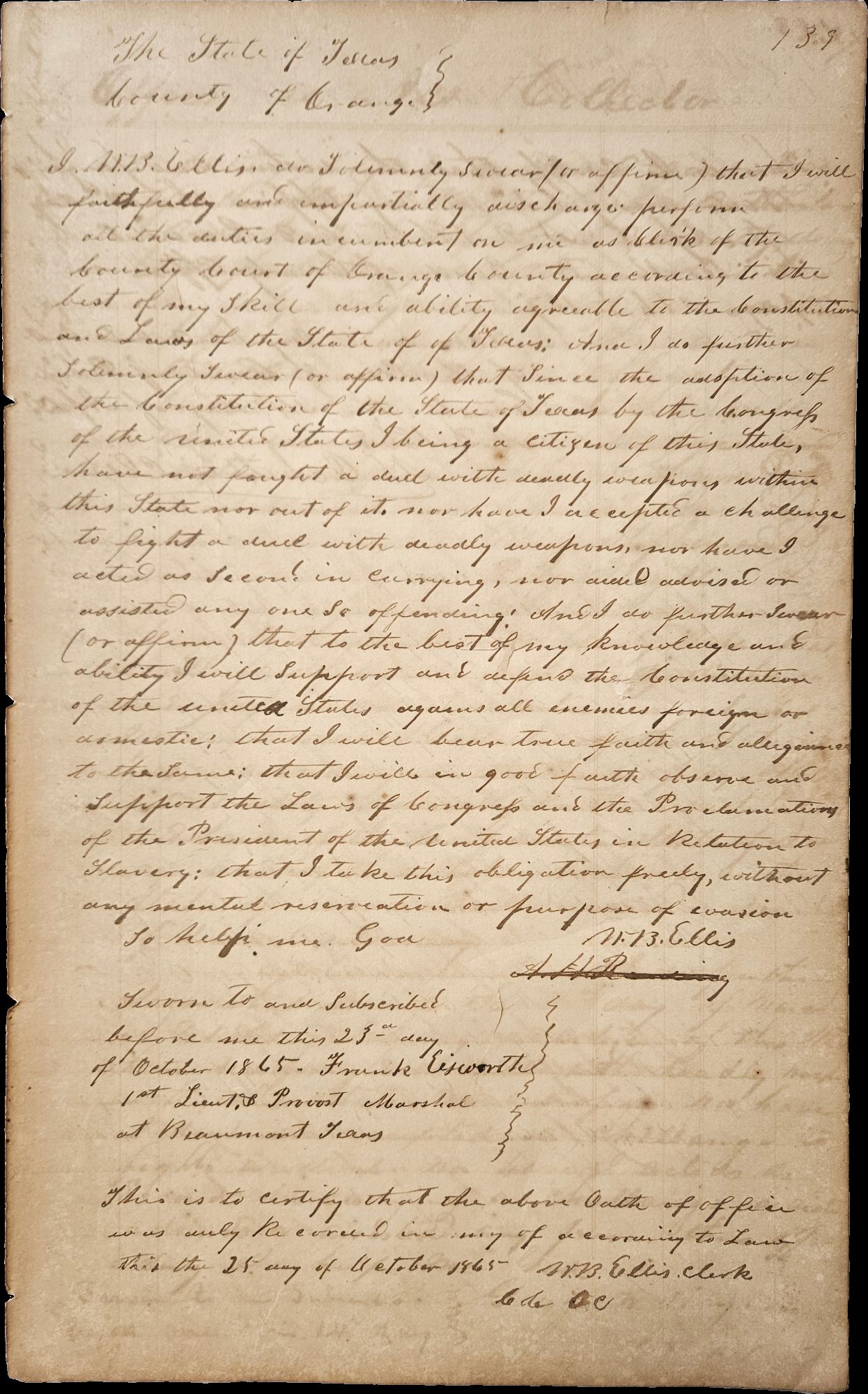
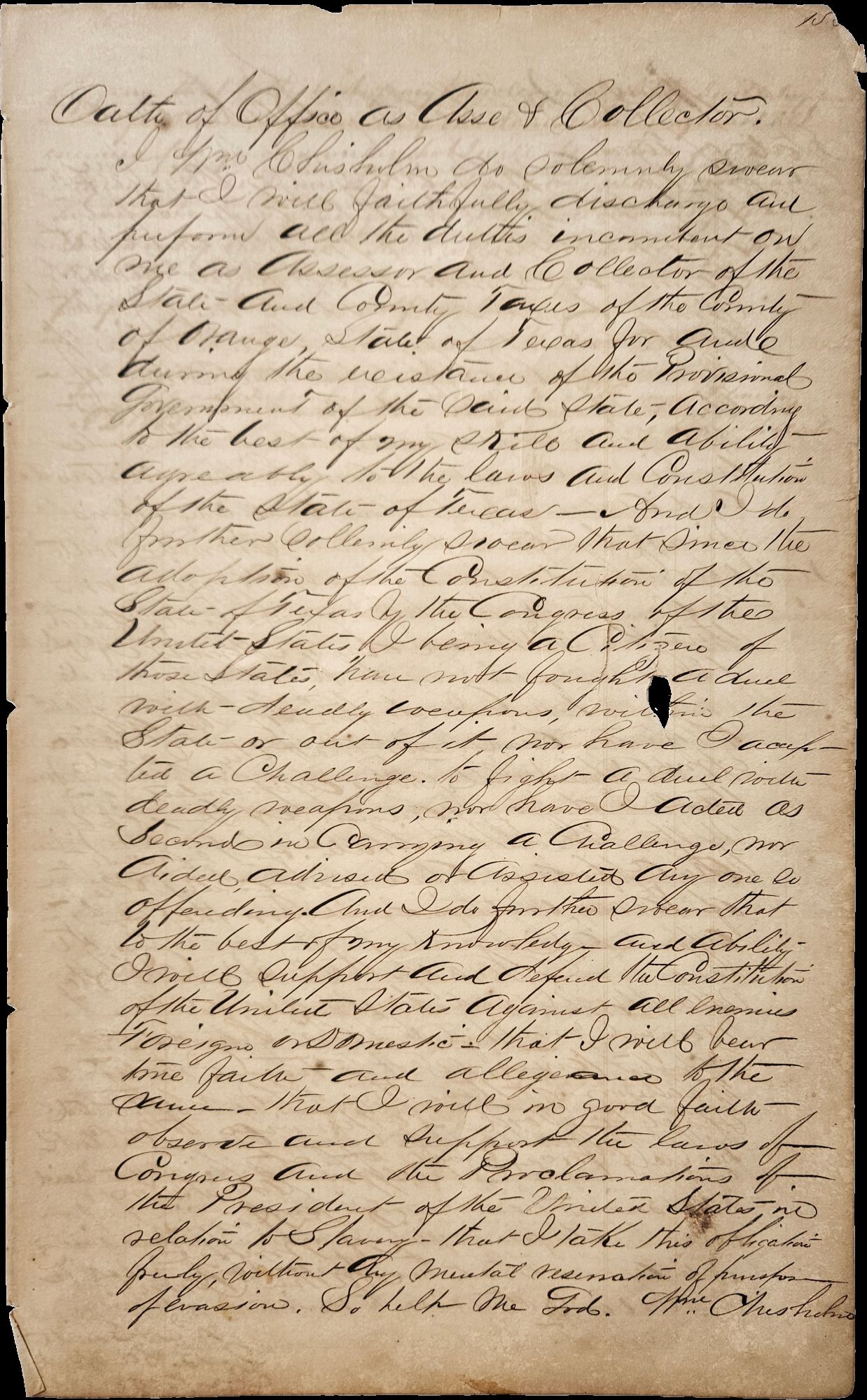
Orange County, Texas, 1866. Three double-sided sheets measuring approximately 12 x 7 ½ inches. Very delicate with some damage intersecting with text. Very good to excellent.. 1864 oaths of office for Coroner Augustus M. Rodgers and Deputy Sheriff W. D. Bryan; an 1865 oath of office and surety bond for County Clerk W.B. Ellis; and an 1866 bond for County Clerk R.H. Smith with an oath of office for Assessor and Collector William Chisholm. The oaths of office in particular are interesting, reading in part:
“I do further solemnly swear (or affirm) that since the adoption of the Constitution of the State of Texas by the Congress of the United States I being a citizen of this state, have not fought a duel with deadly weapons within this state nor out of it, nor have I accepted a challenge to fight a duel with deadly weapons, nor have I acted as a second in carrying, nor aided advised or assisted anyone so offending”.
Dueling was common in the American South in the antebellum period and, according to the Texas State Historical Association, was wildly popular among Texans, with even David G. Burnet challenging his fellow former Republic of Texas president Sam Houston to a duel. The later oaths continue:
“And I do further swear (or affirm) that to the best of my knowledge and ability [...] that I will in good faith observe and support the Laws of Congress and the Proclamation of the President of the United States in Relation to Slavery”.
Famously, emancipation was not enforced in Texas until the arrival of General Gordon Granger in 1865, on what is now celebrated as Juneteenth. By contrast, the 1864 oath of office is a pledge to the Confederate States and of course makes no mention of the Emancipation Proclamation.
“I do further solemnly swear (or affirm) that since the adoption of the Constitution of the State of Texas by the Congress of the United States I being a citizen of this state, have not fought a duel with deadly weapons within this state nor out of it, nor have I accepted a challenge to fight a duel with deadly weapons, nor have I acted as a second in carrying, nor aided advised or assisted anyone so offending”.
Dueling was common in the American South in the antebellum period and, according to the Texas State Historical Association, was wildly popular among Texans, with even David G. Burnet challenging his fellow former Republic of Texas president Sam Houston to a duel. The later oaths continue:
“And I do further swear (or affirm) that to the best of my knowledge and ability [...] that I will in good faith observe and support the Laws of Congress and the Proclamation of the President of the United States in Relation to Slavery”.
Famously, emancipation was not enforced in Texas until the arrival of General Gordon Granger in 1865, on what is now celebrated as Juneteenth. By contrast, the 1864 oath of office is a pledge to the Confederate States and of course makes no mention of the Emancipation Proclamation.