

Flatland, A Romance of Many Dimensions, by A Square
- paperback
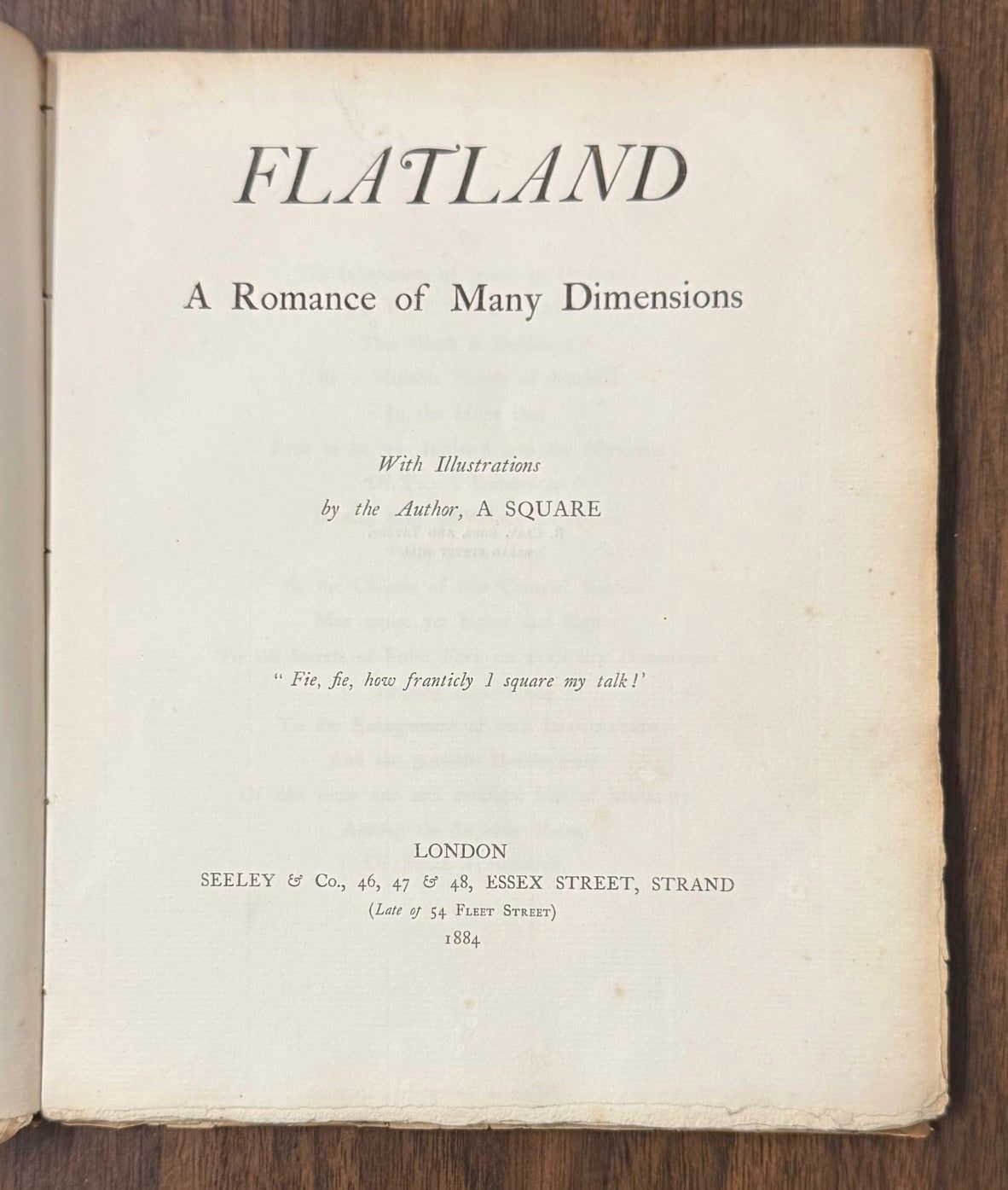
- London: Seeley & Co, 1884
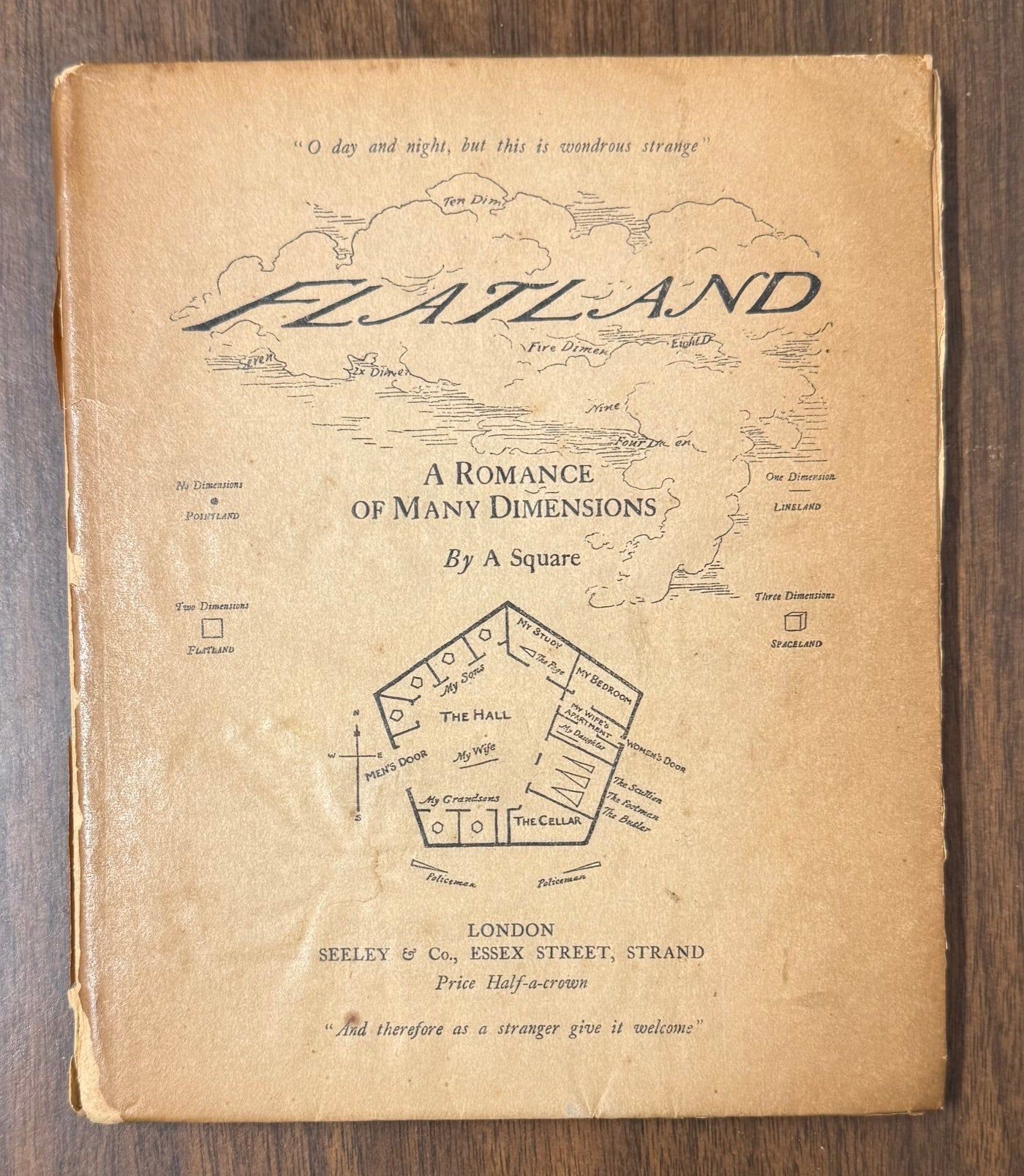
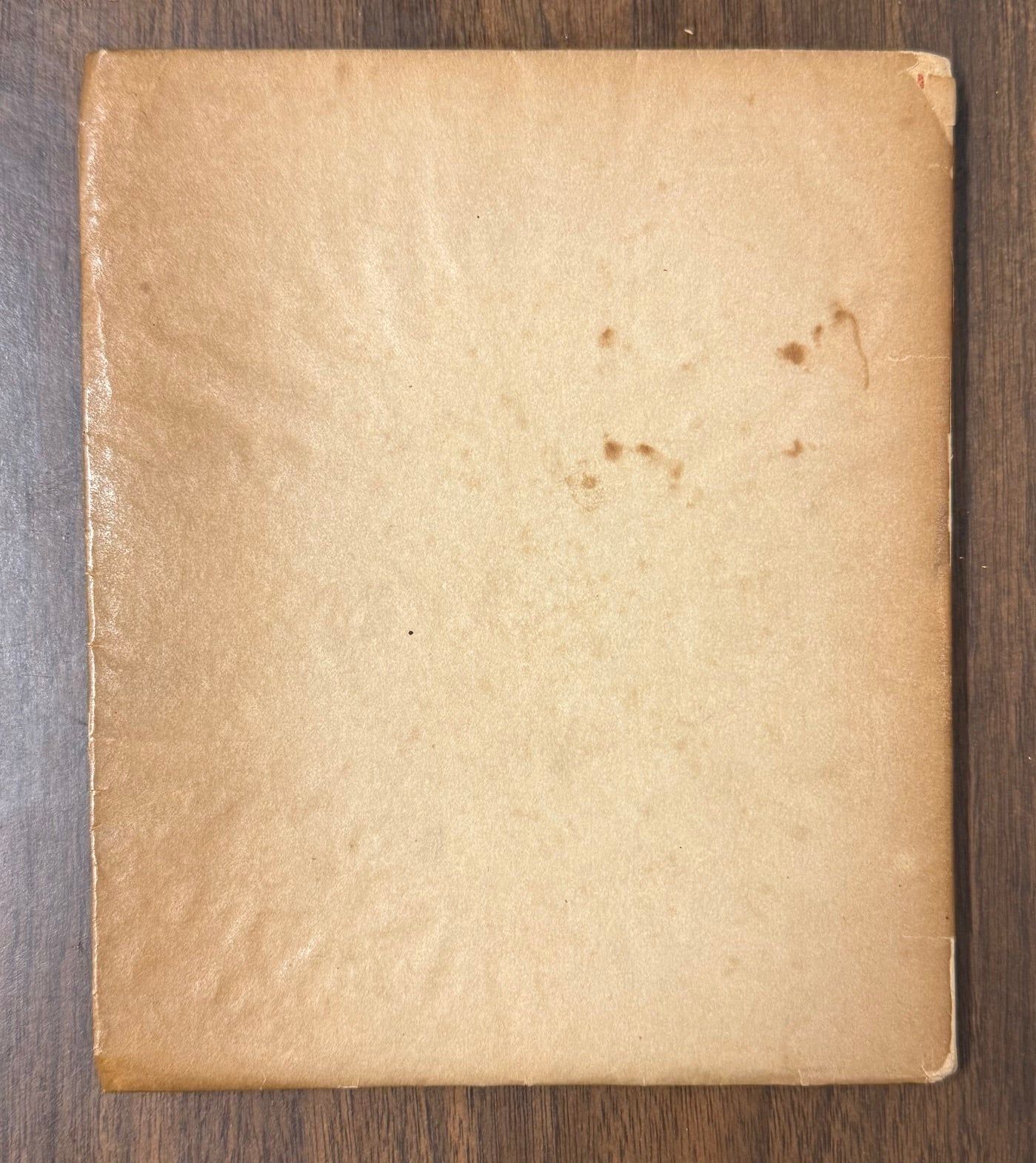
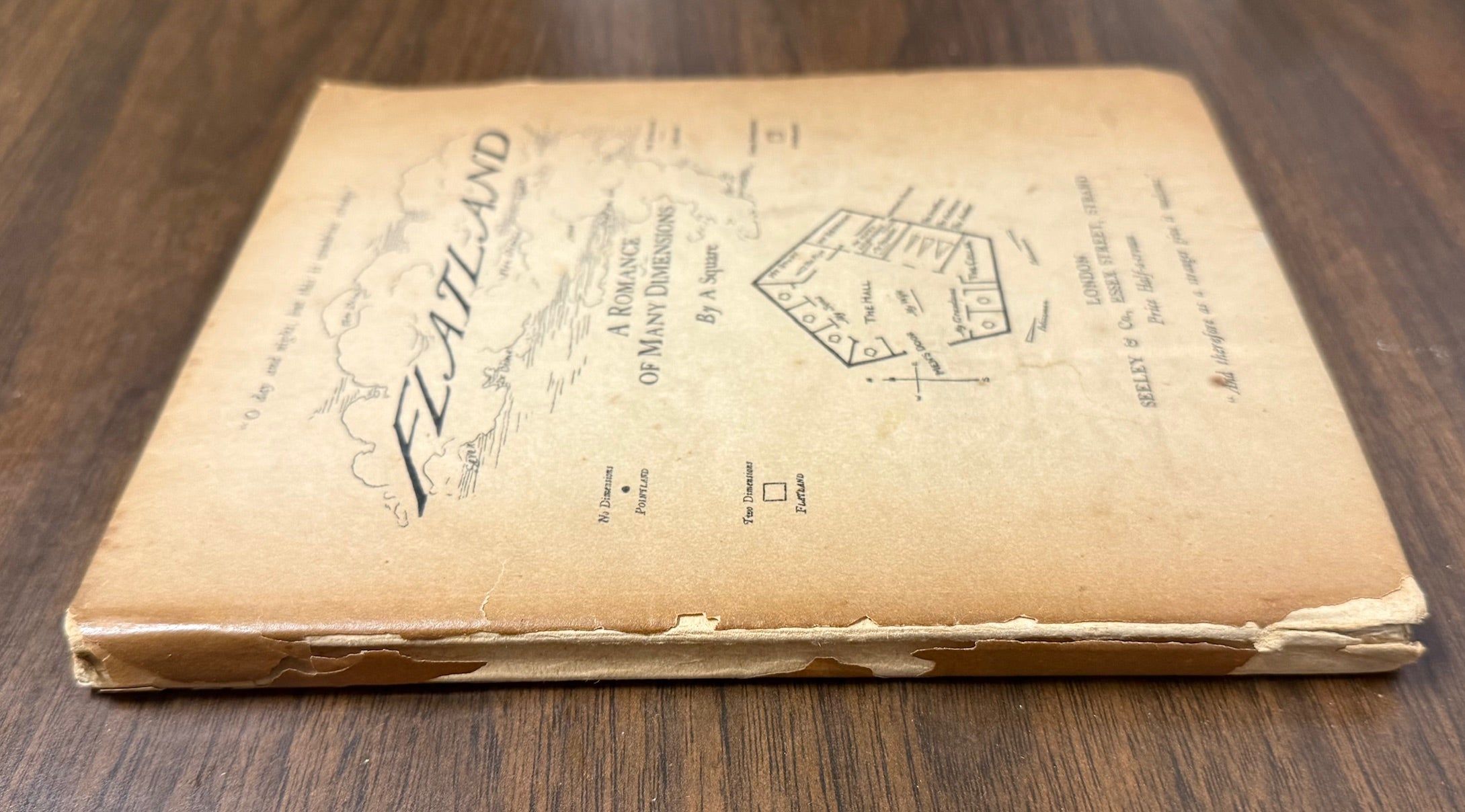
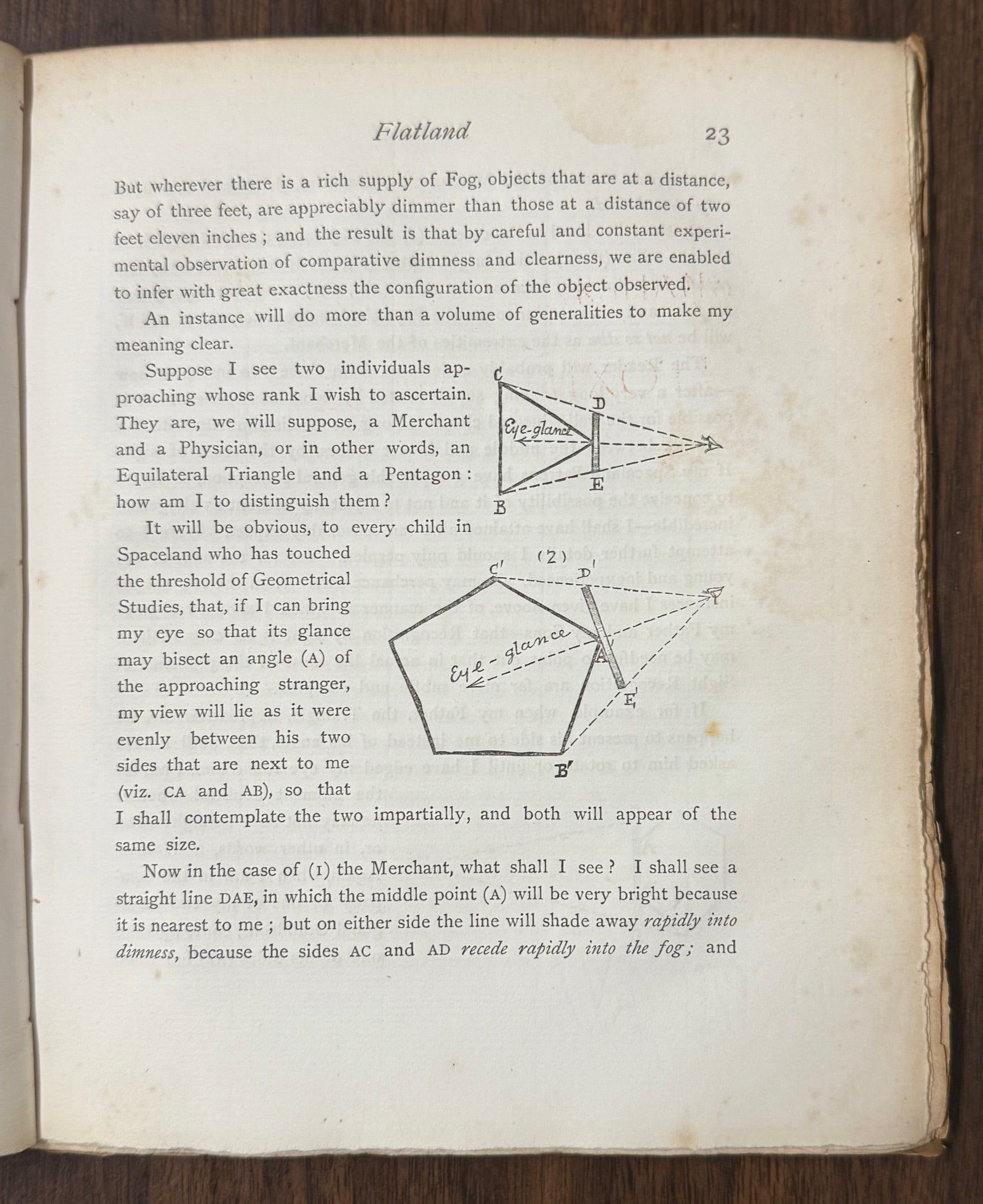
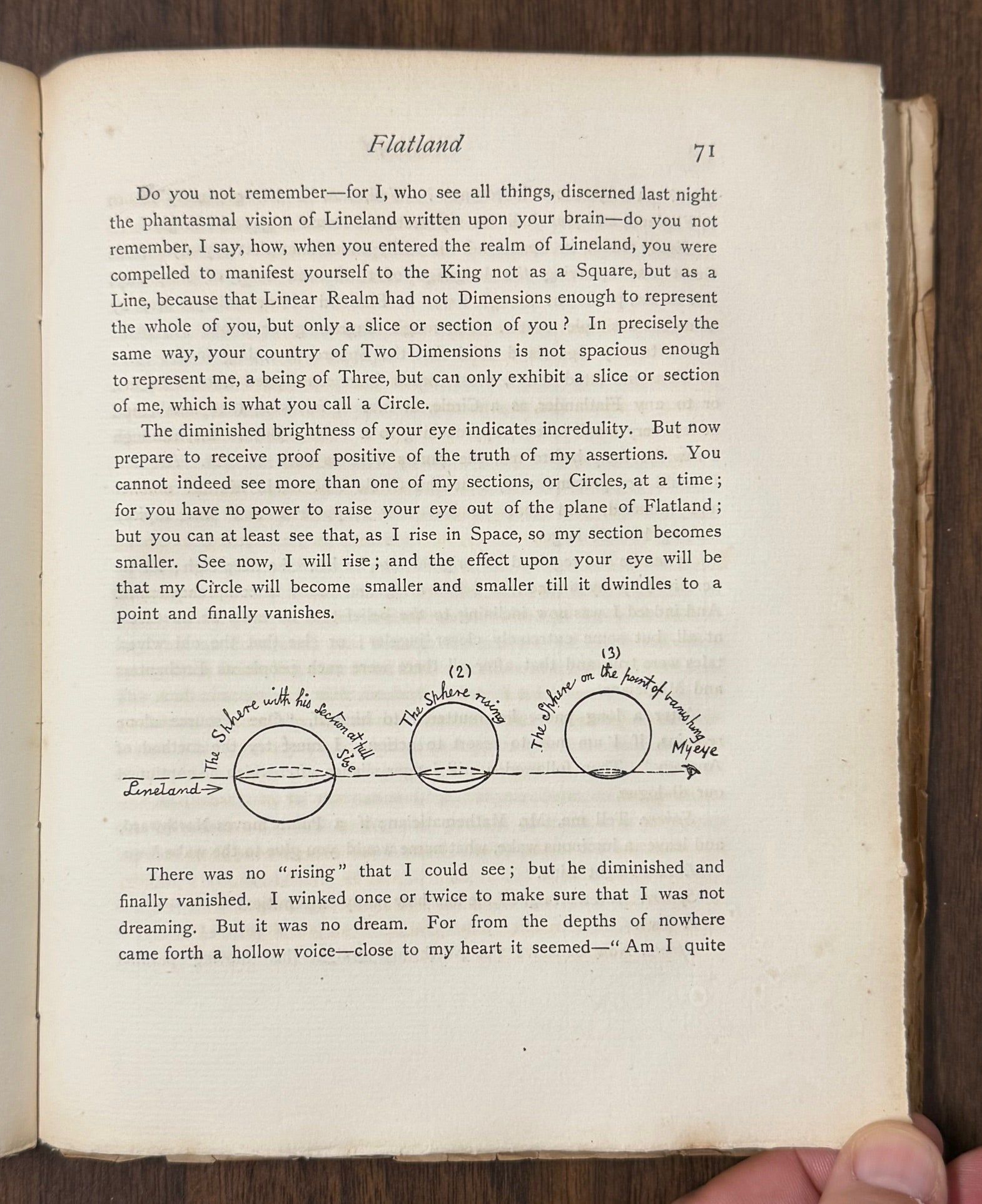
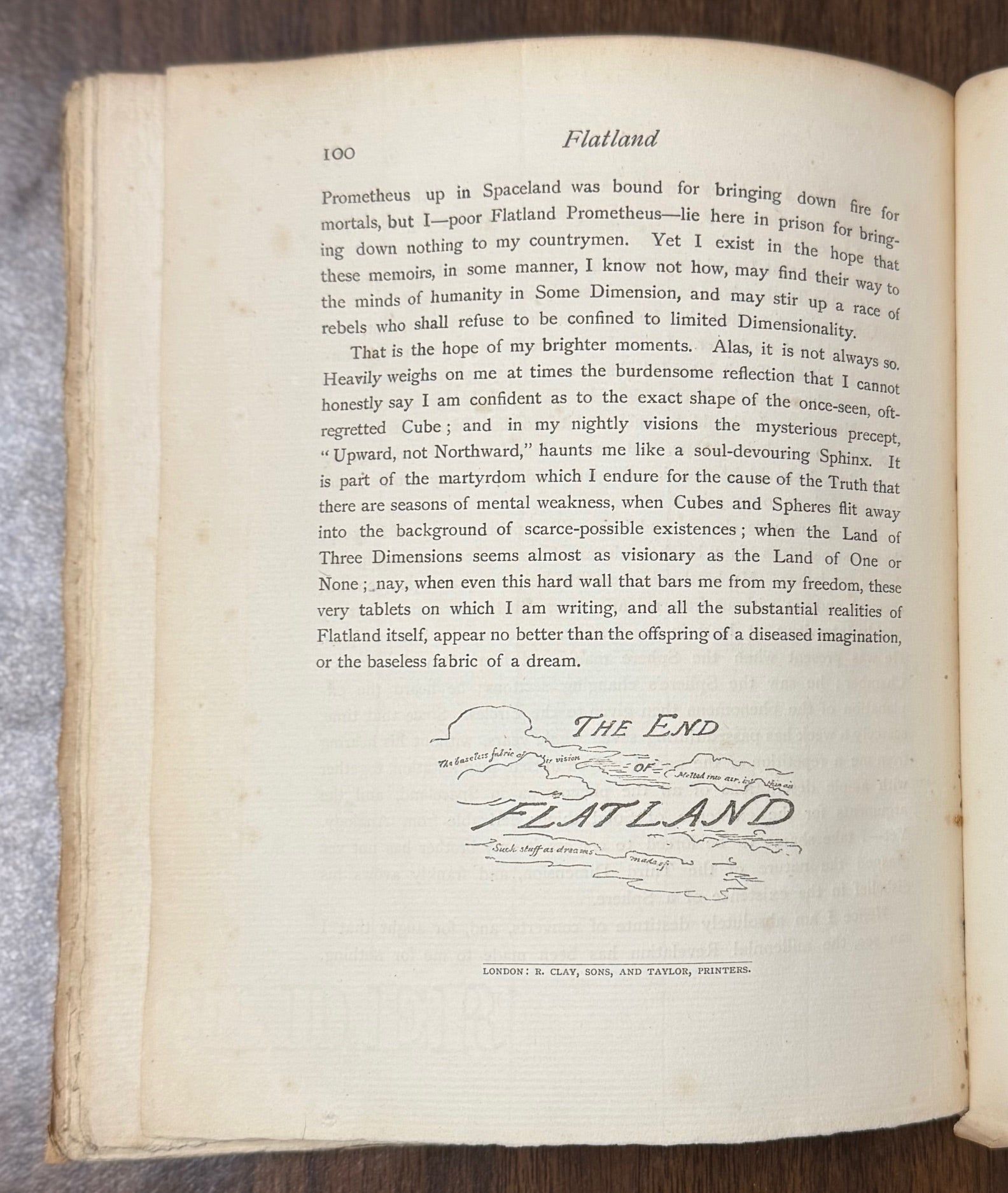
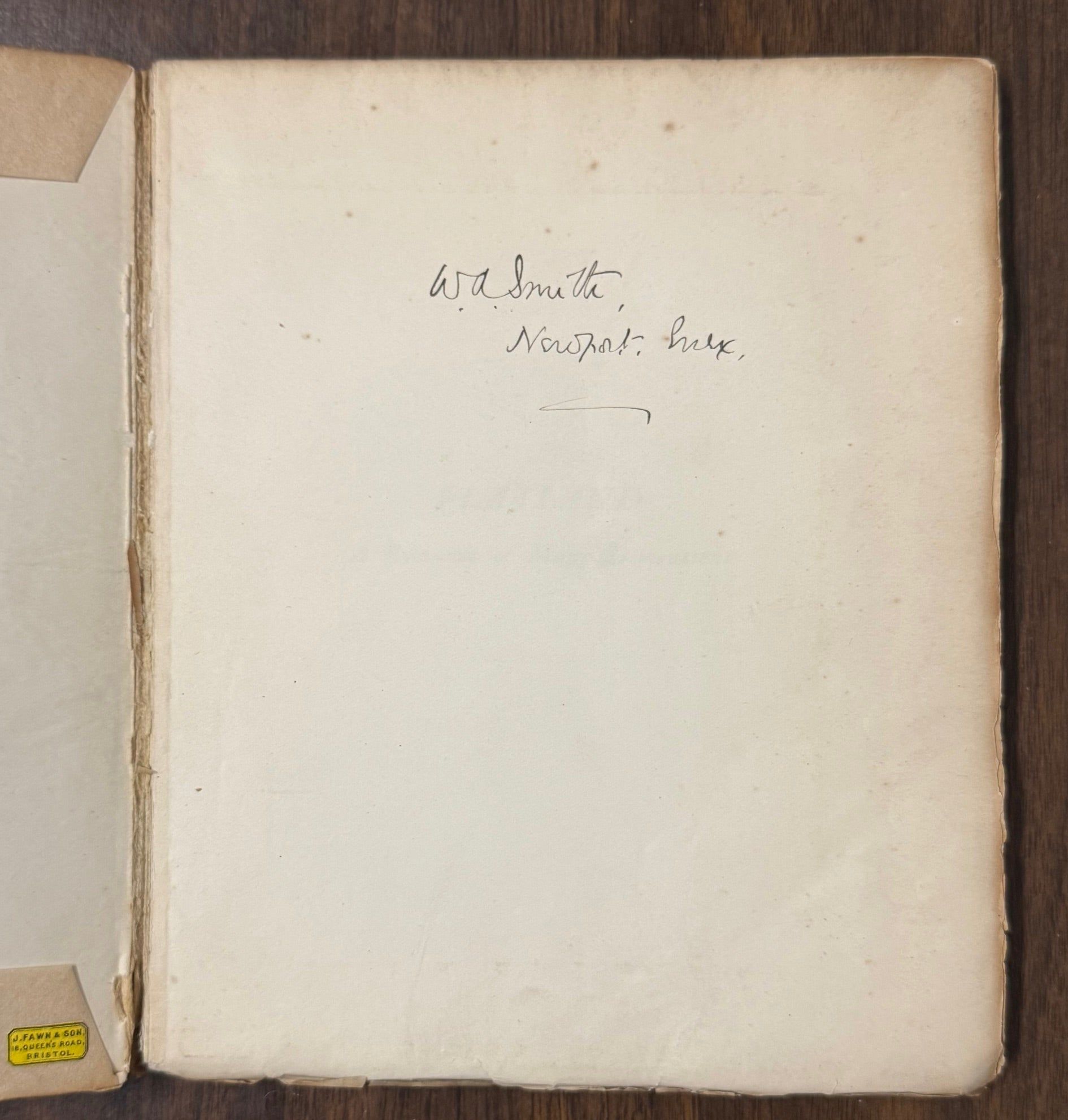
London: Seeley & Co, 1884. First. paperback. near fine/very good. Black and white illustrations within the text by the author. viii, 100 pages. Small square 4to (8.5 x 7 inches), original plain card wrappers with illustrated parchment dust wrapper; uncut edges. London: Seeley & Co., 1884. First edition. Some light scattered foxing and neat contemporary ownership name on front endpaper, otherwise pages are rather clean. Minor wear to spine ends; the fragile wrapper, toned as usual, has significant loss at spine but is otherwise intact. A near fine copy in very good dust wrapper. Rather scarce to see with the delicate original wrappers in decent condition.
Published pseudonymously by Abbott in 1884. "A description of life in Flatland, a world of two dimensions, followed by a dream visit to Lineland, a world of one dimension, followed in turn by the description of a visit from an inhabitant of our three-dimensional world. A classic of the topological sub-genre of science fiction". -- Spectrum of Fantasy, 1, 203.
"Flatland may be one of the most unclassifiable works of literature ever published. While it is acknowledged to be a classic of early science fiction, a work of Victorian social satire, and a religious allegory, it also presents, through its introduction to higher dimensions, an important contribution to the development of an area of mathematics that was eventually merged into non-Euclidean geometry. Flatland is an unusually effective work that spans disciplines and challenges divisional categories. Since its publication in 1884, the book'ss popularity has continued today as its readers have embraced it as science fiction, popular science, and metaphysics. Working from the groundwork of philosophical issues raised by Plato's Republic, Flatland merges social satire and geometry to produce a novel situated in two-dimensional space, a believable world populated by memorable inhabitants whose geometric shapes designate their positions in a complex social structure, one that bears some resemblance to the Victorian class structure" -- Lila Marz Harper, Flatland.
Published pseudonymously by Abbott in 1884. "A description of life in Flatland, a world of two dimensions, followed by a dream visit to Lineland, a world of one dimension, followed in turn by the description of a visit from an inhabitant of our three-dimensional world. A classic of the topological sub-genre of science fiction". -- Spectrum of Fantasy, 1, 203.
"Flatland may be one of the most unclassifiable works of literature ever published. While it is acknowledged to be a classic of early science fiction, a work of Victorian social satire, and a religious allegory, it also presents, through its introduction to higher dimensions, an important contribution to the development of an area of mathematics that was eventually merged into non-Euclidean geometry. Flatland is an unusually effective work that spans disciplines and challenges divisional categories. Since its publication in 1884, the book'ss popularity has continued today as its readers have embraced it as science fiction, popular science, and metaphysics. Working from the groundwork of philosophical issues raised by Plato's Republic, Flatland merges social satire and geometry to produce a novel situated in two-dimensional space, a believable world populated by memorable inhabitants whose geometric shapes designate their positions in a complex social structure, one that bears some resemblance to the Victorian class structure" -- Lila Marz Harper, Flatland.