

The Science of Judicial Proof As Given by Logic, Psychology... 3rd ed
- 1937
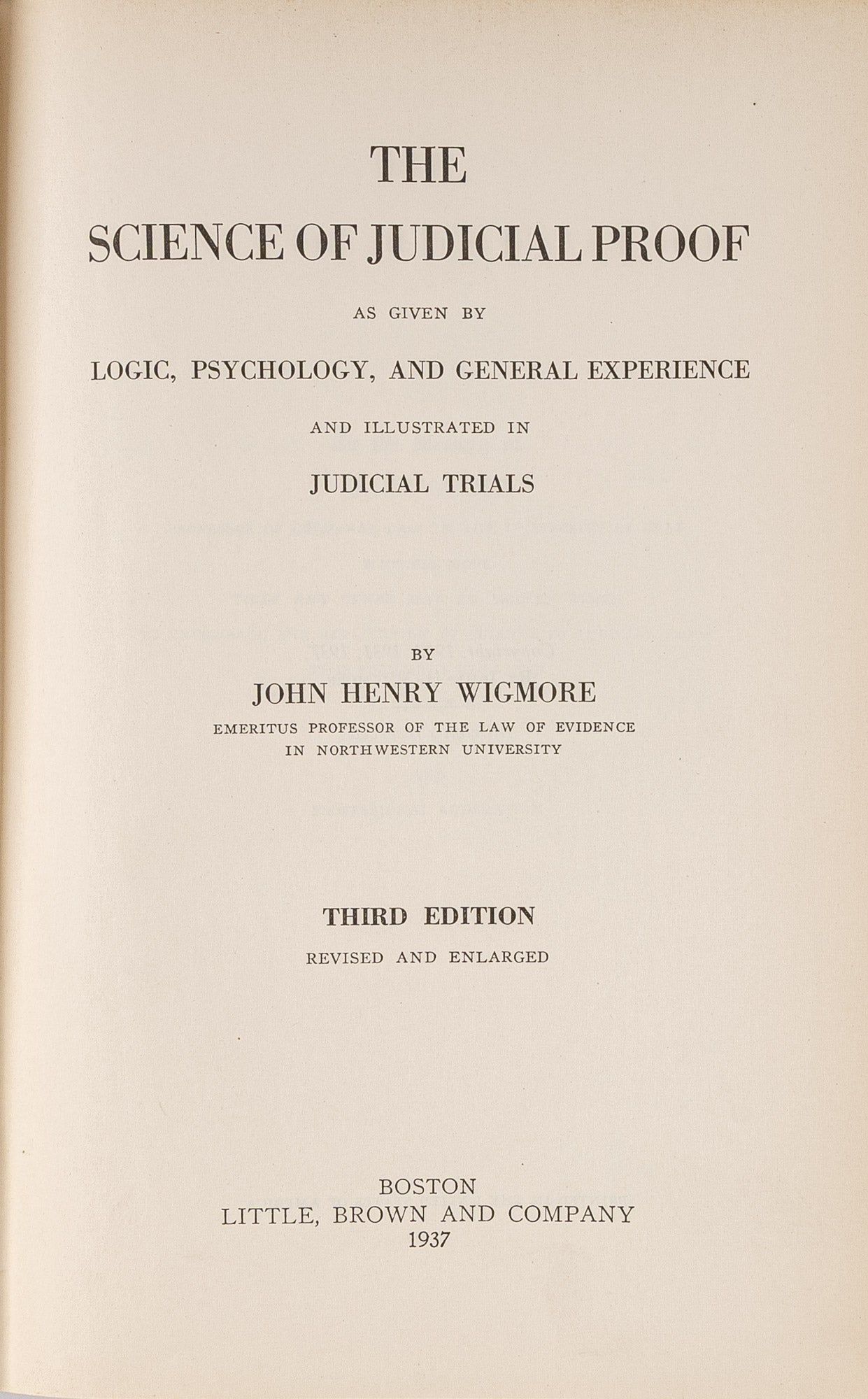
1937. Boston, 1937. Third edition, revised and enlarged.. Boston, 1937. Third edition, revised and enlarged. "Absolutely the Last Word on the Matter of Judicial Proof" Wigmore, John Henry [1863-1943]. The Science of Judicial Proof As Given by Logic, Psychology, And General Experience and Illustrated in Judicial Trials. Boston: Little, Brown and Company, 1937. xxiii, 1065 pp. with two folding plates, and nine illustrations. Publisher's green cloth hardcover, light shelfwear. Small circular embossed property stamp "Library of Anthony B Tohill" to front free endpaper, interior otherwise fresh. A very good copy. $350. * Third edition, revised and enlarged. An extensively revised and expanded edition of The Principles of Judicial Proof (1913), "[i]t is absolutely the last word on the matter of judicial proof and can be used to great value, not only by all practicing lawyers, but as an additional help to those more advanced in the profession.": Lawyer and Banker 24:242. Wigmore argued that the process of proving a case in court should be understood through the lens of logic and psychological principles, essentially outlining how evidence should be presented and evaluated in a trial based on human reasoning and perception. His theory emphasizes how judges and juries analyze evidence presented in court by applying logical reasoning and considering psychological factors that influence how people perceive and interpret information. This concept draws on formal logic to evaluate the consistency and coherence of evidence, ensuring that the facts presented form a logical chain leading to a conclusion. Wigmore recognized the psychological aspects of decision-making in the courtroom, including factors like witness credibility, juror bias, and the impact of persuasive techniques.