

Two previously unknown songs. London, ca. 1700
Folio. Disbound.
9 pp. musical manuscript, [i] (blank). Notated on 12-stave rastrum-ruled paper + 23ff. (rastrum-ruled staves without notation). England, ca. 1698-1705.
MORGAN, Thomas
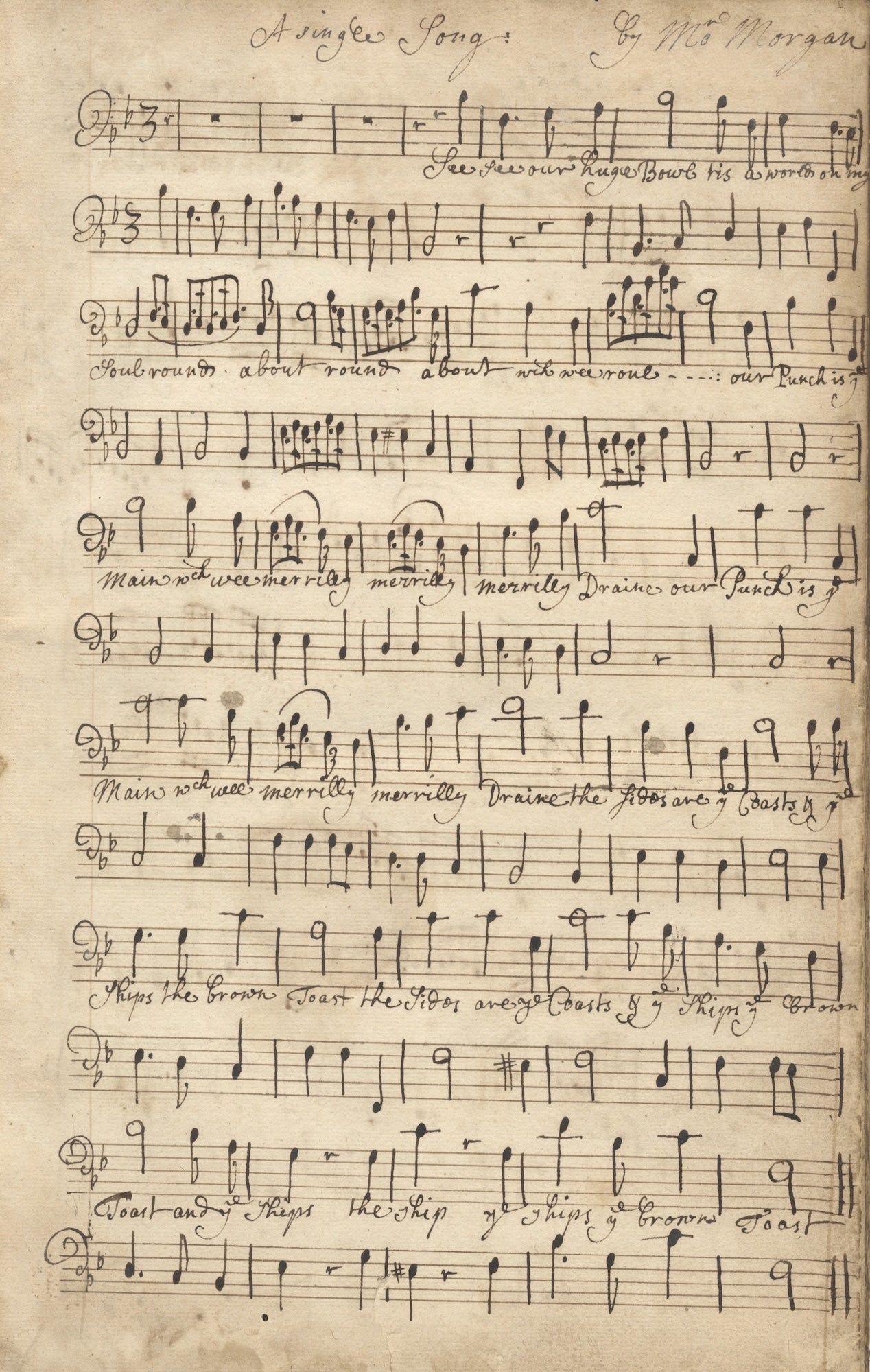
"A single Song," with text commencing "See, see our huge bowl." 3 pp. in total. Scored for bass voice and unfigured basso continuo. A drinking song with some melodic and harmonic similarity to the famous "Anacreontic Song." The present song, with a bounding melody in 3/4, incorporates divisions of running 16th and dotted rhythms. Unlocated.
Morgan, an organist and composer, was "probably Irish. It seems very likely that the ‘Mr Morgan’ to whom a number of late 17th-century songs and instrumental pieces are attributed was the Thomas Morgan appointed organist of Christ Church Cathedral, Dublin, in 1691, who left almost immediately for England to ‘endeavour to attain the perfection of an Organist’. Mercurius musicus (1699) contains a song stated to be ‘the last he made in Ireland’. His Collection of New Songs … and a Sonata for Two Flutes (1697) contains pieces from Motteux’s Europe’s Revels (1697) and Powell’s Imposture Defeated (1697). ... Further details are given in C. Price: Music in the Restoration Theatre (Ann Arbor, 1979)." Ian Spink in Grove Music Online
Bound with:
BARRETT, John
"A Song by Mr. Barrett," with text commencing "When to Cloris I sigh." 5 pp. in total. Scored for soprano voice and figured bass. Structured with three contrasting arioso sections, with an intervening recitative before the final one.
Barrett was an English composer, organist and music master. "From about 1686 to 1691 he was a chorister in the Chapel Royal under John Blow. He became organist of St Mary-at-Hill on 25 August 1693 and was appointed music master at Christ’s Hospital on 28 September 1697. He held both these posts until his death. He contributed a poem in homage to Blow to Amphion Anglicus (London, 1700) and was elected to the Amicable Society of Blues in about 1704. ...
Like many of his contemporaries, such as Jeremiah Clarke, John Eccles and Daniel Purcell, Barrett composed mainly for the theatre, and his many songs, mostly of the double-barrelled art song variety, are both tuneful and attractive, as are the several little keyboard pieces published in the first three books of The Harpsicord Master (1697–1702) and various other early 18th-century anthologies. The style is essentially Purcellian, but the use of motto openings in almost all the extended songs reveals an awareness of rather more up-to-date Italian vocal practice, and in one case (Begone, begone, thou too propitious light, n.d.) Barrett actually produces what must be one of the very first English recitative–aria–recitative–aria cantatas as such (though the term ‘cantata’ is not used). His incidental music for Shadwell’s The Lancashire Witches was popular, and no fewer than 30 performances at Drury Lane between 1713 and 1729 are recorded; like that of several other plays to which he also contributed, however, it is no longer extant." Christopher Powell, revised by H. Diack Johnstone in Grove Music Online
Bound with:
ANON.
"A new Scotch song (Sung by Mrs. Reading)," with text commencing "With tunefull pipe and merry glee." London, ca. 1705. 1 p. With melody line transposed for the flute to lowermost three systems. BUC p. 1087 (citing a published edition naming "Redding" as singer). Possibly a scribal copy of this or a previously unknown imprint.
Worn and slightly browned; small tears repaired with archival tape; trimmed at outer margin, not seriously affecting notation or text but just touching staff lines on one page; signatures separating; some showthrough. A new manuscript source for post-Restoration era vocal music, with two apparently previously unknown songs by Thomas Morgan, a composer who worked with several important playwrights of his day including Aphra Behn and John Dryden, and John Barrett, one of the first British composers to create an Italian-style cantata in English.
9 pp. musical manuscript, [i] (blank). Notated on 12-stave rastrum-ruled paper + 23ff. (rastrum-ruled staves without notation). England, ca. 1698-1705.
MORGAN, Thomas
"A single Song," with text commencing "See, see our huge bowl." 3 pp. in total. Scored for bass voice and unfigured basso continuo. A drinking song with some melodic and harmonic similarity to the famous "Anacreontic Song." The present song, with a bounding melody in 3/4, incorporates divisions of running 16th and dotted rhythms. Unlocated.
Morgan, an organist and composer, was "probably Irish. It seems very likely that the ‘Mr Morgan’ to whom a number of late 17th-century songs and instrumental pieces are attributed was the Thomas Morgan appointed organist of Christ Church Cathedral, Dublin, in 1691, who left almost immediately for England to ‘endeavour to attain the perfection of an Organist’. Mercurius musicus (1699) contains a song stated to be ‘the last he made in Ireland’. His Collection of New Songs … and a Sonata for Two Flutes (1697) contains pieces from Motteux’s Europe’s Revels (1697) and Powell’s Imposture Defeated (1697). ... Further details are given in C. Price: Music in the Restoration Theatre (Ann Arbor, 1979)." Ian Spink in Grove Music Online
Bound with:
BARRETT, John
"A Song by Mr. Barrett," with text commencing "When to Cloris I sigh." 5 pp. in total. Scored for soprano voice and figured bass. Structured with three contrasting arioso sections, with an intervening recitative before the final one.
Barrett was an English composer, organist and music master. "From about 1686 to 1691 he was a chorister in the Chapel Royal under John Blow. He became organist of St Mary-at-Hill on 25 August 1693 and was appointed music master at Christ’s Hospital on 28 September 1697. He held both these posts until his death. He contributed a poem in homage to Blow to Amphion Anglicus (London, 1700) and was elected to the Amicable Society of Blues in about 1704. ...
Like many of his contemporaries, such as Jeremiah Clarke, John Eccles and Daniel Purcell, Barrett composed mainly for the theatre, and his many songs, mostly of the double-barrelled art song variety, are both tuneful and attractive, as are the several little keyboard pieces published in the first three books of The Harpsicord Master (1697–1702) and various other early 18th-century anthologies. The style is essentially Purcellian, but the use of motto openings in almost all the extended songs reveals an awareness of rather more up-to-date Italian vocal practice, and in one case (Begone, begone, thou too propitious light, n.d.) Barrett actually produces what must be one of the very first English recitative–aria–recitative–aria cantatas as such (though the term ‘cantata’ is not used). His incidental music for Shadwell’s The Lancashire Witches was popular, and no fewer than 30 performances at Drury Lane between 1713 and 1729 are recorded; like that of several other plays to which he also contributed, however, it is no longer extant." Christopher Powell, revised by H. Diack Johnstone in Grove Music Online
Bound with:
ANON.
"A new Scotch song (Sung by Mrs. Reading)," with text commencing "With tunefull pipe and merry glee." London, ca. 1705. 1 p. With melody line transposed for the flute to lowermost three systems. BUC p. 1087 (citing a published edition naming "Redding" as singer). Possibly a scribal copy of this or a previously unknown imprint.
Worn and slightly browned; small tears repaired with archival tape; trimmed at outer margin, not seriously affecting notation or text but just touching staff lines on one page; signatures separating; some showthrough. A new manuscript source for post-Restoration era vocal music, with two apparently previously unknown songs by Thomas Morgan, a composer who worked with several important playwrights of his day including Aphra Behn and John Dryden, and John Barrett, one of the first British composers to create an Italian-style cantata in English.