

Sonate a Violino Solo col Violone ò Cimbalo e Sonate A due Violini, Violoncello é Basso Continuo Dedicate All' Altezza Reale del Duca d'Orleans ... Opera prima. ... Le prix des deux Livres en blanc est de 8tt ... Gravé Par H. de Baussen. [Score]
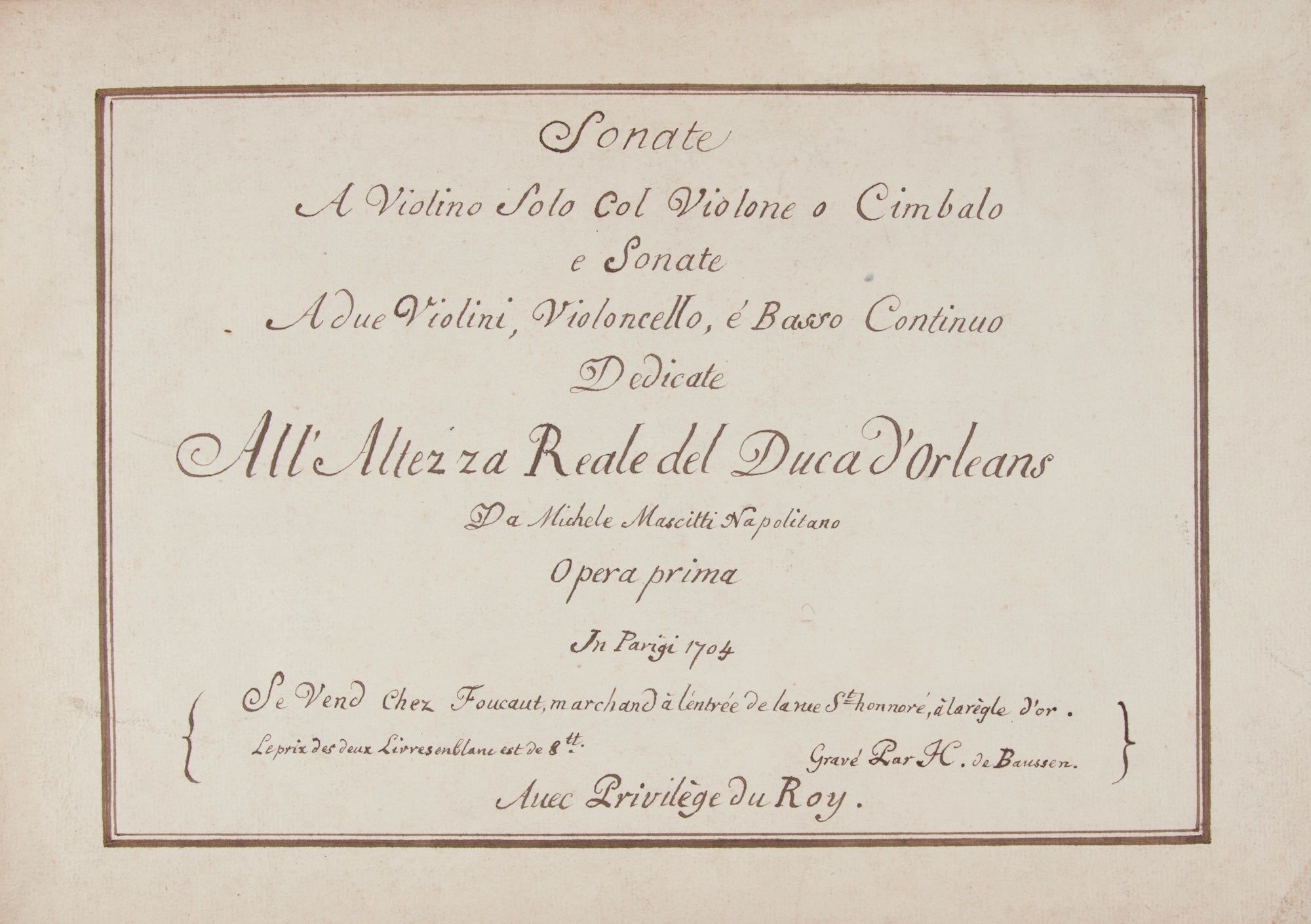
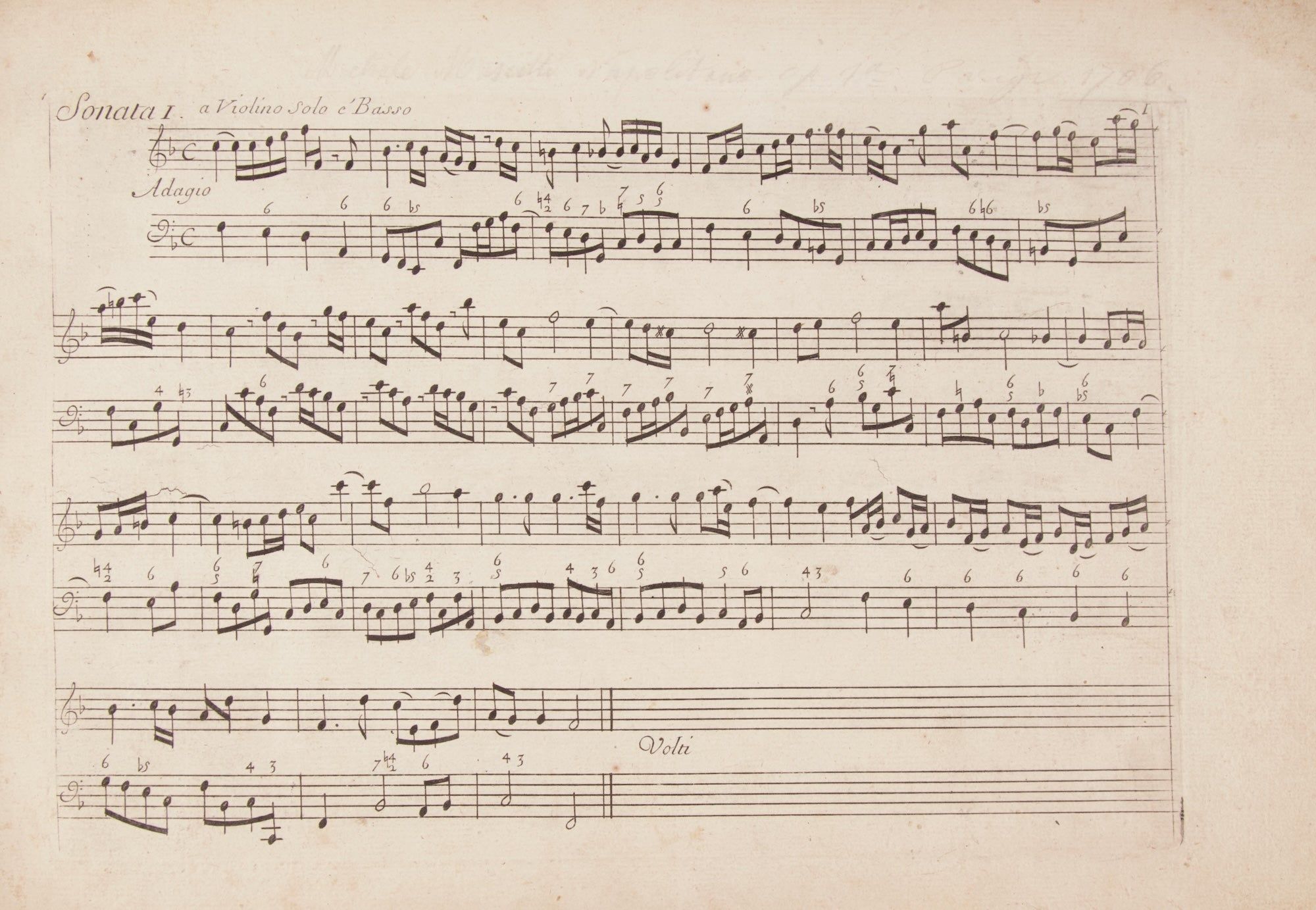
- Paris: Se Vend Chez Foucaut, marchand à l'entrée de la rue St. honnoré[!], à la régle d'or, 1704
Paris: Se Vend Chez Foucaut, marchand à l'entrée de la rue St. honnoré[!], à la régle d'or, 1704. Oblong folio. Early 20th century flexible marbled boards. 1f. (recto title in early manuscript facsimile, verso blank), 59, [i] (privilege) pp. Engraved.
Boards worn, rubbed, bumped, and partially detached; spine lacking. Slightly worn; moderately browned; minor tears, stains, and soiling; occasional dampstaining; some signatures detached. Lacking title, dedication, pp. 5-6 (all supplied in manuscript facsimile), and separately-issued second violin part. First Edition. Lesure p. 422. RISM M1212 (1 copy only in both the U.S. and the U.K.).
Mascitti settled in Paris in 1704, where all nine of his published collections were issued between that year and 1739. "[He] became a figurehead of Italian instrumental music in France and was regarded as the peer of Corelli [who had been his teacher in Rome] and Albinoni. ... Mascitti enjoyed enormous popularity with the French public." TNG Vol. 11, p. 746.
"The success of his sonatas in his own day is evidenced by their several reprints throughout the century ... and the high praise for them to be found in the writings of Daquin, Le Blanc, and La Borde, among others." Newman: The Sonata in the Baroque Era, pp. 368-369.
Boards worn, rubbed, bumped, and partially detached; spine lacking. Slightly worn; moderately browned; minor tears, stains, and soiling; occasional dampstaining; some signatures detached. Lacking title, dedication, pp. 5-6 (all supplied in manuscript facsimile), and separately-issued second violin part. First Edition. Lesure p. 422. RISM M1212 (1 copy only in both the U.S. and the U.K.).
Mascitti settled in Paris in 1704, where all nine of his published collections were issued between that year and 1739. "[He] became a figurehead of Italian instrumental music in France and was regarded as the peer of Corelli [who had been his teacher in Rome] and Albinoni. ... Mascitti enjoyed enormous popularity with the French public." TNG Vol. 11, p. 746.
"The success of his sonatas in his own day is evidenced by their several reprints throughout the century ... and the high praise for them to be found in the writings of Daquin, Le Blanc, and La Borde, among others." Newman: The Sonata in the Baroque Era, pp. 368-369.