

The Favourite Songs in the Opera Call'd La Didone Abbandonata. [Score]
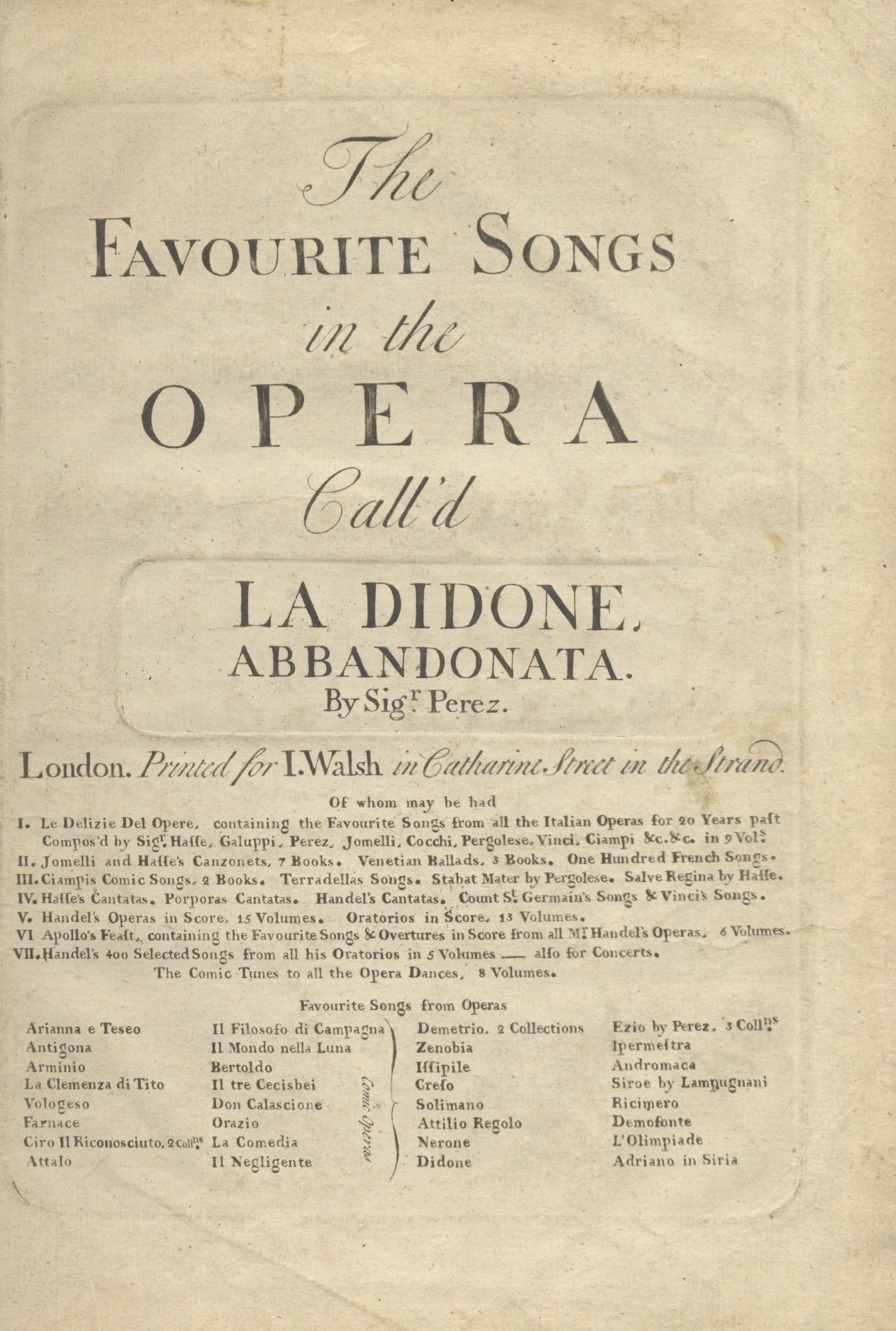
- London: Printed for I. Walsh in Catharine Street in the Strand, 1761
London: Printed for I. Walsh in Catharine Street in the Strand, 1761. GALUPPI, Baldassare 1706-1785. Folio. Full modern carta rustica. Sewn. 1f. (recto passepartout title, verso blank), 20 pp. With publisher's detailed list of available works by other composers to title. Engraved.
Contains five arias (three by Perez and two by Galuppi), with named singers including Sigr. Elisi and Sigra. Mattei.
Slightly worn, soiled, and browned; a few minor stains and occasional light foxing.
A very good, crisp copy overall. Smith and Humphries 1188, p. 265. BUC p. 770. RISM G274, GG274, P1328 and PP1328.
The arias are drawn from operas on the same subject by Galuppi (premiered Modena, 1740) and Perez (premiered Genova, 1751)
Perez, an Italian composer "composed more than 45 dramatic works between 1733 and 1777, about half of which were operas written between 1744 and 1755, the period during which he concentrated almost exclusively on the genre. Excerpts from Arminio, La Didone abbandonata, Ezio, Il Farnace, Solimano and Vologeso were published in London by John Walsh, and many works exist in manuscript. ... 18th-century critics often ranked Perez with Hasse and Jommelli; Burney found ‘an original spirit and elegance in all his production’. 19th- and 20th-century commentary, based for the most part on a few earlier operas, has generally downgraded this judgment. A more complete examination of his works affirms the stature his contemporaries assigned to him. While he was essentially a transitional figure in 18th-century opera, he was nevertheless one of the great composers of opera seria, and as a church composer, he wrote some of the finest Roman Catholic music of the 18th century." Mauricio Dottori and Paul J. Jackson in Grove Music Online
Galuppi, an Italian composer, "was a central figure in the development of the dramma giocoso and one of the most important mid-18th-century opera seria composers. ... Galuppi was an extraordinarily popular composer of both serious and comic operas and a prolific composer of sacred and keyboard music. His facile, elegant and flexible melodic style, joined to Goldoni’s witty and sometimes poignant poetry, created the central watershed for the dispersion of drammi giocosi throughout Europe after 1749; works such as Il filosofo di campagna have few peers in that regard. Yet his serious operas were no less important; their performances exceeded his comic operas in number. Galuppi’s stage music embodies the principal Italian tradition of charming and beautiful melody, clear and lucid accompaniment, and virtuoso or emotive display; as he described it to Burney, good music contained ‘vaghezza, chiarezza e buona modulazione’." Dale E. Monson in Grove Music Online.
Contains five arias (three by Perez and two by Galuppi), with named singers including Sigr. Elisi and Sigra. Mattei.
Slightly worn, soiled, and browned; a few minor stains and occasional light foxing.
A very good, crisp copy overall. Smith and Humphries 1188, p. 265. BUC p. 770. RISM G274, GG274, P1328 and PP1328.
The arias are drawn from operas on the same subject by Galuppi (premiered Modena, 1740) and Perez (premiered Genova, 1751)
Perez, an Italian composer "composed more than 45 dramatic works between 1733 and 1777, about half of which were operas written between 1744 and 1755, the period during which he concentrated almost exclusively on the genre. Excerpts from Arminio, La Didone abbandonata, Ezio, Il Farnace, Solimano and Vologeso were published in London by John Walsh, and many works exist in manuscript. ... 18th-century critics often ranked Perez with Hasse and Jommelli; Burney found ‘an original spirit and elegance in all his production’. 19th- and 20th-century commentary, based for the most part on a few earlier operas, has generally downgraded this judgment. A more complete examination of his works affirms the stature his contemporaries assigned to him. While he was essentially a transitional figure in 18th-century opera, he was nevertheless one of the great composers of opera seria, and as a church composer, he wrote some of the finest Roman Catholic music of the 18th century." Mauricio Dottori and Paul J. Jackson in Grove Music Online
Galuppi, an Italian composer, "was a central figure in the development of the dramma giocoso and one of the most important mid-18th-century opera seria composers. ... Galuppi was an extraordinarily popular composer of both serious and comic operas and a prolific composer of sacred and keyboard music. His facile, elegant and flexible melodic style, joined to Goldoni’s witty and sometimes poignant poetry, created the central watershed for the dispersion of drammi giocosi throughout Europe after 1749; works such as Il filosofo di campagna have few peers in that regard. Yet his serious operas were no less important; their performances exceeded his comic operas in number. Galuppi’s stage music embodies the principal Italian tradition of charming and beautiful melody, clear and lucid accompaniment, and virtuoso or emotive display; as he described it to Burney, good music contained ‘vaghezza, chiarezza e buona modulazione’." Dale E. Monson in Grove Music Online.