

1849 Letter Describing Crossing Panama on the Way to California: “They do not understand Americans”
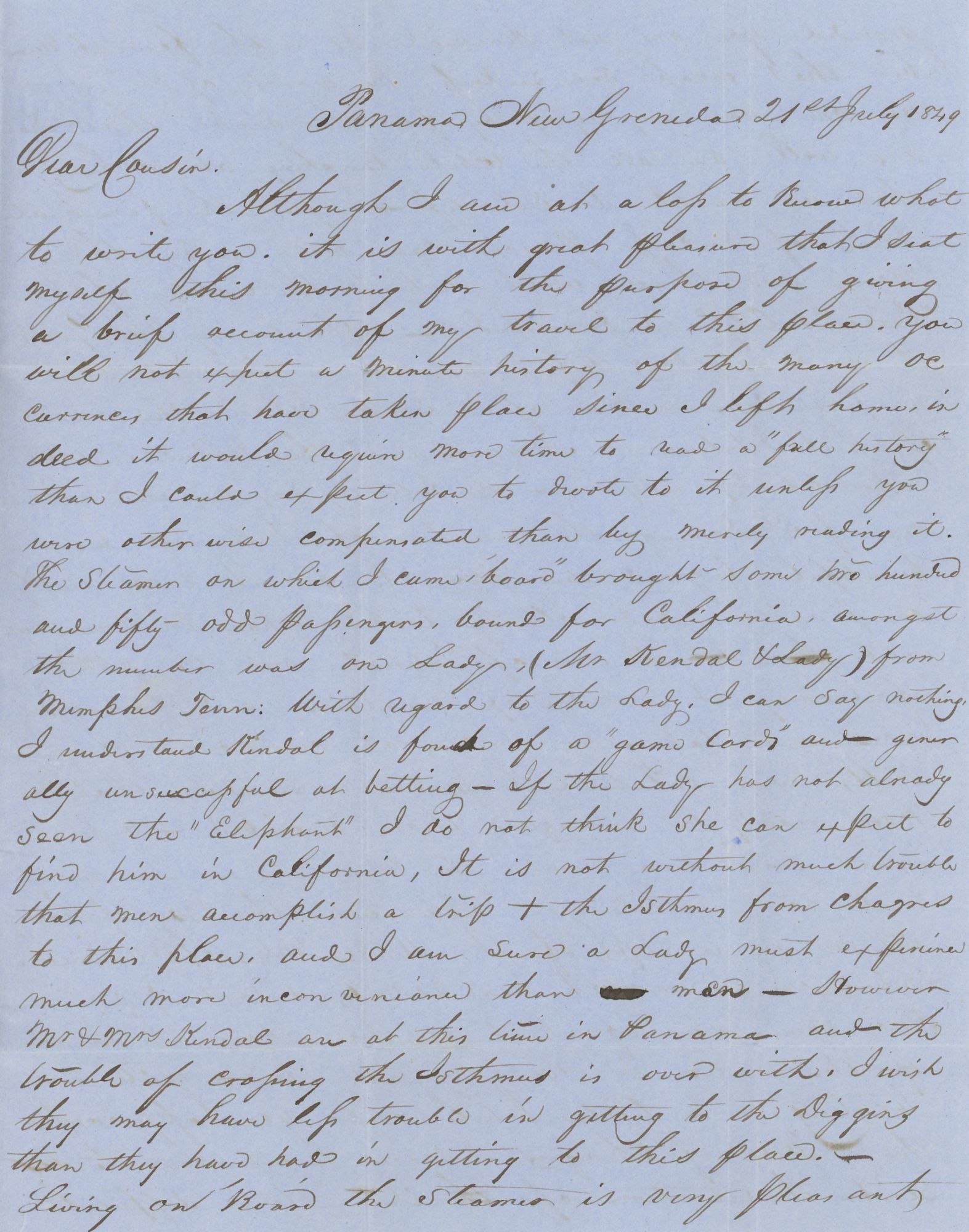
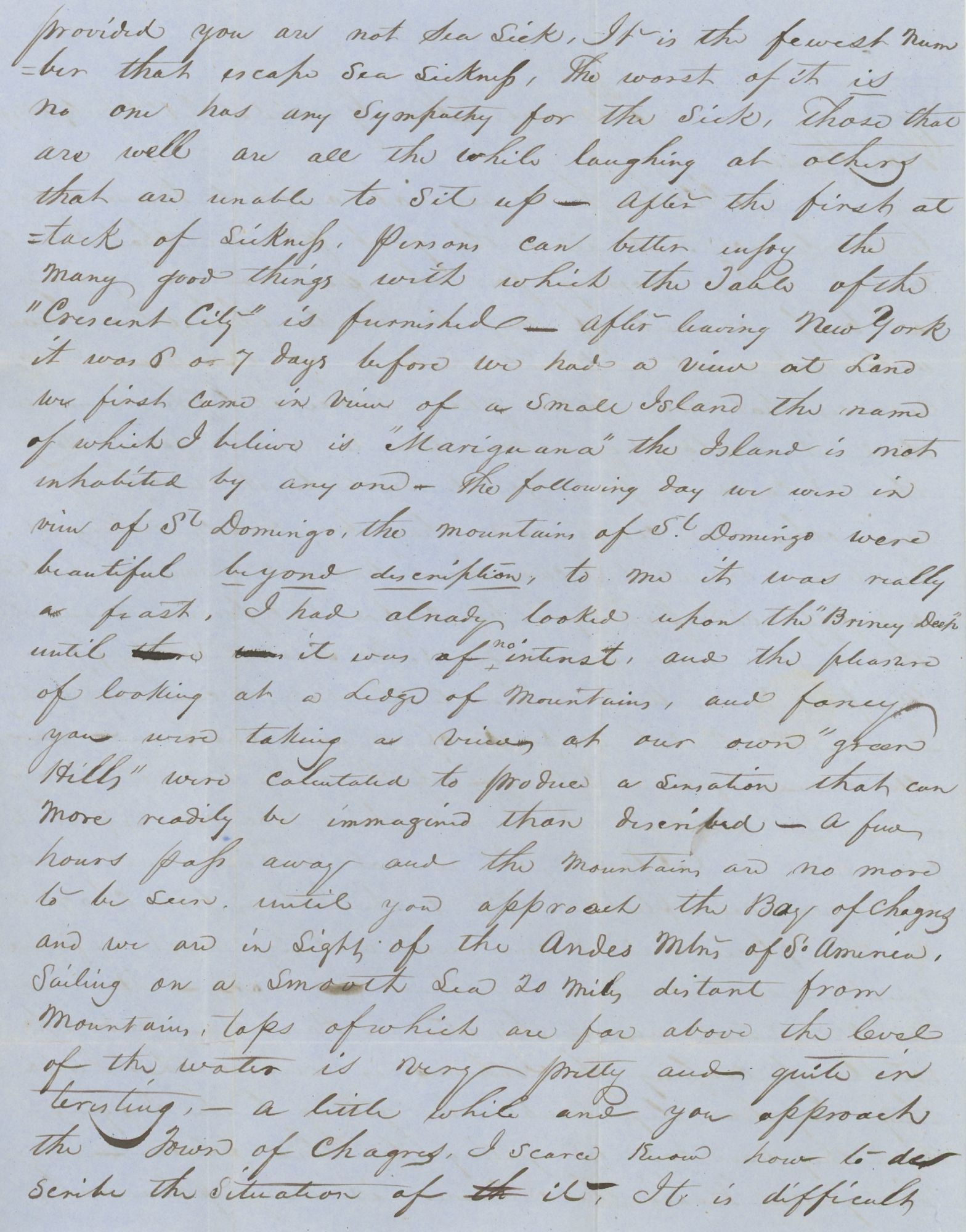
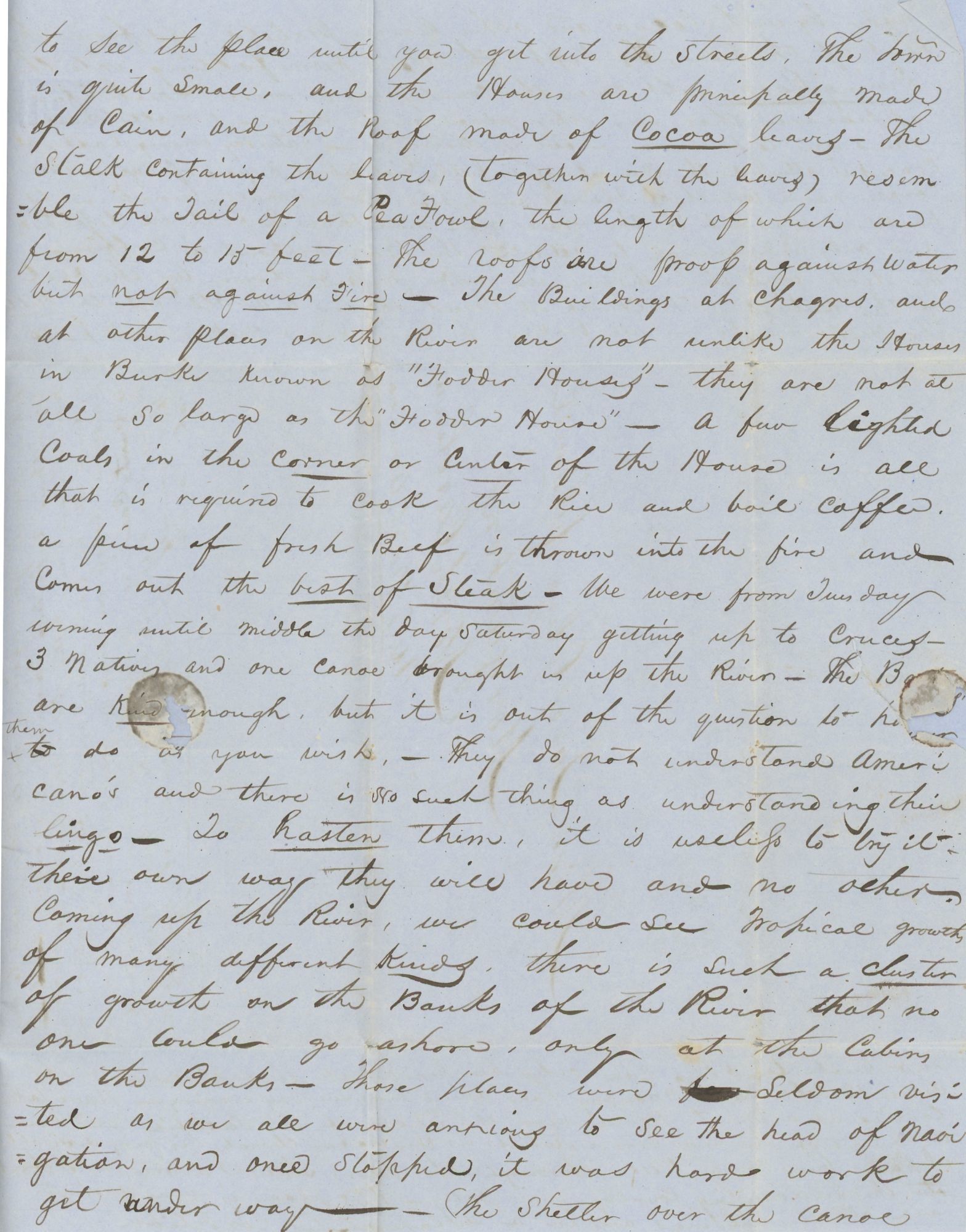
- Single four-page letter measuring 7 ½ x 10 inches. Folded with some small tears; some text missing at seal
- Panama, New Grenada , 1849
Panama, New Grenada, 1849. Single four-page letter measuring 7 ½ x 10 inches. Folded with some small tears; some text missing at seal. Overall excellent to Near Fine.. A letter from W. J. Pearson to his cousin Jane Eliza Caldwell, written from Panama in 1849 as Pearson traveled to California. Pearson first describes the scenery passing by Mayaguana and Hispaniola and entering the Chagres River. Of the town of Chagres, then the isthmus’ main Atlantic port, he writes:
“I scarcely know how to describe the situation of it. It is difficult to see the place until you get into the streets. The town is quite small, and the Houses are principally made of Cain, and the Roof made of Cocoa leaves – The stalk containing the leaves, (together with the leaves) resemble the tail of a Pea Fowl, the length of which are from 12 to 15 feet – The roofs are proof against water but not against fire – The Buildings at Chagres and at other places on the River are not unlike the Houses in Burke [North Carolina] known as ‘Fodder Houses’ – they are not at all so large as the ‘Fodder House’ – a few lighted coals in the corner or center of the House is all that is required to cook the rice and boil coffee. a piece of fresh Beef is thrown into the fire and comes out the best steak –”
His group traveled down the river to Cruces by canoe:
“we were from Tuesday evening until middle of the day Saturday getting up to Cruces – 3 natives and one canoe brought us up the River – the [missing] are kind enough, but it is out of the question to [missing] to do as you wish. – They do not understand American’s and there is no such thing as understanding their lingo – To hasten them, it is useless to try it, their own way they will have and no other.”
Pearson describes Cruces, especially its religious aspects:
“At Cruces the country has a more healthful appearance than any other place on the river – Small mountains are to be seen in every direction – Saturday evening last, at Cruces, I attended the Funeral of a little girl about 3 years of age – The corpse had a wreath of Flowers on its head, and a small bunch in its hands. – was put in the grave not more than 2 feet in depth and only wide enough to admit the Body without a Coffin – The dirt was then thrown in and pressed down by the feet of the natives – The Church at Cruces appears to be as old as the Hills the Bells (3 in No) are all broken. The Sexton has a rock in each hand and such tinkling can only be heard at that place – [...] I think the surrounding country very pretty – This place is very ancient and all the buildings are in a dilapidated condition”.
In the short time between the discovery of gold in California and the construction of Panama’s railroad and, later, canal—and before the US constructed a transcontinental railroad of its own—traffic from the hopeful travelers on their several days’ journey across the isthmus was quite lucrative for the area.
Of interest to historians of Panama in the California Gold Rush, and travel there prior to the railroad’s construction.
“I scarcely know how to describe the situation of it. It is difficult to see the place until you get into the streets. The town is quite small, and the Houses are principally made of Cain, and the Roof made of Cocoa leaves – The stalk containing the leaves, (together with the leaves) resemble the tail of a Pea Fowl, the length of which are from 12 to 15 feet – The roofs are proof against water but not against fire – The Buildings at Chagres and at other places on the River are not unlike the Houses in Burke [North Carolina] known as ‘Fodder Houses’ – they are not at all so large as the ‘Fodder House’ – a few lighted coals in the corner or center of the House is all that is required to cook the rice and boil coffee. a piece of fresh Beef is thrown into the fire and comes out the best steak –”
His group traveled down the river to Cruces by canoe:
“we were from Tuesday evening until middle of the day Saturday getting up to Cruces – 3 natives and one canoe brought us up the River – the [missing] are kind enough, but it is out of the question to [missing] to do as you wish. – They do not understand American’s and there is no such thing as understanding their lingo – To hasten them, it is useless to try it, their own way they will have and no other.”
Pearson describes Cruces, especially its religious aspects:
“At Cruces the country has a more healthful appearance than any other place on the river – Small mountains are to be seen in every direction – Saturday evening last, at Cruces, I attended the Funeral of a little girl about 3 years of age – The corpse had a wreath of Flowers on its head, and a small bunch in its hands. – was put in the grave not more than 2 feet in depth and only wide enough to admit the Body without a Coffin – The dirt was then thrown in and pressed down by the feet of the natives – The Church at Cruces appears to be as old as the Hills the Bells (3 in No) are all broken. The Sexton has a rock in each hand and such tinkling can only be heard at that place – [...] I think the surrounding country very pretty – This place is very ancient and all the buildings are in a dilapidated condition”.
In the short time between the discovery of gold in California and the construction of Panama’s railroad and, later, canal—and before the US constructed a transcontinental railroad of its own—traffic from the hopeful travelers on their several days’ journey across the isthmus was quite lucrative for the area.
Of interest to historians of Panama in the California Gold Rush, and travel there prior to the railroad’s construction.