

1860 Letter Likely from Plumas County Describing “sorry Chinese” and Indigenous Populations
- Single four-page letter measuring 7 ½ x 9 ½ inches
- Likely Plumas County, California , 1860
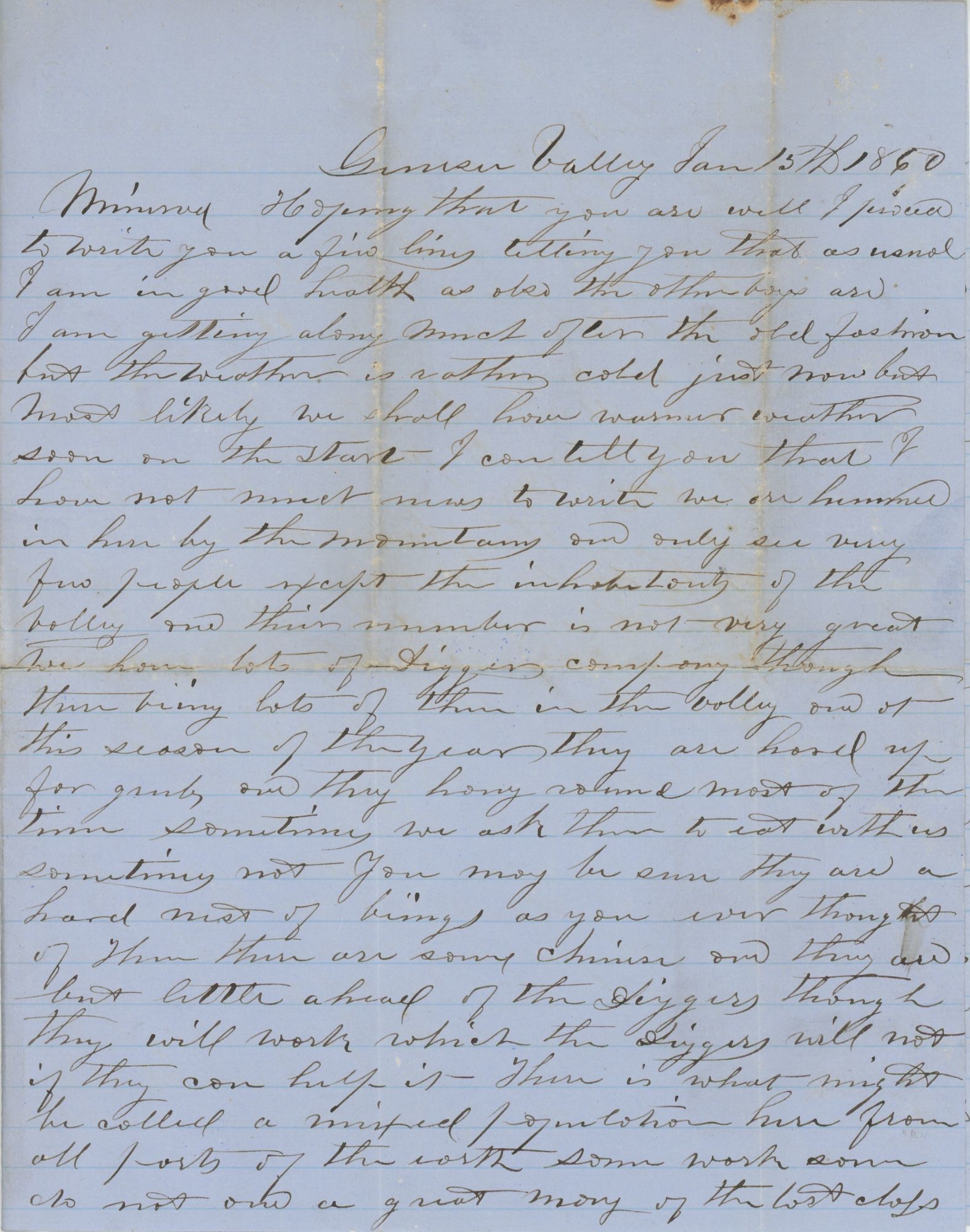
Likely Plumas County, California, 1860. Single four-page letter measuring 7 ½ x 9 ½ inches. Folded with some small tears at folds; excellent.. A letter from “Charly” to his wife or fiance, written in January of 1860 from “Ganser [possibly sic] Valley”, likely in Plumas County, California. Located in the Sierra Nevada, Plumas County contained a number of mining towns following the California gold rush; however, Charly does not specify his line of work or discuss any particulars. Instead—besides inquiring after the health of family and friends and considering when he would return home—Charly discusses the other residents of the valley. He writes:
“I can tell you that I have not much news to write we are hemmed in here by the mountains and only see very few people except the inhabitants of the valley and their number is not very great we have lots of Digger company though there being lots of them in the valley and at this season of the year they are hard up for grub and they hang round most of the time sometimes we ask them to eat with us sometimes not You may be sure they are a hard [nest?] of beings as you ever thought of them there are sorry Chinese and they are but little ahead of the Diggers though they will work which the Diggers will not if they can help it There is what might be called a mixed population here from all parts of the earth some work some do not and [there are] a great many of the last class”.
“Digger” is a derogatory term applied to several Indigenous peoples in the region, referring to their diet of root vegetables. In this part of California, they would likely have been Northern Paiute or Mono people. Following the US’s acquisition of California and especially after the discovery of gold, these groups were decimated by murder, enslavement, and disease; an 1896 article notes that the Plumas area had proportionally more survivors of American depredations.[1]
Of interest to historians of the late gold rush, especially relations between Anglo-Americans and other races.
[1] Mabel L. Miller, “The So-Called California ‘Diggers’,” Popular Science Monthly 50 (December 1896), 201–214.
“I can tell you that I have not much news to write we are hemmed in here by the mountains and only see very few people except the inhabitants of the valley and their number is not very great we have lots of Digger company though there being lots of them in the valley and at this season of the year they are hard up for grub and they hang round most of the time sometimes we ask them to eat with us sometimes not You may be sure they are a hard [nest?] of beings as you ever thought of them there are sorry Chinese and they are but little ahead of the Diggers though they will work which the Diggers will not if they can help it There is what might be called a mixed population here from all parts of the earth some work some do not and [there are] a great many of the last class”.
“Digger” is a derogatory term applied to several Indigenous peoples in the region, referring to their diet of root vegetables. In this part of California, they would likely have been Northern Paiute or Mono people. Following the US’s acquisition of California and especially after the discovery of gold, these groups were decimated by murder, enslavement, and disease; an 1896 article notes that the Plumas area had proportionally more survivors of American depredations.[1]
Of interest to historians of the late gold rush, especially relations between Anglo-Americans and other races.
[1] Mabel L. Miller, “The So-Called California ‘Diggers’,” Popular Science Monthly 50 (December 1896), 201–214.