

San Francisco Chinese Directory including Oakland-East Bay Section
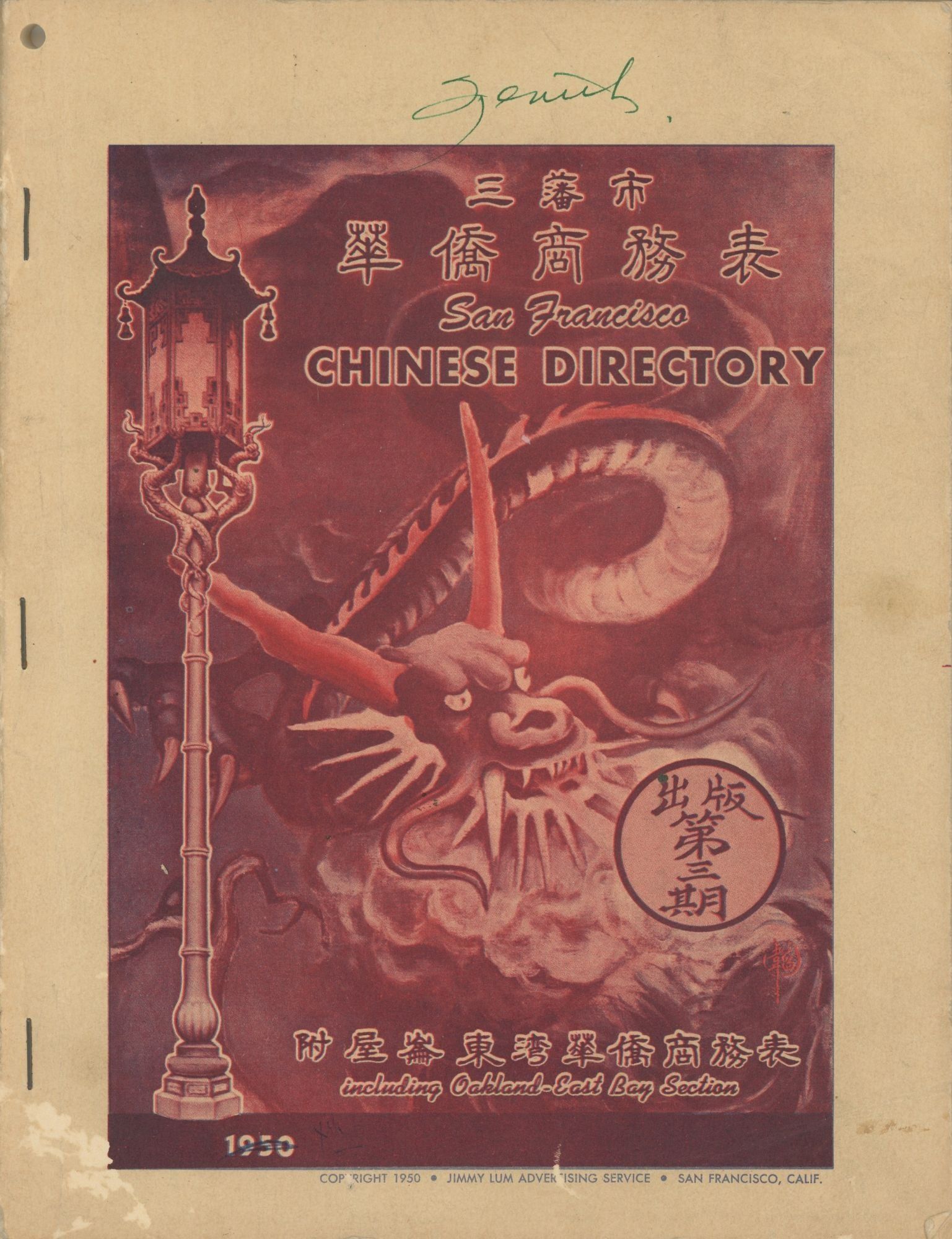

- 107 pp directory measuring 8 ½ x 11 inches. Normal wear, with some manuscript markings on wraps; contents excellent with some m
- San Francisco, California: Jimmy Lum Advertising Service, 1950
San Francisco, California: Jimmy Lum Advertising Service, 1950. 107 pp directory measuring 8 ½ x 11 inches. Normal wear, with some manuscript markings on wraps; contents excellent with some markings and wear. Overall very good to excellent.. The 1950 edition of the San Francisco Chinese Directory, published by the Jimmy Lum Advertising Service. The directory contains telephone listings of Chinese residents and advertisements for businesses—appliance and furniture stores, restaurants, clothiers, driving schools, and more—around the city. The advertisements are mainly in both English and Chinese, though some are without English. Not all the businesses are Chinese-owned, with the exception of the medical practitioners and vendors. The directory also includes a two-page map of San Francisco’s Chinatown neighborhood, between Hyde and Sansome Streets.
Before World War II, the Chinese Exclusion Act and other laws restricting Chinese immigration kept San Francisco’s Chinese population low and majority male, with most concentrated in Chinatown. Discrimination and violence further reduced the population into the 1920s. Wartime alliance with China, and Chinese Americans’ participation in the war effort, began to soften public attitudes and led to the 1943 repeal of the Chinese Exclusion Act; though new quotas following the repeal were extremely strict, they allowed families to reunite—or form—and by 1950, people of Chinese descent made up about 3% of the city’s population, a significant rebound from previous decades.
OCLC locates two physical copies of the directory.
Before World War II, the Chinese Exclusion Act and other laws restricting Chinese immigration kept San Francisco’s Chinese population low and majority male, with most concentrated in Chinatown. Discrimination and violence further reduced the population into the 1920s. Wartime alliance with China, and Chinese Americans’ participation in the war effort, began to soften public attitudes and led to the 1943 repeal of the Chinese Exclusion Act; though new quotas following the repeal were extremely strict, they allowed families to reunite—or form—and by 1950, people of Chinese descent made up about 3% of the city’s population, a significant rebound from previous decades.
OCLC locates two physical copies of the directory.