

1844 Letter Describing “beautiful wonderful” Kalamazoo, Michigan, the “magical village of the west”

- Single three-page letter measuring 7 ½ x 9 ¾ inches. Folded with very small tears at folds; larger tear at seal intersecting w
- Kalamazoo, Michigan , 1844
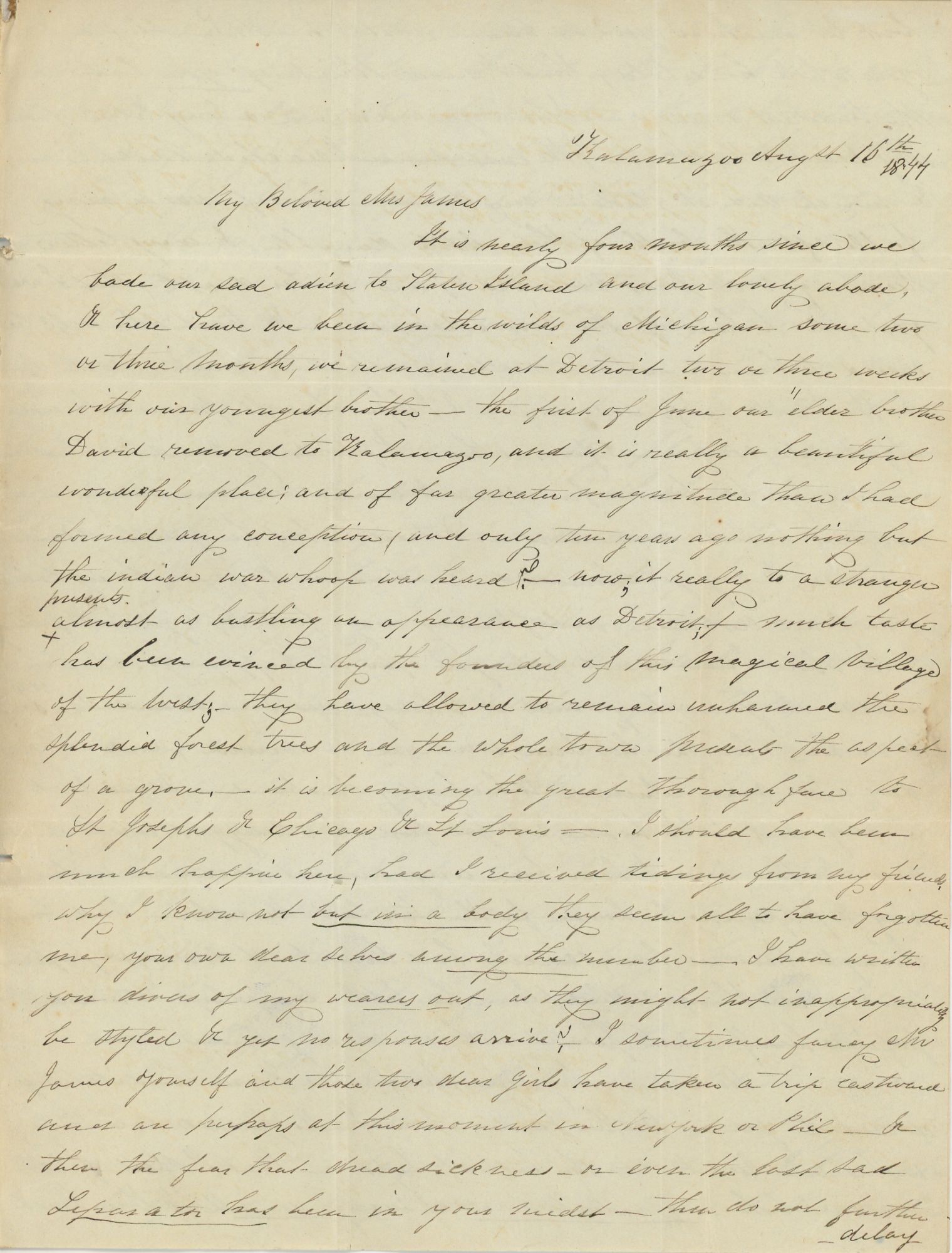
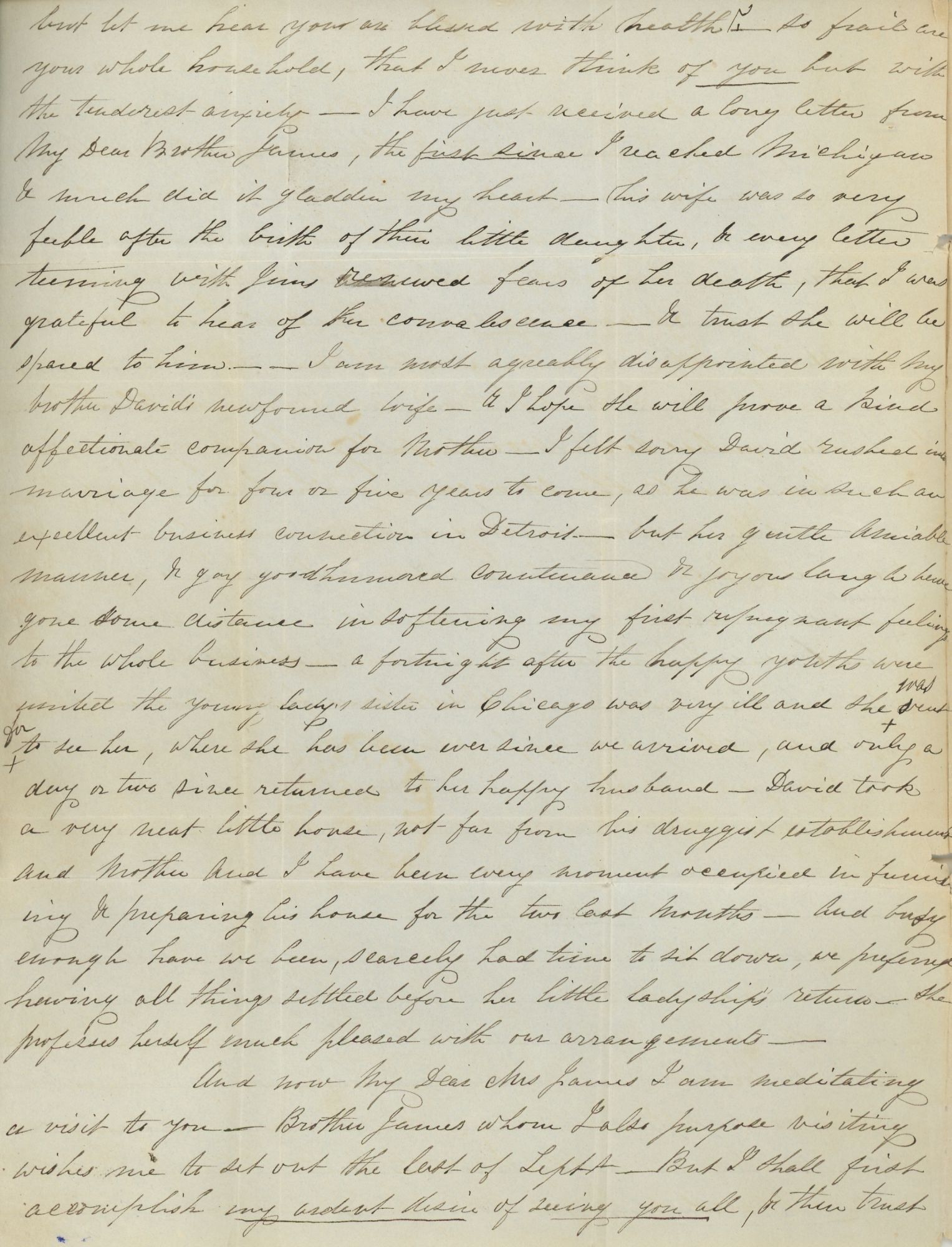
Kalamazoo, Michigan, 1844. Single three-page letter measuring 7 ½ x 9 ¾ inches. Folded with very small tears at folds; larger tear at seal intersecting with text. Overall excellent to Near Fine.. An 1844 letter from a woman who had recently moved to Kalamazoo to a friend in Urbana, Ohio. The writer describes Kalamazoo:
“It is nearly four months since we bade our sad adieu to Staten Island and our lovely abode, & here have we been in the wilds of Michigan some two or three months, we remained at Detroit two or three weeks with our youngest brother — the first of June our elder brother David removed to Kalamazoo, and it is really a beautiful wonderful place; and of far greater magnitude than I had formed any conception, and only ten years ago nothing but the indian war whoop was heard — now, it really to a stranger presents almost as bustling an appearance as Detroit; + much taste has been evinced by the founders of this magical village of the west; – they have allowed to remain unharmed the splendid forest trees and the whole town presents the aspect of a grove, — it is becoming the great thoroughfare to St Josephs & Chicago & St Louis —.”
The first white settler within what is now the city of Kalamazoo, Titus Bronson, arrived in 1829; within ten years, Kalamazoo County had several thousand residents.
The writer also describes her plans for traveling to New Orleans, hoping to avoid the seasickness-inducing “‘big lake’ travelling”. This would have been difficult, as plank roads were not laid in the area until the following year, and railroads would not reach Kalamazoo until 1846.
Of interest to historians of white American settlement of Michigan.
“It is nearly four months since we bade our sad adieu to Staten Island and our lovely abode, & here have we been in the wilds of Michigan some two or three months, we remained at Detroit two or three weeks with our youngest brother — the first of June our elder brother David removed to Kalamazoo, and it is really a beautiful wonderful place; and of far greater magnitude than I had formed any conception, and only ten years ago nothing but the indian war whoop was heard — now, it really to a stranger presents almost as bustling an appearance as Detroit; + much taste has been evinced by the founders of this magical village of the west; – they have allowed to remain unharmed the splendid forest trees and the whole town presents the aspect of a grove, — it is becoming the great thoroughfare to St Josephs & Chicago & St Louis —.”
The first white settler within what is now the city of Kalamazoo, Titus Bronson, arrived in 1829; within ten years, Kalamazoo County had several thousand residents.
The writer also describes her plans for traveling to New Orleans, hoping to avoid the seasickness-inducing “‘big lake’ travelling”. This would have been difficult, as plank roads were not laid in the area until the following year, and railroads would not reach Kalamazoo until 1846.
Of interest to historians of white American settlement of Michigan.